
Searching for the best ball head for your monopod—one that delivers faster framing, steadier tracking, and crisper telephoto shots without extra bulk?
Choosing the right ball head is that tweak for many shooters, and it can be the difference between a usable keeper and a missed opportunity.
This guide compares five monopod-friendly ball heads, highlighting each head’s strengths and best-use scenarios while offering practical buying guidance.
We focus on real-world performance—speed, stability, range of motion, quick-release compatibility, and how much weight each head realistically supports in the field.
Whether you stalk raptors with a big telephoto or travel light for street and landscape work, the right head matches your shooting tempo and kit weight.
I’ll break down the trade-offs so you can choose a head that balances smooth motion control, secure locking, and a low profile for comfortable carry.
Along the way you’ll find concise pros and cons, real-user impressions, and a practical checklist to narrow your options quickly.
By the end you’ll know which features to prioritize for your monopod setup and which compromises are acceptable for speed versus precision.
If you care about speed in the field or rock-solid support for long glass, this guide will cut through the jargon and trade-offs.
Stay with us and you’ll be armed to match a ball head’s key traits to your shooting style and gear weight in minutes.
1. The Original SpeediGimbal Overview
Supports heavy telephoto lenses with ultra-smooth panning and vertical tilt, offering rock-solid stability for wildlife and sports photographers.
Check PriceThis two-part head is built specifically for monopods and cleverly separates the ball and cup for tool-free mounting. The design lets you attach or remove the camera rapidly, which is exactly what you want when subjects appear and disappear fast.
Because the ball and cup separate, you get near-unrestricted camera movement — essentially a nearly 360° freedom that makes tracking fast subjects much easier. That freedom, combined with the quick mount, is why wildlife and sports shooters with long telephoto lenses favor it.
Users call it a “game-changer” for speed and ease versus conventional heads, and from a practical standpoint it behaves that way in the field. The quick‑release convenience is real, and it also doubles as a comfortable grip when attached to the monopod, which reduces hand fatigue during long waits.
It’s remarkably light at 125 g total, so you’re not adding much weight to your monopod setup. That low mass helps keep the balance close to your lens and makes long carries less tiring.
There are trade-offs to consider. The cup does add bulk to the lens end and can feel awkward on tight setups or when storing gear. Also, its specialized approach means compatibility is primarily for monopod users with telephoto lenses — it’s not the best choice if you need a multi-purpose head for tripods or small mirrorless kits.
If your shooting style is fast-paced tracking with big glass and you value speed above all, this is an excellent match. If you need an all‑around head or prefer minimal bulk at the lens end, weigh those downsides first.
- Very quick to mount and dismount camera.
- Nearly unrestricted 360° camera movement.
- Lightweight (125 g total).
- Provides comfortable grip versatility when attached to the monopod.
- Cup adds bulk to the lens end; can feel awkward or cumbersome.
- Specialized design limits compatibility mainly to monopod users with telephoto lenses.
2. Wimberley MH-100 MonoGimbal Overview

Wimberley MH-100 MonoGimbal Head
Adds precise tilt control and rapid plate release to your monopod, improving compositional flexibility and fast setup.
Check PriceThe Wimberley MH-100 MonoGimbal is a top-tier gimbal head designed specifically for monopods and heavy telephoto lenses. It delivers very smooth, gimbal-style operation that lets you rotate and tilt the camera with minimal induced monopod movement.
In the field it’s praised for extreme smoothness and the ability to spin the camera freely for creative angles. The build is durable and clearly meant for demanding outdoor use, with a high load capacity of about 50 lbs, so you can confidently mount big glass without worry.
Because it keeps induced vibration low, the MH-100 is excellent for tracking fast subjects like birds or sports where fluid motion and stability matter. There is a learning curve; the head can feel offset or visually odd at first, and it’s slightly bulky compared with minimalist monopod heads.
If you routinely work with heavy telephotos and need near-frictionless panning and tilt on a monopod, this unit is mostly a great choice. Casual shooters with lighter setups may find the price and complexity unnecessary, but for serious wildlife or sports photographers the freedom and capacity make it worth considering.
- Extremely smooth gimbal-style movement
- High load capacity (about 50 lbs)
- 360° rotation and easy tilt control
- Low induced vibration for tracking fast subjects
- Slightly bulky; can feel offset initially
- Price and complexity may be overkill for casual users
3. Manfrotto 234RC Monopod Head Overview

Manfrotto 234RC Monopod Tilt Head with Quick Release
Ultra-smooth ball movement with high-load capacity and adjustable R-lock clamp for secure, repeatable camera positioning.
Check PriceAs a photographer who values simplicity on long walks or quick shoots, the Manfrotto 234RC Monopod Head is a very straightforward tool. It’s a classic tilt-style head with a quick-release clamp, designed specifically to make plate swaps fast and painless with Manfrotto quick-release systems.
In the field it earns its keep through dependability — the mechanism is simple, predictable, and easy to master, which is why I often recommend it to beginners or anyone using lighter telephoto lenses. That said, the tilt locking knob is small and can be fiddly if you wear gloves; plan accordingly in cold weather or when you need fast changes.
Capacity is the practical limit: the head is rated for a load capacity of approx. 5.5 lbs, so it’s best paired with mirrorless bodies or DSLRs with small-to-medium lenses rather than heavy telephoto glass. Its compact, lightweight design makes it an excellent travel or entry-level choice when you prioritize portability over brute load-bearing ability.
If your camera-plus-lens combo stays well under the 5.5 lb limit and you appreciate uncomplicated controls, the 234RC will serve reliably and give you fast plate swaps with Manfrotto plates. If you regularly use heavy glass or need gloved operation, consider a different head or plan for thinner gloves and careful handling.
- Reliable and straightforward for lightweight setups
- Compatible with Manfrotto quick-release systems
- Compact and lightweight
- Good entry-level choice
- Small locking knobs hard to use with gloves
- Limited load capacity (~5.5 lbs)
4. Really Right Stuff BH-40 Ball Head Overview

Really Right Stuff BH-40 Ball Head with SC-ARC Adjustable R-Lock Clamp (BH-40-SCR)
Precision-machined ball head offering silky movement, quick-release lever convenience, and reliable support for pro photography gear.
Check PriceThe Really Right Stuff BH-40 is a premium ball head built around durability and straightforward performance. It isn’t sold as a monopod-specific head, but many of us mount it on monopods because it delivers dependable, vibration-free support.
In use the BH-40 feels solid and reassuring under heavy telephoto lenses. The build quality controls vibration well, so images stay sharp even when you’re tracking fast subjects from a monopod.
Adjustment and locking are clean and efficient thanks to the lever clamp. The lever-style clamp gives quick, secure adjustments and the head is compatible with Arca‑Swiss plates for fast plate swaps.
The BH-40 is compact and well-balanced for monopod applications, so it won’t make your setup feel top‑heavy or awkward. It focuses on core ball‑head function rather than gimmicks, which keeps control predictable during vigorous shooting.
The main trade-offs are simple: it doesn’t offer extra bells and whistles that some multifunction heads have. It is also slightly heavier than minimalist monopod heads, so if absolute lightness is your priority you might look elsewhere.
All told, the BH-40 is a strong choice if you want a robust, professional ball head that plays very nicely on a monopod and prioritizes stability and dependable locking over complexity.
- Heavy-duty build with excellent vibration control
- Smooth and secure locking with lever clamp
- Compatible with Arca‑Swiss plates
- Compact and well-balanced for monopod application
- No additional features beyond solid ball‑head functions
- Slightly higher weight compared to minimalist monopod heads
5. Acratech GXP Ball Head Overview

Acratech GXP Ball Head with Lever Quick Release Clamp
Premium photographic head designed for stability, fast adjustments, and reliable performance in demanding shooting conditions.
Check PriceThe Acratech GXP Ball Head blends ball, pan, and tilt functions into a single, compact, lightweight package. That hybrid approach gives you more control than a basic ball head without adding much bulk to your monopod setup.
Its clamp is adjustable, so you can tweak tightness to fit various plate standards. The locking mechanism is similarly adaptable, which helps when you switch between Arca‑style plates or other quick‑release systems.
In practice the GXP shines for smooth panning and vertical panoramas on a monopod. It also positions the camera slightly away from the monopod base, which makes low‑angle shooting far easier and more comfortable.
Because it combines multiple movement styles, the head is especially useful for panoramas and macro work where fine adjustments matter. It’s compact and lightweight enough to make long outings less fatiguing.
There is a learning curve, though: the clamp requires some getting used to. The multiple adjustments mean the operation is a bit more complex than a simple single‑knob ball head, so expect to spend a little time dialing in your preferred tension settings.
If you want a versatile monopod head that covers panning, tilting, and ball movement without adding weight, the Acratech GXP is a strong choice. If you prefer one‑knob simplicity and zero fiddling between shots, this might feel like overkill.
- Very versatile: pan, tilt, and ball functions.
- Adjustable clamp tightness to fit various plates.
- Compact and lightweight for long outings.
- Great for panoramas and macro use on monopods.
- More complex operation due to multiple adjustments.
- Initial difficulty mastering clamp tightness settings.
Key Features for Monopod Ball Heads
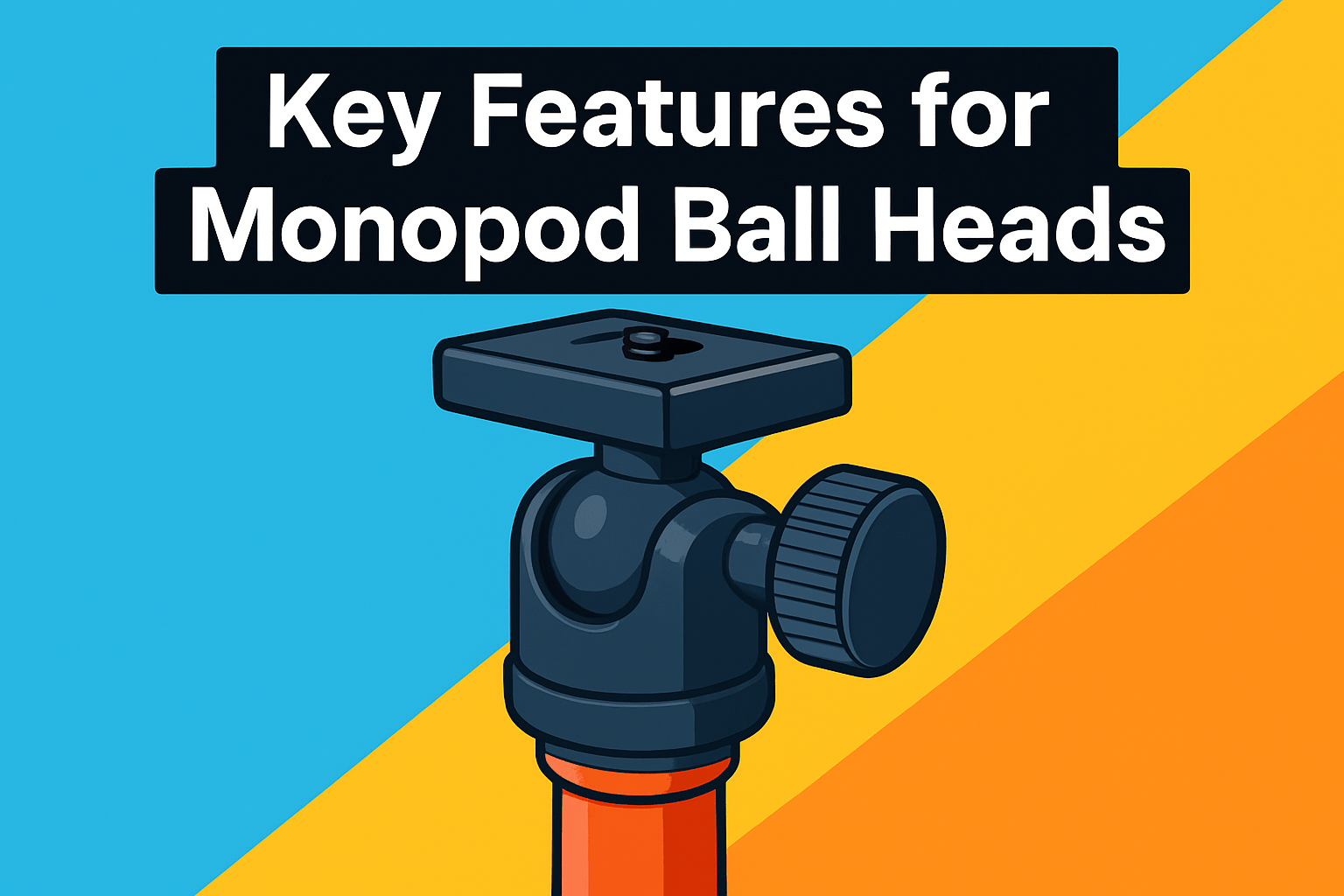
When I pick a ball head for a monopod, the first thing I look for is smooth, controllable movement. A head with variable tension or friction control lets you feather the ball so heavy telephotos don’t suddenly drop or swing when you loosen the clamp—vital when you’re tracking birds or athletes.
Secure locking matters just as much as smoothness. A robust main lock and, where possible, a secondary safety catch or positive-stop on the clamp reduce the chance of slippage and give you peace of mind when mounting expensive glass at odd angles.
Quick‑release compatibility is a real time-saver in the field. Arca‑Swiss style clamps are the most universal and make swaps between monopod, tripod, and gimbal fast and repeatable, which is priceless during short light or fast-moving action.
Weight versus strength is always a balancing act. Look for aluminum or magnesium alloys that keep the head light for long hikes but rigid enough to resist flex and vibration under load; a head that’s too heavy defeats the purpose of a trim monopod kit.
Range of motion should match how you shoot. True 360° panning and generous tilt—ideally up to vertical—make it easy to flip between landscape and portrait orientations or to follow a subject through a full arc without wrestling the monopod.
Finally, respect load capacity and the leverage of long lenses. Choose a head rated comfortably above your heaviest camera-plus-lens setup—think 20–30% safety margin—because long telephotos exert additional torque and can reveal weaknesses in an otherwise solid head.
Test with your actual rig before committing. The right combination of smooth friction, solid locks, compatible clamps, and sensible weight will keep you steady and let you concentrate on composing the shot, not fighting the gear.
Choosing Ball vs Pan-Tilt Heads for Monopods
When you’re choosing between a ball head and a pan-tilt head for a monopod, think about how you work in the field. Ball heads give you one-knob freedom: loosen, swing the camera, tighten and you’re ready. That speed is invaluable when tracking birds, sports, or any fast-changing scene where you don’t have time to dial in separate axes.
Pan-tilt heads, by contrast, give independent control over each axis. If your work demands precise panning or repeatable framing—slow-motion video, stitched panoramas, or studio setups where you need exact tilts—they make it far easier to lock down a composition without fiddling. They’re slower to operate but superior when precision beats speed.
Load capacity and stability should be the deciding technical factors. Many compact ball heads handle everyday mirrorless kits easily, but if you run big glass, opt for a head (ball or gimbal-style pan-tilt) rated well above your camera-plus-lens weight to avoid sag and vibration. I usually add a safety margin of 20–30% above the heaviest lens I own.
Practical small details matter too. Look for friction or tension control on ball heads so you can soften movement for smoother tracking; on pan-tilt heads, check for comfortable, glove-friendly knobs or handles. Quick‑release compatibility with your plates saves heaps of time when you mount and unmount in the field.
For most photographers using monopods—I’d estimate around 95% of cases—a good ball head is the sweet spot: compact, fast, and versatile. Choose a pan-tilt when you need deliberate, controlled motion or when shooting video that requires repeatable pans. Match your choice to your subjects, kit weight, and how often you need to move quickly versus compose precisely.
What People Ask Most
What is the best ball head for a monopod?
The best ball head depends on your shooting style and the weight of your gear. Choose a head that balances smooth control, a secure lock, and the right weight for how and where you shoot.
Should I use a ball head or a pan-tilt head on a monopod?
Ball heads are faster and more compact, making them a good choice for dynamic outdoor shooting. Pan-tilt heads offer more controlled, axis-by-axis movement and are better for deliberate panning or precise framing.
How do I choose the right ball head for a monopod?
Consider load capacity, locking reliability, quick‑release compatibility, and how smooth the adjustments feel. Also weigh portability against the range of motion you need for your typical shots.
Can I use a tripod ball head on a monopod?
Yes, many tripod ball heads work well on monopods if they provide secure locking and appropriate support for your equipment. Just verify the mounting thread and that the head matches your camera and lens weight.
What load capacity should a ball head have for a monopod?
Select a head rated to support your camera plus your heaviest lens, and allow a safety margin for stability. Follow the manufacturer’s stated capacity and choose a sturdier option if you use large telephoto lenses.
Are low-profile ball heads better for monopods?
Low-profile heads are more compact and lighter, which helps with portability and handheld-style monopod use. They can trade off some range of motion or clamp accessibility, so choose based on your need for compactness versus flexibility.
How do I attach a ball head to a monopod?
Match the monopod’s mounting screw to the head’s base and tighten securely, using a compatible quick‑release plate if available. Ensure the connection is firm and check that any plate standard is supported by both the head and your camera plate.
Conclusion for the Best Monopod Ball Head
Choosing the right monopod head comes down to matching your shooting style and gear weight: pick a speedy, specialized option for fast telephoto work, a heavy-duty gimbal for large glass, a simple tilt head for lightweight setups, a premium ball head for vibration-free support, or a compact versatile head for panoramas and travel.
Before you buy, run through a quick checklist: confirm load capacity, evaluate the locking mechanism and quick‑release compatibility, assess weight for portability, and make sure the head offers the range of motion you need.
In short, ball heads are the go-to choice for speed and portability while pan‑tilt systems still shine when you need controlled, precise movements for video or methodical shoots.
If you want to sharpen your monopod and head selection skills, browse more of our site to explore hands‑on tips, comparisons, and workflow ideas that will speed your learning curve.
Have questions or want to share your experience with a particular head? Leave a comment below and we usually reply within a few hours.





0 Comments