
Which camera will make your first leap into photography feel effortless and actually fun? We’ve narrowed the options to the five best cameras for beginners in 2026, selected from dozens of new and used models. Expect gear that’s simple to learn and built to grow with your skills.
We judged each camera on practical criteria that matter in real shooting. Ease of use, image quality, autofocus reliability, battery life, video capability, portability, and the strength of the lens ecosystem were our priorities. That mix separates toys from tools for new shooters.
This guide favors hands-on impressions over spec sheets. You’ll find straightforward notes about how these cameras behave in the real world—how they focus, how the battery holds up on a day out, and how intuitive menus and controls feel. We also flag which setups are more travel-friendly and which give you room to expand with lenses and accessories.
Whether your main focus is crisp stills, better video, lightweight travel gear, or long shooting days without a spare battery, this guide helps you make the trade-offs clear. No needless jargon. Just clear recommendations and buyer profiles you can trust.
If you’ve been overwhelmed by specs and choices, this guide simplifies the decision. Consider it the shortlist you wish you had before your first camera purchase.
1. Canon EOS Rebel T8i Essentials
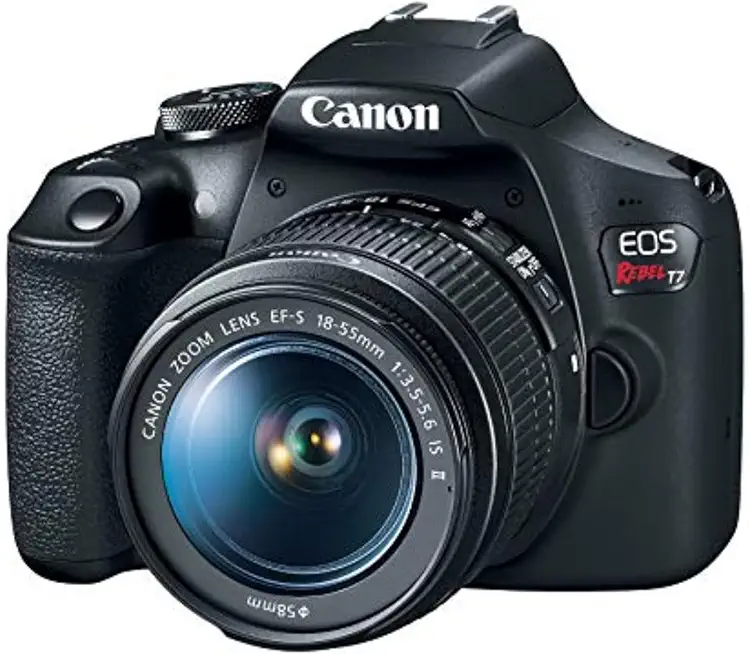
Canon EOS Rebel T7 DSLR with 18-55mm lens
Beginner-friendly DSLR delivering sharp images, intuitive controls, and a versatile kit lens for everyday shooting and learning photography
Check PriceThe Canon EOS Rebel T8i (EOS 850D) is a versatile entry-level DSLR built around a 24.1MP APS-C sensor that delivers sharp, vibrant images with very pleasing color rendition. Guided modes and a vari-angle touchscreen make it easy for a beginner to learn composition and camera controls without feeling overwhelmed.
In Live View the T8i uses Canon’s Dual Pixel AF, which is accurate and straightforward for stills and run-and-gun shooting. That Live View performance, paired with the touchscreen, makes framing and focusing intuitive compared with traditional optical-viewfinder workflows.
It also offers 4K video, which is handy for occasional clips, but note the 4K mode lacks Dual Pixel AF and the body has no headphone jack. So if you plan heavy video work or detailed audio monitoring, the T8i isn’t optimized for that—still, it’s capable for casual video and vlogging starters.
Battery life is a real plus; the T8i is more robust than many mirrorless options and will comfortably make it through longer days of shooting. Do be aware the optical-viewfinder AF can feel clunky and slow, with manual AF-point selection, and kit lenses tend to struggle in low light—the AF can slow when tracking fast subjects in dim conditions.
Overall, this camera suits beginners who want a traditional DSLR feel, excellent still-image quality, and room to grow into Canon’s EF/EF-S lens ecosystem. If you prioritize stills, ease of use, and longer battery life over top-tier video autofocus and low-light speed, the T8i is a solid choice.
- Beginner-friendly guided modes
- Sharp, vibrant images with good color rendition
- Vari-angle touchscreen for flexible shooting angles
- Long battery life vs mirrorless
- Optical-viewfinder AF can be clunky and slow (manual AF-point selection)
- Performance drops in low light and fast-action scenes
2. Nikon D3500 Beginner Highlights

Nikon D3500 with AF-P DX NIKKOR 18-55mm f/3.5-5.6G VR
Lightweight, easy-to-use camera with exceptional battery life and crisp image quality—ideal for newcomers capturing travel, family, and outdoor moments
Check PriceThe Nikon D3500 is a classic entry-level DSLR built around a 24.2MP APS-C sensor, and it shines where beginners usually care most: stills, simplicity, and endurance. Images are sharp with rich color and fine detail straight out of camera, so you’ll get printable results and social-ready files without fuss.
Its Guide Mode is genuinely helpful — it teaches settings while you shoot, which accelerates learning far more than reading a manual. The body is lightweight and comfortable to hold, which makes longer walks and full-day shoots enjoyable rather than tiring.
Battery life is one of the D3500’s standout features: expect extended shooting sessions and, in real use, up to about 1550 shots on a single charge. That reliability makes it ideal for travel, events, or anyone who dislikes charging mid-day.
Autofocus is reliable for general shooting but conservative in capability — 11 focus points means it won’t rival modern cameras for fast-action tracking or low-light hunting. Video is serviceable for basics but limited to Full HD; there’s no 4K option if you want future-proofed video.
Overall, the D3500 is mostly a very good camera for beginners whose priority is learning photography and making great stills without complexity. If you value long battery life, simple controls, and excellent image quality for prints and sharing, it’s a strong, low-stress choice.
- 24.2MP APS-C — sharp, detailed photos
- Up to ~1550-shot battery life
- Intuitive Guide Mode for learning
- Lightweight, comfortable handling
- Autofocus limited (11 points) — not ideal for fast action
- No 4K video — Full HD only
3. Canon EOS 250D (Rebel SL3) Essentials

Canon EOS Rebel SL3 with EF-S 18-55mm lens
Compact, feature-packed camera with a vari-angle touchscreen, user-friendly interface, and capable video for vloggers and hobbyists
Check PriceThe Canon EOS 250D (Rebel SL3) is a very compact, lightweight DSLR — just 449 g with battery — with a vari-angle touchscreen and Dual Pixel AF available in Live View and for 4K recording. Its small size and thoughtful controls make it a real travel-friendly camera that’s easy to toss in a daypack and use all day.
Live View Dual Pixel AF is fast and accurate, which is a huge advantage when you’re learning composition and focus. The vari-angle touchscreen makes composing at high or low angles simple and speeds up menu navigation, so you spend more time shooting and less time fumbling.
It does offer 4K video, but the 4K performance isn’t as strong as modern mirrorless rivals — still, it’s perfectly usable for occasional vlogging and home videos. Where the 250D really shines for beginners is in practical, everyday use: strong still-image capability paired with approachable controls.
Battery life is better than many mirrorless cameras, so you can shoot longer on a day out without a spare battery. The optical-viewfinder autofocus is basic with 9 points, so for the quickest, most reliable focusing I tend to use Live View. The body is compatible with Canon EF/EF‑S lenses, which keeps future lens options open as you grow.
- Extremely portable for a DSLR
- Fast, reliable Live View autofocus
- Guided Mode assists beginners
- Strong battery life vs mirrorless
- 4K video quality limited compared with mirrorless cameras
- Optical-viewfinder AF is basic and slower than Live View AF
4. Canon EOS R100 Mirrorless Overview

Canon EOS R100 with RF-S 18-45mm f/4.5-6.3 IS STM lens
Lightweight mirrorless designed for beginners offering fast autofocus, steady kit lens stabilization, and great image quality in a pocketable body
Check PriceThe Canon EOS R100 is a straightforward mirrorless camera that’s clearly aimed at beginners. It pairs a 24MP APS-C sensor with Canon’s approachable guided menus and autofocus, so you can spend less time wrestling with settings and more time making images.
In real use the UI is very accessible—those extensive guided menus genuinely help you learn while shooting. The autofocus is accurate and fast for stills, and the EVF plus quick Live View give a modern, comfortable shooting experience that’s easy to carry around thanks to the compact body.
There are a few trade-offs to keep in mind. 4K video comes with a significant crop and only moderate image quality, so it’s more for casual clips than serious videography. Burst shooting and battery life are average, which means it’s not built for long days of fast-action photography or heavy continuous shooting.
Overall, the R100 is a great first mirrorless camera if your priorities are learning, portability, and reliable stills autofocus. If you mainly shoot portraits, travel snaps, family moments, or want a simple, modern camera body to step up from a smartphone, it makes excellent sense. If you need uncropped 4K, extended battery endurance, or pro-speed burst performance, you’ll want to look elsewhere.
- Highly beginner-friendly guided interface
- Fast, accurate autofocus for photos
- Compact mirrorless body easy to carry
- Decent video specs for casual use
- 4K video crop and quality limitations
- Not designed for continuous fast shooting or sports
5. Fujifilm X-S20 Mirrorless Highlights
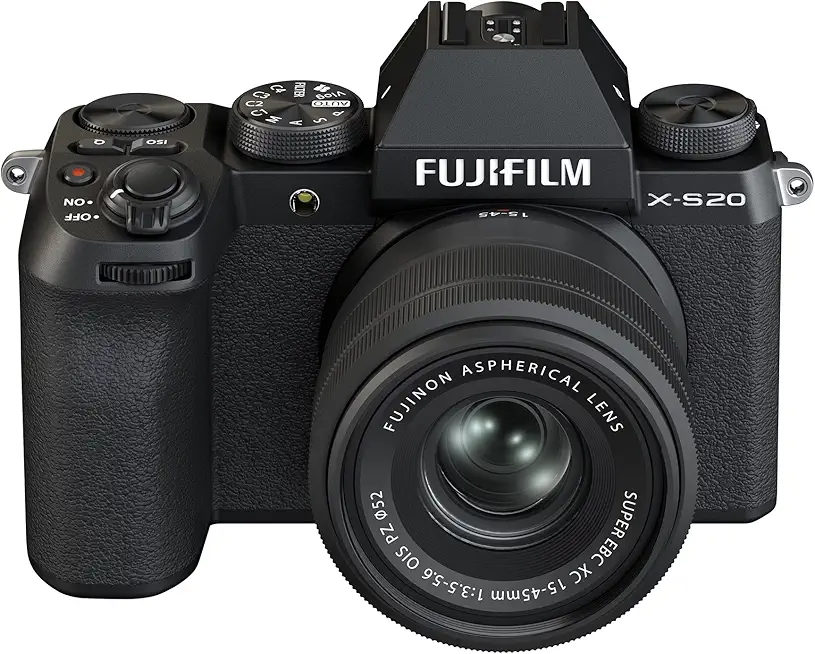
Fujifilm X-S20 with XC15-45mm lens
Advanced compact camera with rich color science, versatile zoom, powerful video features, and professional-grade controls for creators
Check PriceThe Fujifilm X-S20 is a compact, well-rounded mirrorless that punches above its class with a 26.1MP APS-C sensor and Fujifilm’s beloved film simulation modes. As a photographer, I appreciate how those simulations give JPEGs a rich, film-like look straight out of camera, which is great when you want attractive results fast.
Its in-body 5-axis stabilization is genuinely useful for handheld shooting. That IBIS keeps photos and video noticeably sharper, which helps you shoot in lower light without a tripod.
Video is a standout here: the X-S20 records up to 6.2K/30fps and includes a dedicated Vlog mode. If you’re learning both stills and video, those features let you experiment with high-resolution footage and easy vlog-ready settings without feeling overwhelmed.
Autofocus is reliable for most everyday subjects, though it can struggle with tracking very fast-moving subjects or in tricky lighting. The body’s compact, comfortable ergonomics make it easy to carry all day and handle while you focus on composing shots and learning the craft.
One practical note: the X-S20 is discontinued new, so you’ll mainly find it on the used market. That actually makes it a compelling option if you want a feature-rich camera at a lower price, but be mindful to check condition and shutter count when buying used.
- 26.1MP APS-C image quality
- 5-axis IBIS for handheld sharpness
- 6.2K/30fps video & Vlog mode
- Film simulation for film-like JPEGs
- Autofocus less certain for fast action
- Discontinued new — mainly available used
Canon vs Nikon For Beginners
Both Canon and Nikon make excellent starter cameras, so the choice often comes down to what you plan to shoot and how you like to work. If you want something that feels instantly comfortable in the hand, will last all day on a single battery, and makes still photography simple, Nikon’s entry-level DSLRs shine — think big grip, excellent ergonomics and legendary battery life that’s forgiving when you’re learning or traveling.
Canon’s beginner models bring different strengths. Their Live View autofocus systems (Dual Pixel AF on many models) are fast and reliable for both photos and vlogging-style video, and Canon’s control layout around the screen tends to be very intuitive for newcomers. Canon also wins on lens variety — there are more budget-friendly lenses, adapters and third-party options that make growing your kit easier without breaking the bank.
Practically speaking, choose Nikon if you prioritize long shooting days, simple handling, and great still-image results straight out of the camera. Pick Canon if you expect to shoot a mix of photos and video, want snappy Live View AF, or plan to expand with lots of affordable lenses later on.
Before buying, go hold both systems in a store. Menus, button placement and how the camera feels often matter more than spec sheets. Also check used-lens availability and think two steps ahead: a model with better Live View AF will make learning composition and autofocus tracking less frustrating as you progress.
Bottom line: there’s no wrong choice. Match the brand to your priorities — battery life and comfy handling for Nikon, versatility and lens choices for Canon — and you’ll be shooting great images while you learn.
Should Beginners Buy An Expensive Camera
Short answer: no — an expensive camera won’t make you a better photographer overnight. What will help is time behind the viewfinder, learning light and composition, and using gear that feels comfortable. As a pro I’ve seen beginners get great results from modest DSLRs and entry-level mirrorless bodies because they focus on technique rather than chasing specs.
If your budget is tight, prioritize lenses and stability over a flagship body. A good prime or a stabilized kit lens and basic knowledge of aperture and shutter speed will transform your images far more than extra megapixels or fancy video codecs. Also consider battery life and ergonomics; DSLRs often last longer on a single charge and can be more forgiving on long shoots, while compact mirrorless bodies win on portability and quick live-view AF.
Buying new and expensive makes sense only when the extra features solve real problems you face — fast, reliable subject tracking for sports, in-body stabilization for handheld video, or specific lens options you need. Otherwise, a well-chosen used mid-range camera can give you most of the benefits for a fraction of the price. Bodies like the Fujifilm X-S20, for example, hold appeal used because they combine IBIS and strong video without breaking the bank.
Rent, borrow, or buy used before committing. Renting lets you test ergonomics and autofocus behavior in real scenarios, so you don’t discover mid-shoot that a camera’s size or menus frustrate you. Resale value is decent on well-kept bodies, so you can upgrade later without a massive loss.
Bottom line: invest in tools that support what you want to shoot and leave room in your budget for lenses, memory cards, and learning. Start with something reliable and learn fast; once your needs become clear, upgrade to the pricier gear that truly unlocks new possibilities for your photography.
What People Ask Most
What is the best camera for beginners?
There is no single best camera for everyone; the right choice depends on what feels comfortable and easy to use. Prioritize cameras with intuitive controls, reliable autofocus, and a lens ecosystem that fits your plans.
Should beginners choose a DSLR or a mirrorless camera?
Both DSLR and mirrorless cameras can be great for beginners. Choose a DSLR if you prefer a traditional feel and long battery life, or mirrorless if you want a more compact body and modern live-view features.
What features should I look for in a beginner camera?
Look for ease-of-use features like guided modes, dependable autofocus, clear menus, and good battery life. Also consider lens compatibility and ergonomics so the camera is comfortable to handle as you learn.
How many megapixels do I need as a beginner?
Megapixel count is less important than overall image quality and usability. Most entry-level cameras offer more than enough resolution for common uses like sharing online and printing.
Is a point-and-shoot camera good for beginners?
Point-and-shoot cameras are a good starting point for casual photography thanks to their simplicity and portability. They do limit long-term flexibility compared with interchangeable-lens systems if you plan to grow your skills.
Can I learn photography with a smartphone or do I need a dedicated camera?
You can learn core photography concepts with a smartphone, as it covers composition and exposure basics well. A dedicated camera adds manual controls and lens options that help you expand your skills further.
What is the easiest camera for beginners to use?
The easiest cameras offer guided menus, straightforward controls, and reliable autofocus so you can focus on learning. Try handling a few models in person to find which interface and size feel most intuitive.
Conclusion For Best Camera For Beginners
This roundup shows five approachable cameras that cover the main beginner priorities — ease of use, image quality, autofocus, battery life, video features, portability and a healthy lens ecosystem.
The Canon EOS Rebel T8i suits learners who want a classic DSLR feel and strong stills, the Nikon D3500 is ideal for simplicity and long battery life, the Canon EOS 250D fits travel-friendly DSLR users, the Canon EOS R100 is a gentle mirrorless step for novices, and the Fujifilm X-S20 appeals to those chasing creative color and strong stabilization for photo and video.
Rather than chasing specs, pick the body that aligns with your main priorities — stills versus video, portability, battery endurance, autofocus agility, and the lenses you plan to use.
If you want to keep improving, explore more guides and gear roundups on the site to build skills and confidence at your own pace.
Have questions or want help choosing one of these cameras? Leave a comment below — we usually reply within a few hours.


0 Comments