
What’s the single flash that can make your Canon R5 perform like a studio rig when the light gets tough? The R5’s high-resolution sensor and lightning-quick autofocus deliver razor-sharp images, but they also expose lighting flaws that a smart flash can fix. Choosing the right unit, then, becomes as important as picking lenses or modifiers.
This guide distills five top flash choices for Canon R5 shooters into clear recommendations and hands-on setup advice. We tested real-world usability, mounting and communication quirks, and practical performance across portraits, events, and mixed-light environments. No tech fluff — just what you need to know before you buy and how to get reliable results on the first shoot.
You’ll find product highlights and straightforward compatibility checks so you can avoid surprises on a shoot. We’ll also share off-camera lighting tips and simple troubleshooting steps that save time during tight shoots and long sessions. For busy photographers, there’s a short FAQ that answers the most common setup and sync questions.
Whether you’re chasing rock-solid professional reliability, a budget-friendly workhorse, or a specialist unit for superior light quality, you’ll find a direction here. Read on and you’ll finish the guide with confident next steps, practical setups, and a clear shortlist tailored to your shooting style. Let’s get started.
1. Canon Speedlite EL-1 for R5

Canon Speedlite EL-1 Version 2
Professional flagship flash delivering consistent, high-speed TTL performance, fast recycling, durable weather-sealed build and intuitive controls for demanding photographers.
Check PriceThe Canon Speedlite EL‑1 is Canon’s flagship flash for the R5 (and R5 Mark II), built for professionals who need top-tier power, reliability, and features. It handles high‑speed sync, offers wireless radio control, and delivers consistently clean output even under demanding shoots.
In practical use the EL‑1 shines for events and portraits thanks to its GN 60 output and a wide zoom range of 20–200mm, which gives you flexibility from tight headshots to longer‑bounce setups. Users praise its fast recycle times and predictability — important when you can’t afford missed frames.
Battery and thermal performance are standout points: the Li‑ion battery life is significantly better than AA‑powered alternatives, and Canon designed excellent heat management so the unit keeps working through long sessions. Note that the Li‑ion battery pack ships without a charger, so plan accordingly if you buy one.
Build quality is professional grade — the EL‑1 offers ultimate reliability and a durable construction that can take the knocks of frequent use. Wireless communication is advanced and stable, making it straightforward to integrate into multi‑flash setups where timing and repeatability matter.
If you are a working pro or serious enthusiast shooting weddings, corporate events, or portrait sessions, the EL‑1 is a hard‑to‑beat choice for consistent, high‑quality flash performance. Just be aware that some R5 bodies require the AD‑E1 adapter for full multi‑shoe functionality, and you’ll need to sort charger logistics for the Li‑ion pack.
- GN 60 power
- Wide zoom range (20–200mm)
- Super‑fast recycle times & advanced wireless communication
- Excellent heat management; durable professional build
- Requires AD‑E1 adapter for some R5 models
- Li‑ion battery pack ships without charger
2. Godox V1 Pro C for Canon

Godox V1 Pro C flash for Canon
Round-head on-camera strobe with soft, natural light, magnetic modifiers, and rechargeable battery for effortless off-camera creativity.
Check PriceThe Godox V1 Pro C is a popular, budget‑friendly alternative for Canon R5 shooters who want a more flattering on‑camera light without breaking the bank. Its signature round flash head produces a softer, more natural falloff than traditional rectangular heads, which makes it especially pleasing for portraits and event work.
In practice the V1 Pro C delivers stable TTL integration with Canon bodies, including the R5 and R5 Mark II, and it supports full TTL, manual, and HSS operation. Power is very flexible — from 1/1 down to 1/256 in 1/3‑stop increments — so you can dial in subtle fill or full flash easily.
Battery life is a real advantage compared with AA units: the Li‑ion battery gives you roughly ~550 flashes per charge and noticeably faster recycle times. That longer usage and quicker recycle makes it a reliable choice for multi-hour events or continuous portrait sessions.
Users appreciate the natural light quality from the round head and the precise power control, but be aware there have been occasional minor glitches and some reports of build‑quality quirks. It is also slightly larger and heavier than a few native Canon speedlites, so consider balance on smaller rigs or gimbals.
Overall, if you want an affordable flash that prioritizes flattering light, long battery life, and full TTL/HSS compatibility with the R5, the Godox V1 Pro C is a very attractive option — just be ready to update firmware occasionally and accept a bit more bulk.
- Soft, natural light from round head
- Approx. 550 pops per charge; quick recycle
- Reliable TTL and full HSS support
- Precise power control to 1/256 in 1/3‑stop steps
- Occasional software glitches reported
- Slightly larger and heavier than some Canon flashes
3. Canon Speedlite EL-5 for R5
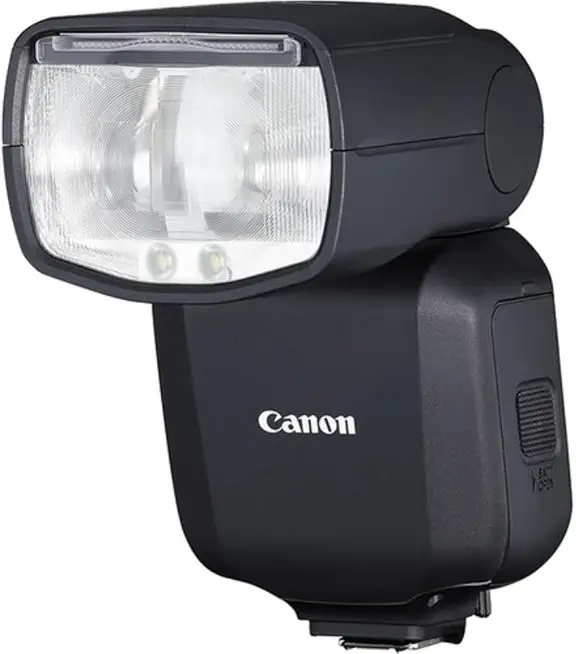
Canon Speedlite EL-5 for EOS R series
Compact yet powerful TTL strobe featuring rapid recycling, versatile zoom head, and seamless integration with mirrorless systems.
Check PriceThe Canon Speedlite EL-5 is built with the EOS R mirrorless system in mind, so it feels like a native companion for the R5. It uses Canon’s Multi Function Shoe for advanced communication and includes a Li‑ion battery with GN 60 power, plus wireless RF master/slave modes for on‑camera and simple off‑camera setups.
In practice the EL‑5 is lightweight and responds quickly, which makes it easy to handhold or bounce for portraits and events. You get ample power for most portrait and event work thanks to the GN 60 output, and the Li‑ion pack delivers good recycle speed compared with AA units.
It also packs practical features for mirrorless shooters: an LED modeling lamp and AF‑assist tailored to mirrorless AF systems, and reliable RF wireless control. One caveat is the RF control range — users report it’s slightly shorter, around ~30m, compared with some competitors, so plan your off‑camera distances accordingly.
Compatibility is smooth with modern R5 bodies that have the Multi Function Shoe, but older R5 models without that shoe may not get full feature support. Also note Canon ships the EL‑5 without a battery charger, so budget for that accessory if you don’t already own a compatible charger.
- Native EOS R support via Multi Function Shoe
- GN 60 power
- Fast Li‑ion battery and good recycle speed
- LED modeling lamp; reliable RF master/slave wireless
- Limited compatibility with older R5 models without Multi Function Shoe
- No battery charger included
4. Profoto A10 for Canon

Profoto A10 on-camera flash for Canon
Studio-grade, pocketable strobe delivering superior light quality, precise TTL control, and ultra-fast sync for professional results on the go.
Check PriceThe Profoto A10 (Canon version) is a premium, small-format flash built around one goal: beautiful, natural light. Its compact, round-head design gives a consistent, flattering quality that blends exceptionally well in mixed lighting scenarios.
As a working portrait and event photographer I appreciate how reliable its TTL and HSS integration is with the Canon R5. Controls are intuitive and the unit is small enough to stay unobtrusive on stands or in handheld work, which speeds setups and keeps subjects relaxed.
Users praise the A10 for delivering a specialist “quality over quantity” result — it’s a tool designed to make light look great rather than to churn out the highest number of pops per battery cycle. That said, battery life is decent but noticeably shorter than some Li‑ion competitors, so plan for spare batteries on long shoots.
If you prioritise light quality and are invested in the Profoto system, the A10 is an excellent choice; it’s favoured by portrait and professional event photographers for consistent output and straightforward operation. If you need maximum runtime or are on a tight budget, weigh the higher cost and battery trade-off against the clear advantage in light quality.
- Outstanding, natural light quality
- Compact form and easy-to-use controls
- Reliable TTL and HSS integration with Canon
- Favoured by portrait and event photographers
- Battery life shorter than some Li‑ion competitors
- Higher cost; best for those invested in Profoto
5. Neewer Z2C Pro for Canon R5

Neewer Z2PRO-C round-head TTL flash for Canon
Affordable round-head speedlight with TTL, built-in modeling light, and long-lasting battery for creative portrait and event lighting.
Check PriceThe Neewer Z2C Pro sits between entry-level and pro gear as an enthusiast-level flash with some serious creative chops. It offers TTL support, a round flash head for softer falloff, and high-speed sync up to 1/8000s — a combination that immediately caught my attention.
It plays well off-camera, too, working with dedicated wireless triggers such as the Neewer Q Pro for more elaborate setups. That makes it useful for boom or stand-mounted placements when you want clean, directional light without lugging big strobes.
Users report impressive high-speed sync performance up to 1/8000s, which is exactly what you need to shoot wide open in bright daylight while still freezing motion or using dramatic fill. In practice that means cleaner background separation and control over ambient light without resorting to tiny apertures.
Integration with the Canon R5 Mark II is reported as smooth, and the unit delivers reliable output with decent power and recycle times for its class. It won’t match pro-level durability, but for portraits, architecture, and daylight drama it punches well above its price point.
As a working photographer I appreciate the round head and TTL/manual flexibility — you can bounce or feather light for natural results, or switch to manual for consistent multi-light setups. The main caveats are brand maturity and ecosystem size; expect fewer specialized accessories and less historical reliability data than more established names.
Overall, the Z2C Pro is a smart choice if you want creative high-speed sync and a soft round head without stepping into high-end pricing, as long as you accept a slightly smaller ecosystem and shorter track record.
- High sync speed (up to 1/8000s)
- Round head — diffused, natural light
- TTL and manual support
- Good integration with R5 Mark II
- Newer, less-established brand; long-term reliability less proven
- Smaller ecosystem vs Godox or Canon
Ensure Flash Compatibility With Canon R5
Compatibility isn’t just about whether a flash fires when you press the shutter — it’s about whether TTL, AF‑assist, high‑speed sync and wireless control behave reliably when you need them. The R5 uses Canon’s Multi‑Function Shoe to unlock those advanced features. A flash that speaks Canon’s protocol will save you headaches.
If you want everything to work out of the box—E‑TTL II, group control, AF‑assist and remote radio control—stick with Canon Speedlites like the EL‑1, EL‑5 or 430EX III‑RT. They integrate with the R5’s metering and Dual Pixel AF for predictable TTL performance. They expose group and power controls in the camera menus.
Good third‑party flashes can also work well, provided you buy the Canon‑specific model and keep firmware up to date. Godox’s V1 Pro C, Profoto A10 and compatible Neewer units offer TTL and HSS on the R5, but make sure the manufacturer explicitly lists Canon support and any required firmware. Check user reports for AF‑assist or TTL quirks before relying on them for paid work.
Firmware matters—update both camera and flash regularly to fix glitches and improve radio reliability. Before any shoot mount the flash and run TTL and manual tests; try high‑speed sync and confirm flash exposure compensation and sync mode in the R5’s flash menu.
Take simple physical precautions: power off before attaching or removing a flash, lock the shoe, and keep the contacts clean to avoid miscommunication. Ensure the shoe latch fully engages. Note that some setups require Canon’s AD‑E1 adapter for full functionality on older R5 versions, so pack the adapter and spare batteries.
If you mix brands or older units, plan for manual operation as a fallback. Manual off‑camera lighting is perfectly reliable, but don’t assume AF‑assist, TTL or advanced wireless will behave unless you’ve tested them under real conditions. On client shoots run a quick TTL test and bracket a manual exposure to avoid surprises.
Off-Camera Flash Tips for Canon R5
Taking flash off the camera instantly opens up better shaping and separation, and the R5 supports both radio and optical control for remote Speedlites. I favor radio triggers in bright or complex environments — Canon’s ST‑E3‑RT or ST‑E10 work well, and plenty of third‑party transmitters now speak Canon’s protocol reliably.
Place lights to create depth: a key at about 45 degrees sculpts the face, a low‑power fill lifts shadows, and a rim behind the subject separates them from the background. Stands, booms or a hand‑held flash each have their place, and even small modifiers or a bounce card will soften results on the R5’s high‑resolution sensor.
Bounce off ceilings or walls whenever possible to avoid harsh catchlights; when ceilings are low, an angled card or reflector gives similar softening. A little bounce goes a long way with skin tones and fine detail.
Map a custom button on the R5 to open flash controls quickly so you can switch TTL/manual, change power, or adjust flash exposure compensation in one press. Use the camera’s flash menu to assign groups and channels, then fire a quick test frame to confirm ratios and wireless reliability.
Choose the sync mode that matches your intent: first‑curtain for static portraits, second‑curtain for natural motion trails, and HSS to balance bright daylight or use very fast shutter speeds. My workflow is often TTL to get a starting exposure, then switch to manual to lock predictable ratios for multi‑light setups.
Finally, keep batteries fresh in both flashes and transmitters, use the same chemistry across units, and power off before mounting or dismounting to avoid electrical hiccups. A quick channel/group check and two test shots will turn off most on‑set surprises and keep your shoot moving.
What People Ask Most
What is the best flash for the Canon R5?
There is no single best flash for every photographer; choose based on your shooting needs and budget. Some users prioritize native integration and reliability while others prefer lighter or more affordable options.
Which external speedlite is most compatible with the Canon R5?
Canon’s current Speedlite models offer the most seamless compatibility with the R5 and its flash menus. Third‑party flashes can work well but you should confirm compatibility and keep firmware updated.
Does the Canon R5 have a built-in or pop-up flash?
The Canon R5 does not include a built-in pop-up flash. It is designed to be used with external speedlites mounted on the shoe or operated off‑camera.
Can I use Canon Speedlites with the EOS R5 and get full TTL support?
Yes, Canon Speedlites are designed to provide full TTL integration with the R5 for automatic flash exposure control. Make sure both camera and flash firmware are kept up to date for best performance.
What are the best off-camera flash options for the Canon R5?
Use compatible speedlites paired with reliable radio or optical triggers to control multiple lights off‑camera. Position flashes on stands or handheld and use bounce or modifiers to shape and soften the light.
How do I set up and use a speedlight with the Canon R5?
Mount the flash securely, power your gear on in the correct order, and choose TTL or manual mode from the camera’s flash settings. Check batteries and run a few test exposures to confirm settings before shooting.
Which flash triggers and wireless systems work best with the Canon R5?
Canon’s own radio transmitters and third‑party triggers that explicitly support Canon’s protocol tend to be the most reliable. Look for systems that offer group control and proven compatibility with Canon cameras.
Conclusion for Best Flash for Canon R5
This guide pulled together practical choices, compatibility pointers, and off‑camera tips to help Canon R5 shooters select and use flash with more confidence.
Key takeaway: match your priorities—professional reliability and integration, budget‑friendly versatility, superior light quality, or high‑speed creative flexibility—to the flash and workflow that suit your shooting style.
Keep sharpening your lighting and camera skills by reading more articles on the site to deepen technique, troubleshoot setups, and compare real‑world approaches.
If you have questions or need help picking or configuring gear for a specific shoot, leave a comment below and we’ll usually reply within a few hours.


0 Comments