
Ever wondered why some diamonds explode with fire in photos while others look flat and lifeless? A single change in lighting can turn dull glass into brilliance that jumps off the frame.
In this feature we compare the 5 best lights for diamond sparkle (in 2026). From compact continuous panels to portable strobes, we examine tools that photographers and jewelers actually use. The aim is practical: realistic setups, reproducible highlights, and images that sell.
My goal is to help professionals and hobbyists alike choose lighting that maximizes brilliance, fire, and consistent results. That means showing which kinds of lights create crisp facet definition, believable white balance, and repeatable sparkle.
You’ll read about trade-offs between convenience and creative control, brightness versus heat, and continuous light versus strobes. We also look at portability, power sources, and how easy each option is to set up between sessions.
Consider this your compass for choosing the best light for diamond sparkle—clear, tested guidance you can use today. Flip the switch and let’s make every facet sing.
We prioritize color accuracy, repeatability, and sample-to-sample consistency so your images look professional across platforms. Keep reading—your next shoot could be the one that finally captures the diamond exactly as the eye sees it.
1. GemLightbox by Picup Media
Picup Media GemLightbox
Create flawless, shadow-free product photos and 360° spins with automated lighting and background removal for fast e-commerce imaging.
Check PriceThe GemLightbox by Picup Media is a purpose-built jewelry lightbox that encloses the piece and evenly diffuses light across facets. As a photographer, I appreciate how that enclosure removes distracting reflections and reduces harsh shadows that faceted gems often produce.
Setup is simple and fast, which makes it ideal for jewelers and small-business owners who need consistent product shots without learning complex lighting techniques. It’s smartphone-friendly, so you can get professional-looking images without a full camera kit.
For best color consistency and sparkle, the GemLightbox works best with LED bulbs. Using LEDs gives a stable color temperature and helps the lightbox produce predictable results from shot to shot.
One of the biggest productivity wins is reduced post-processing. Because the light is soft and diffused, images need fewer corrections for glare and balance, which speeds up turnaround for sample-to-sample shoots.
Keep in mind this is a highly practical tool rather than a creative lighting system. If you want elaborate multi-angle highlights or dramatic creative setups, the box is limited. It also requires additional LED bulbs for optimal performance, which adds a small cost and setup step.
- Simple, fast setup with consistent results
- Great for smartphone photography; no complex skills required
- Soft, diffused light enhances sparkle without harsh reflections
- Compact; improves sample-to-sample consistency
- Limited flexibility for creative lighting
- Needs additional LED bulbs for best performance
2. Godox AD300Pro Pocket Flash
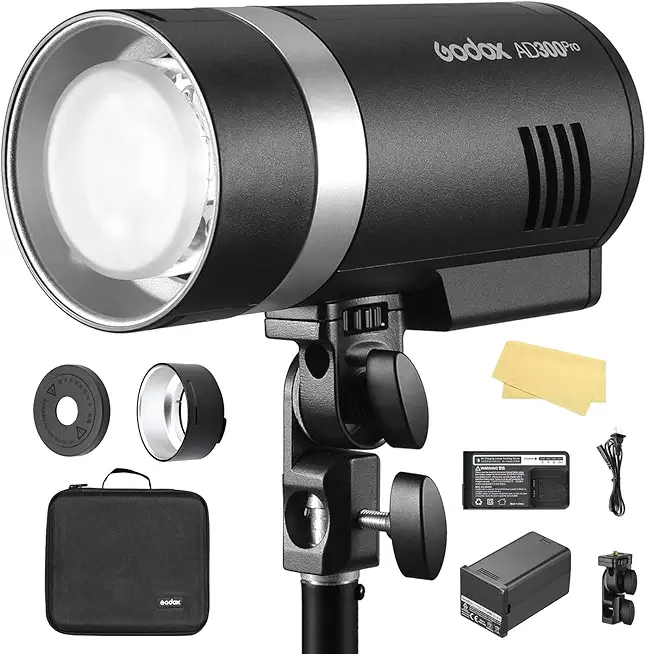
Godox AD300Pro 300Ws TTL HSS Portable Flash Rechargeable Battery
Powerful, battery-powered 300Ws flash delivering TTL and HSS precision for on-location portraits and action photography.
Check PriceThe Godox AD300Pro Pocket Flash is a solid workhorse for jewelry and product photographers who need a portable yet powerful strobe. In practice it delivers strong output that highlights a diamond’s facets and brilliance without washing out fine details, so you get crisp highlights and visible sparkle in your shots.
It’s built for off-camera use and excels both indoors and on location thanks to reliable wireless control. That wireless ease makes multi-light arrangements straightforward, so you can layer hard and soft sources to shape reflections and maximize fire across different facets.
Users consistently praise its brightness, even illumination, and simple setup—traits that matter when you’re juggling tiny tweezers and rotating stones. Enthusiasts and semi-pros like it because it produces consistent light that improves sharpness and sparkle without needing a complex rig.
Two practical caveats to keep in mind: it does generate noticeable heat during extended shooting, so plan breaks or limit continuous firing during long sessions. Also, compared with some systems it has a more limited native accessory ecosystem, which can slightly restrict customization unless you source third-party modifiers.
Overall, if you’re stepping up from basic lighting and want a portable flash that reliably teases out facet detail, the AD300Pro is a very good value for photographers focused on diamond sparkle. It balances power, portability, and straightforward wireless control in a package that helps you get usable, sparkle-rich images fast.
- Powerful output highlights facets
- Wireless and easy multi-light setup
- Consistent light improves sharpness and sparkle
- Good price-performance ratio
- Produces noticeable heat during extended sessions
- Limited accessories compared to other brands
3. Profoto B10X Plus

Profoto B10X Plus Off-Camera Flash and Continuous Light
Compact studio light offering balanced flash and continuous modes, yielding natural color and effortless creativity for professionals.
Check PriceAs a working photographer I reach for the Profoto B10X Plus when I need pro-level results without a full studio rig. It’s a high-end portable strobe known for excellent color accuracy and versatility, which matters when you’re trying to render a diamond’s true tones and fire.
In practice it’s ideal for detailed product work. The unit produces true-to-life color and sharp highlights, and the strong, controllable modeling LED lets you preview how light will hit facets before you fire the flash. Its portable, lightweight design makes location shoots realistic rather than a logistical headache.
What users (and I) appreciate is how it reduces post-production time. Because color rendering and highlights are so accurate, you spend less time chasing color shifts or rebuilding sparkle in editing. It consistently captures jewelry sparkle and clarity in a way that makes final selects easier to justify to clients.
There are trade-offs, of course. The B10X Plus is expensive and can feel like overkill if you’re a beginner or on a tight budget. Also, the bulbs used with this system can be delicate, so you need to handle and store them carefully to avoid costly replacements.
If you’re a pro or serious enthusiast who values color fidelity, portability, and the ability to shape precise highlights, this is a smart investment. If budget or rough handling is a concern, weigh those factors first.
- Professional-quality lighting with accurate color rendering
- Portable and lightweight for on-the-go shoots
- Strong, controllable LED modeling light to preview effects
- Wide range of compatible lighting accessories
- Expensive; potentially overkill for beginners
- Bulbs can be delicate and require careful handling
4. Lume Cube Studio Panel Kit
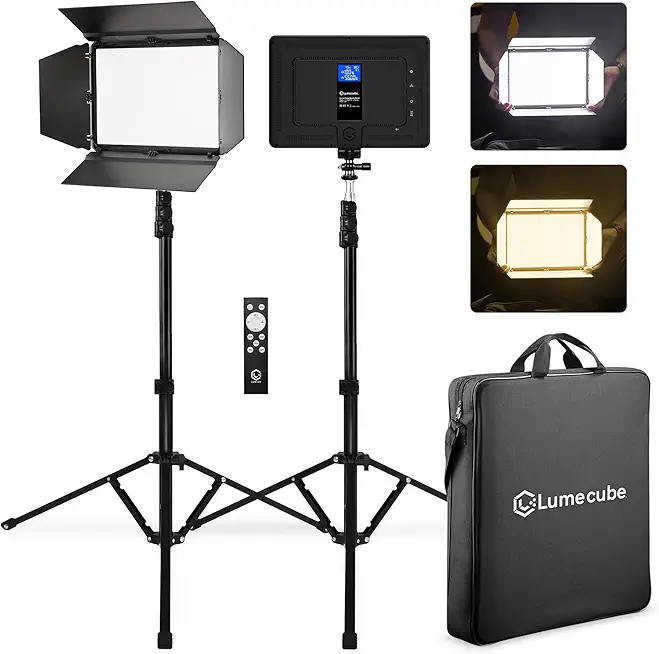
Lume Cube Studio Panel 2-Point Lighting Kit
Two-panel kit delivers soft, flicker-free illumination with adjustable color temperature for polished interviews, streaming, and product videos.
Check PriceAs a product photographer, I reach for LED panel kits like the Lume Cube Studio Panel Kit when I need precise, adjustable illumination that really teases out facet reflections. The panels offer adjustable color temperature and brightness, which makes matching ambient or studio light painless and keeps color rendering predictable for diamonds.
The directional control is a major advantage over ring lights — you can aim a tight beam to create crisp pinpoint highlights on facets without flooding the whole stone. That precise highlight control improves sparkle depiction, letting you dial in contrast and scintillation without nasty hot spots.
They’re compact and easy to mount, so they work well in a small studio or even a home setup where space is limited. Photographers appreciate the fine control over color and intensity; that control translates into fewer retakes and less fiddling in post.
LED efficiency means the panels run cooler, which reduces heat risk to delicate jewelry during long sessions. Still, if you want very soft, even light you’ll likely need additional modifiers — diffusion or softboxes — to avoid harsh edges on highly reflective stones.
One practical note: battery capacity can limit extended shoots without AC power, so plan on mounting on AC or swapping batteries for longer jobs. Overall, for anyone prioritizing control, compactness, and cooler operation, this kit is a smart, mostly low-hassle choice for showcasing diamond sparkle.
- Adjustable color temperature
- LED efficiency — cooler operation
- Precise highlight control
- Compact design for small studios
- Needs modifiers for very soft light
- Battery capacity limits long shoots
5. Hobolite Mini 20W Bi-Color Continuous LED Light Kit

Hobolite Mini Creator Kit 20W Bi-Color LED Light
Compact bi-color LED produces versatile, high-CRI lighting with portable power for vlogging, macro shots, and tabletop broadcasts.
Check PriceThe Hobolite Mini 20W Bi-Color Continuous LED Light Kit is a compact, 20W bi-color LED built for content creators and small studios who need precise, real-time control over lighting. As a photographer, I value continuous lights because they let you see the final exposure and how highlights play across facets before you press the shutter, and this unit delivers that immediate feedback.
In practice the Hobolite Mini shines for solo photographers and small-product setups where positioning and quick tweaks matter; it’s easy to move around a ring of gems and see how reflections and sparkle change on the fly. Users consistently report the balance of brightness and diffusion is well judged for close-up work, so you get punchy facet highlights without overly harsh glare.
Two practical advantages stand out: the bi-color control lets you dial in white balance on the spot to match ambient or to favor warmth or coolness in a stone, and its relatively low heat output means longer shooting runs without stressing delicate settings or worrying about hot metal touching gems. For tabletop and e‑commerce jewel shots where you need consistent, repeatable previews of sparkle, this light is an efficient, affordable tool.
Be realistic about limitations: a single 20W unit can struggle in larger setups or with very reflective scenes, so you may need multiple units or stronger sources for full studio rigs. Also, if you expect heavy, day-in-day-out rental use, the build quality isn’t as rugged as premium pro lights, so treat it as a hardworking small-studio fixture rather than a road-tested workhorse.
- Bi-color continuous light for precise white balance
- Portable and easy to position
- Instant feedback on reflections and sparkle
- Relatively low heat output
- Sometimes insufficient brightness for larger setups
- Build quality less robust than premium brands
How Lighting Affects Diamond Sparkle
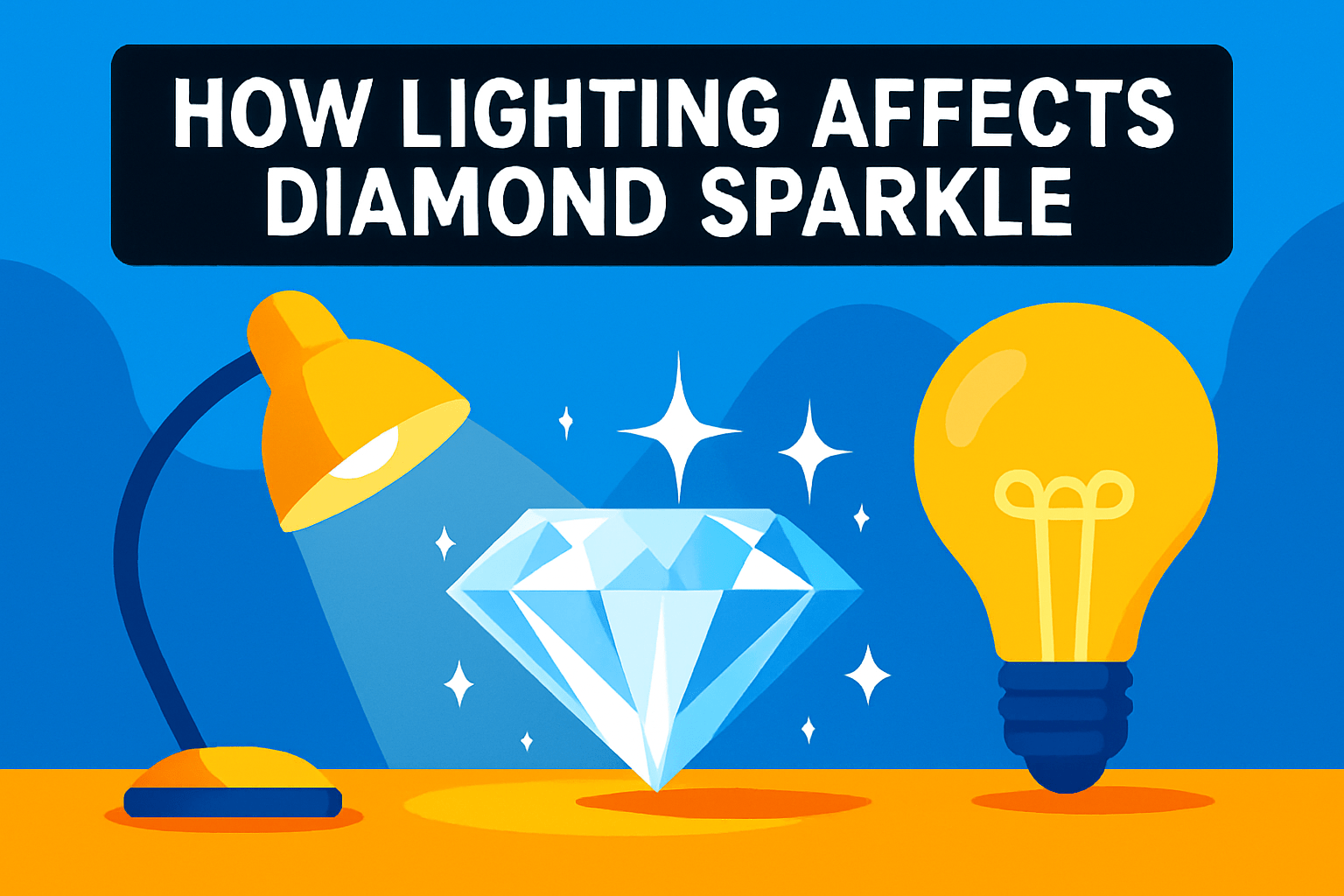
Lighting is the single most important thing that determines whether a diamond sings or looks flat. Sparkle — the mix of brilliance, fire and scintillation — is a product of how light enters, bounces around inside the stone, and returns to the camera or eye. As a photographer, you’re not just illuminating a gem; you’re sculpting light to reveal its personality.
Hard, direct light gives you strong pinpoint highlights and intense fire, but it can also create harsh glare and blown-out areas. Soft, diffused light wraps the stone and reduces distracting reflections, often making the diamond look whiter but sometimes muting sparkle. In practice the best images come from combining both: use diffusion to shape the overall tone and add small, focused sources to create the crisp flashes that read as sparkle.
Angle matters more than many realize. Side lighting at roughly 45 degrees tends to engage more facets and produces lively reflections, whereas flat overhead or frontal light can make the stone look two-dimensional. Try lights from the side, slightly above, and a subtle fill from behind to reveal transparency and contrast — small shifts of a few degrees change which facets catch the light.
Source type affects mood and control. Sunlight is full-spectrum and dynamic but unpredictable; studio strobes give consistent power and punch for crisp highlights; LEDs and modeling lights let you preview effects in real time. A practical workflow is to set continuous LEDs for composition and white balance, then fire strobes or small focused LEDs to lock in the sparkle.
Reflections and environmental glare will steal attention from the stone. Control the scene with diffusers, polarizers, and dark backdrops like black velvet or matte Plexiglass to absorb stray light. Remove shiny objects from the frame and keep the environment minimal so only facet reflections tell the story.
Finally, rotate the diamond while shooting to showcase scintillation and use small pinpoint lights for fire. Experiment patiently — tiny changes in angle, distance, or modifier make huge differences. Once you learn how your lights interact with a particular cut, you’ll be able to reproduce that sparkle reliably.
How Diamond Cut Affects Sparkle
Cut is the single biggest determinant of how a diamond behaves in light. As a photographer who shoots countless stones, I can tell when a gem’s proportions are right before I even meter the scene—well-cut diamonds return light to the viewer and sing with brilliance; poorly cut stones look flat no matter how good the lighting is.
Facet pattern and count shape the personality of a diamond. The round brilliant—usually 58 facets—is engineered to maximize light return, brilliance, and fire. Shapes like princess, oval, and marquise also carry high facet counts and deliver lively sparkle, while step cuts such as emerald and Asscher have larger, fewer facets that create a “hall of mirrors” effect: dramatic depth and reflections rather than rapid scintillation.
Cut quality matters as much as shape. Within any shape, proportions, symmetry, and polish determine whether light is reflected back or leaked away. When possible, choose excellent or ideal cut grades for photographs; they consistently give the strongest visual punch with less retouching.
Internal partitioning in a well-cut stone creates virtual facets that boost perceived sparkle. Scintillation—the little flashes you see when the stone moves—is largely a product of the cut. During a shoot I’ll gently rotate the stone to capture those flashes; a few frames with movement often communicate sparkle better than one static shot.
Match your lighting to the cut. Brilliant cuts thrive under dynamic, multi-angle lighting and small, bright highlights that engage many facets. Step cuts benefit from softer, even illumination that reveals clarity and contrast instead of trying to force glitter where the cut doesn’t produce it.
Finally, test and tweak. Small changes in angle, rotation, and light quality bring out very different behaviors in different cuts. Photographing a variety of stones in motion under the same setup will quickly teach you which lighting approach flatters each cut the most.
What People Ask Most
What is the best light to make a diamond sparkle?
The best light emphasizes contrast and creates pinpoint highlights while also providing gentle fill to reveal shape. Combining focused hard light with soft, diffused light often produces the most pleasing sparkle and dimensionality.
Does LED lighting make diamonds sparkle more than incandescent?
LED lighting is popular because it offers consistent color and cooler operation, which helps reproduce sparkle reliably. Incandescent light can give a warmer tone but is generally less controllable for consistent results.
Is natural sunlight the best light for showing a diamond’s sparkle?
Natural sunlight is full-spectrum and can show a diamond’s sparkle very effectively, but it is unpredictable and can produce unwanted reflections. For repeatable results, controlled artificial lighting is often preferable.
What color temperature makes diamonds sparkle brightest?
There is no single ideal temperature; neutral, full-spectrum light that renders color accurately tends to show both fire and brilliance best. Adjusting toward a balanced white point helps avoid color casts that can mask sparkle.
Do fluorescent lights make diamonds look dull or sparkly?
Fluorescent lighting can sometimes appear flat and may reduce perceived liveliness compared with more controlled sources. Using dedicated studio lights or quality LEDs usually yields more vibrant sparkle.
What type of lighting brings out a diamond’s fire and brilliance?
A mix of focused, harder light to create bright facet highlights and softer fill to define the stone’s shape brings out both fire and brilliance. Controlling direction and intensity is key to showcasing each stone’s best qualities.
How does lighting angle affect a diamond’s sparkle?
Angle determines which facets catch and reflect light, so changing the position of lights alters the pattern of sparkle. Using lights from multiple directions and experimenting with placement helps reveal the most attractive reflections and scintillation.
Conclusion for Best Diamond Sparkle Lighting
Good lighting remains the single most important factor in revealing a diamond’s sparkle, and the goal of this guide was to help you match lighting approaches to your workflow and creative goals.
For quick, repeatable smartphone shots choose a compact, diffused setup that simplifies reflections, while photographers who need punch and portability will prefer a powerful off‑camera flash; professionals often lean toward strobes for color fidelity, adjustable LED panels for fine control, and continuous bi‑color lights when real‑time preview matters.
Ultimately the best results come from testing combinations of hard and soft light, varying angles, and tuning intensity to the stone’s cut and movement until the facets sing.
If you want to keep improving, browse more of our site’s practical guides to sharpen your lighting and shooting skills.
Questions or experiences to share? Leave a comment below — we usually reply within a few hours.



0 Comments