
Ever wondered why pros still tuck a small handheld device into their camera bag when modern cameras and smartphone apps promise perfect exposures? In this ultimate guide we test and compare five handheld light meters to help you find the best light meter for photography and simplify getting the exposure you want. Whether you shoot portraits, landscapes, or motion work, a reliable meter gives consistent exposure and creative control.
Inside, you’ll find hands-on reviews that focus on real-world performance, ease of use, and reliability across studio and location shoots. We’ll demystify incident versus spot metering and show when to rely on each to protect highlights and preserve shadow detail. You’ll also get clear guidance on measuring flash versus ambient light, balancing mixed sources, and a practical FAQ on whether you need a handheld meter.
Expect straightforward recommendations for different shooting styles and simple workflows to speed setups on location or in the studio. If you care about cleaner highlights, truer skin tones, or consistent exposures during long shoots, a meter will repay the time you invest learning it. Read on to find the best light meter for photography for your needs and to master measuring flash and ambient light with confidence.
1. Sekonic L-858D-U Speedmaster Review

Sekonic Speedmaster L-858D-U Light Meter
Professional wireless exposure and flash meter offering high-speed sync, ambient and flash readings, color-temperature support, and intuitive controls for cinema and photo workflows.
Check PriceThe Sekonic L-858D-U Speedmaster is a workhorse for professionals — widely used by photographers, cinematographers, and landscape shooters who need reliability and advanced features. It’s praised for an intuitive touchscreen interface that many find easier to navigate than older Sekonic models, and it sports a large 2.7-inch color dot-matrix touchscreen for clear readouts. The build feels robust and weather-resistant, so it stands up well in challenging outdoor conditions.
Its retractable lumisphere with 270-degree rotation makes incident-light measurement flexible and practical on location, while the spot meter function is highly accurate for both landscape and studio work. You can compare readings from different light sources directly on the screen, which speeds up troubleshooting mixed-light setups. Its high sensitivity (down to 0.1 lux) is especially helpful for low-light and long-exposure work where every stop counts.
For flash shooters, the Speedmaster measures flash duration and supports HSS, making it useful for action and portrait photography where controlling flash timing and power is critical. Overall, if you’re a working photographer or cinematographer who values accuracy, flexibility, and weather resistance, this meter is a solid investment. Be mindful that the touchscreen can be less responsive in cold weather and it’s relatively expensive compared to entry-level models.
- Intuitive touchscreen interface
- Retractable lumisphere with 270-degree rotation
- High sensitivity (down to 0.1 lux)
- Measures flash duration and supports HSS
- Touchscreen can be less responsive in cold weather
- Relatively expensive compared to entry-level models
2. Sekonic L-478DR LiteMaster Pro Review

Sekonic L-478DR-U-PX Light Meter
Compact cine-focused exposure meter with wireless radio triggering, precision spot and incident readings, and customizable presets for fast, on-set measurement.
Check PriceAs a working photographer I appreciate tools that balance precision with practical workflow — the Sekonic L-478DR LiteMaster Pro does that well. It’s highly regarded by pros and cinematographers for its versatility and consistent, reliable readings across different scenarios.
The 2.7-inch touchscreen gives clear, comprehensive incident readings for both ambient and flash luminance, so I can quickly set base exposures and check flash output without guessing. That display makes it easy to interpret readings on location, especially when juggling mixed light.
If you need spot metering the meter accepts an optional 5-degree viewfinder accessory, which I’ve found useful when I want to zero in on highlights or shadows. The Sekonic Data Transfer Software is another plus — it lets you fine-tune camera-specific profiles so your meter’s readings align with your camera system.
For hybrid shooters, Cine mode supporting shutter angles and frame rates is genuinely helpful when switching between stills and video work. And for off-camera flash setups the built-in PocketWizard wireless triggering system lets you control remote flash units directly from the meter, speeding up lighting tests.
In short, the L-478DR is a professional-grade meter that’s especially attractive if you shoot both stills and motion and need accurate, repeatable readings. It’s powerful and feature-rich, though you’ll pay a premium and should expect a slightly larger, heavier unit than the most compact meters.
- 2.7-inch touchscreen
- Comprehensive incident measurement of ambient and flash
- Optional 5-degree viewfinder for spot metering
- PocketWizard wireless triggering for remote flash control
- Relatively expensive compared to entry-level models
- Touchscreen can be less responsive in cold weather
3. Sekonic L-308X-U Flashmate Review
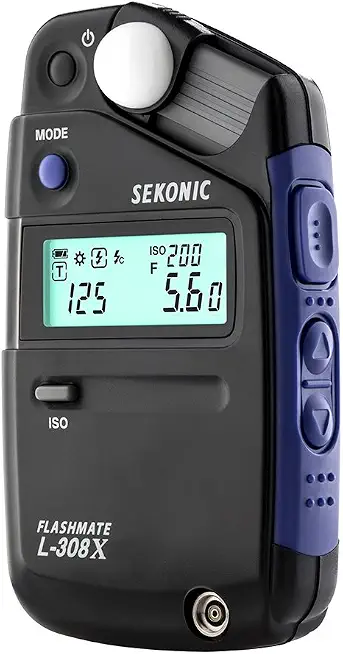
Sekonic Flashmate L-308X Exposure Meter
Pocket-sized exposure meter delivering accurate flash and ambient measurements, simple interface, and reliable readings for photographers on the move.
Check PriceThe Sekonic L-308X-U Flashmate is one of those tools I keep reaching for when I need a no-fuss, accurate reading without lugging a larger meter. It’s popular with beginners and professionals alike because it pairs compact size with straightforward operation and dependable accuracy.
Where it shines is versatility — it’s usable in almost any setting beyond near-total darkness, so I’ll grab it for quick location shoots, run-and-gun portraits, or classroom lighting demos. Its lightweight, portable design makes it easy to carry on long assignments or slip into a small bag for travel.
Practically speaking, the Flashmate measures both flash and ambient light, which is a real advantage in mixed-lighting scenarios. I’ll usually set my ambient exposure first, then switch to flash mode to balance strobe output; the L-308X-U handles both tasks reliably and consistently.
Cinematographers will appreciate the Cine-mode — it’s a nice touch for people who work in both stills and motion and need shutter-angle/frame-rate style references. In short, it’s a very capable pocket meter for everyday shooting and for anyone stepping up from smartphone apps or camera meters.
It’s not without compromises: it lacks some advanced features found on higher-end Sekonic models, and the lumisphere is fixed rather than retractable or swivel. If you need HSS timing measurements, wireless triggering, or a rugged pro-grade body, you’ll want to look elsewhere.
- Compact and lightweight
- Versatile across a wide range of lighting conditions
- Cine-mode useful for cinematography
- Measures both flash and ambient light
- Lacks some advanced features of higher-end meters
- Lumisphere is not retractable or swivel
4. Gossen Digipro F2 Review

Gossen Digipro F Exposure Meter
High-precision exposure meter featuring flash and ambient modes, memory recall, and ergonomic controls for studio and location shooters.
Check PriceThe Gossen Digipro F2 is a surprisingly capable little meter — compact and lightweight but built around accuracy and useful features. It measures both incident and reflected light, so you can establish a reliable base exposure and then fine-tune specific areas with reflected readings.
The swivel head is one of my favorite practical touches: it lets you point the sensor exactly where you need it without awkward body positioning, which matters when you’re working in tight spaces or setting cross-light for portraits. The interface is simple and intuitive, so it’s friendly to beginners but doesn’t feel toy-like for pros.
One real advantage is the precision of its exposure readout — you can display values in ½ or 1/3 stop increments, which makes dialing in exact exposure or matching multiple light sources much easier. Its durability and long-term consistency mean you can rely on it shoot after shoot, even if you’re traveling light.
Where it falls short is mainly in refinement: the display is smaller than some modern meters, so reading settings quickly under bright sun can be a bit fiddly. Also, the build is not as bombproof as high-end pro meters, so if you throw gear around or work in extremely harsh conditions, you might prefer something more rugged.
All told, the Digipro F2 is a very good choice if you want a precise, easy-to-use meter that won’t weigh you down. It’s especially well suited to travel shooters, portrait photographers who value incident metering, and anyone moving from smartphone/light apps to a proper handheld meter.
- Compact and lightweight
- High accuracy and broad feature range
- Swivel head for controlled readings
- Exposure values at ½ or 1/3 stop increments
- Smaller display
- Build quality not as robust as higher-end meters
5. Sekonic L-398A Studio Deluxe III Review

Sekonic L-398A Studio Deluxe III Light Meter
Reliable studio meter offering incident and reflective measurements, easy-to-read dial, and dependable accuracy for controlled lighting environments.
Check PriceThe Sekonic L-398A Studio Deluxe III is a throwback in the best way: a classic analog design with a needle-and-dial system that does not require a battery. The display is immediate and easy to read, which makes setting exposure fast when you want to work deliberately and without menu diving.
Users consistently praise its accuracy and consistency over time, so you can rely on repeated readings across shoots. The analog design is favored by photographers who prefer a simple, straightforward metering experience rather than digital bells and whistles.
Do note this meter is built for ambient-light work only. It cannot measure flash or strobe levels, so it’s not the right tool if you routinely work with studio strobes or need flash power readings on the fly.
Where the L-398A shines is durability and longevity; it’s made to last and to deliver steady, repeatable ambient readings for years. If you value tactile controls, predictable analog feedback, and a meter that won’t die when the battery does, this is mostly a very good choice.
If your workflow is studio flash-heavy or you depend on digital conveniences, this might feel limiting. But for photographers who shoot natural or continuous light and want dependable, no-nonsense metering, the Sekonic L-398A is a solid, trustworthy tool.
- Analog needle-and-dial; no battery
- Highly accurate and consistent
- Simple, straightforward metering
- Durable and long-lasting
- Cannot measure flash or strobe levels
- Analog interface less intuitive for digital users
Spot Vs Incident Metering
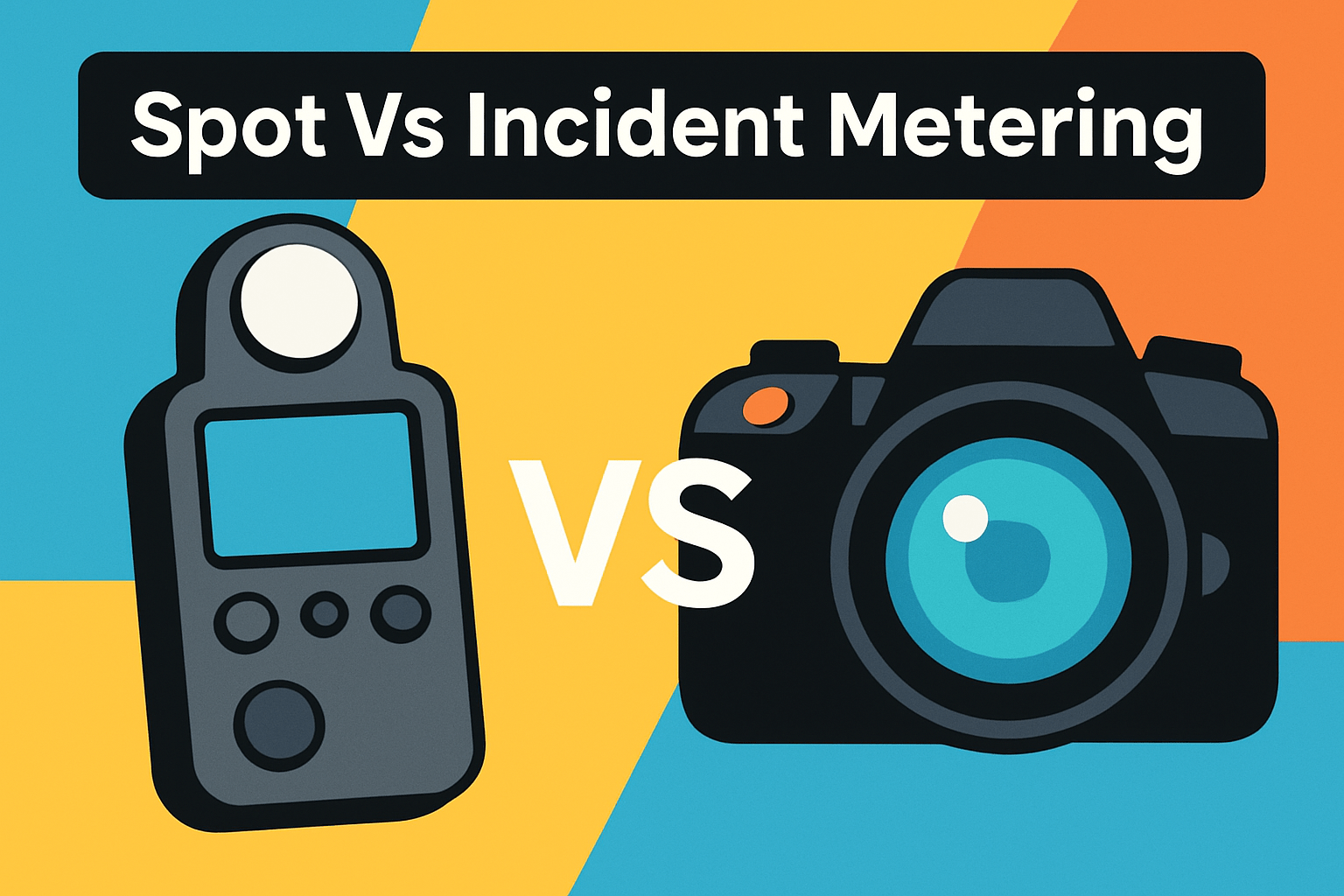
Spot and incident metering are both indispensable, but they answer different questions about your scene. Spot metering reads reflected light from a very small area—typically a 1°–5° cone—so it’s superb when you need exact control over a specific highlight, shadow, or detail. Incident metering, on the other hand, measures the light falling on the subject using the meter’s white hemisphere, giving you a reading that’s independent of subject color or reflectivity.
Think of incident metering as your dependable baseline. Place the lumisphere at the subject facing the light source and you’ll get a consistent exposure that preserves tonality and skin tones. It’s my go-to for portraits, still life, and any situation where you want predictable, repeatable results regardless of how bright or dark the subject is.
Spot metering shines when you need precision. Point the meter at a specific area of the scene to judge exposure for highlights or deep shadows. Because spot meters assume the measured patch is an 18% gray, be careful: a bright spot will underexpose if you don’t compensate, and a dark spot will overexpose. Use it to protect highlights or to place important tones exactly where you want them in the zone system.
In practice I often combine both. Start with an incident reading to set a solid base exposure. Then use the spot meter to check the brightest highlights and the deepest shadows and to measure lighting ratios between key and fill. This gives you a balanced starting point and the control to sculpt contrast.
Also remember logistics: spot requires aiming at the subject or area, incident requires positioning at the subject facing the light. Background brightness will skew spot readings but won’t affect incident measurements. Master both techniques and you’ll be able to expose confidently in any lighting scenario.
Flash Vs Ambient Light Measurement
Light meters tell two different stories: ambient meters read continuous light, while flash meters read a very brief burst. I like to think of ambient as the scene’s mood — shaped largely by shutter speed and aperture — and flash as the sculpting tool that you control primarily with aperture and flash power.
My usual workflow is to nail the ambient exposure first. With the meter’s dome facing the light or pointed at the subject, I set shutter and aperture to preserve the look I want. Remember, changing shutter speed will change how bright the ambient looks, while aperture affects both ambient and flash.
Once the ambient base is set, switch the meter to flash mode and trigger your strobe. Place the meter where your subject will be, or point it in the flash’s direction, and read the f‑stop the flash produces. Then tweak flash power until the meter reads the aperture you already chose, or deliberately set a fill ratio by dialing the flash a stop or two below the ambient reading.
Be mindful of sync speed: your shutter must be at or below sync unless you’re using HSS. If you need fast shutters for motion or wide apertures in daylight, HSS will let you balance flash and ambient but sacrifices some flash efficiency. If you’re using off‑camera flash, move the lights around and re‑meter — position changes the shadow shape and exposure quickly.
Use spot or reflected readings to check critical highlights and shadows after incident metering. That’s especially useful with tricky materials like satin or black fabric that fool incident readings. In mixed lighting, metering each source separately and then combining the values helps you preserve dynamic range and keep both natural and artificial light working together.
What People Ask Most
What is the best light meter for photography?
There is no single best meter for everyone; the right choice depends on your shooting style, whether you need flash control or precise spot readings, and your budget. Choose a meter that matches the modes and ergonomics you use most often.
Do photographers need a light meter?
Not every photographer needs one, but handheld meters provide consistent and predictable exposures, especially with flash or mixed lighting. Many photographers rely on camera meters and histograms for less critical work.
How do you use a handheld light meter for photography?
Select the appropriate mode, position the meter where it will measure the light you care about, take the reading, and then set your camera exposure to match the meter. Use incident mode for base exposure and spot mode to check specific areas if needed.
What is the difference between incident and reflective light meters?
Incident metering measures the light falling on the subject and is independent of subject reflectivity, giving consistent exposure. Reflective or spot metering reads the light reflected from the subject and can be influenced by subject brightness or color.
Can you use a smartphone as a light meter for photography?
Smartphone apps can give a useful approximation in a pinch and help with basic exposure decisions. They may lack the accuracy and advanced features of dedicated meters, so use them cautiously for critical shoots.
How do you choose the right light meter for portrait versus landscape photography?
For portraits, meters that make incident readings and flash control easy are often most helpful to maintain skin tone and exposure consistency. For landscapes, meters with reliable spot metering and portability can help manage highlights and shadows.
Are built-in camera light meters as accurate as handheld light meters?
Built-in meters are convenient and accurate for many situations, but they read reflected light from the scene and can be fooled by very bright or dark subjects. Handheld meters offer more control and consistent results when you need precise exposures.
Conclusion for Best Light Meters
Across the five meters reviewed you’ll find options for advanced multi‑mode use and rugged outdoor reliability (Sekonic L-858D), versatile professional cine and flash control (Sekonic L-478DR), compact and user‑friendly portability (Sekonic L-308X), a precise compact digital choice (Gossen Digipro F2), and a classic analog option for consistent ambient readings (Sekonic L-398A), each with trade‑offs in features, size, and price that suit different shooting styles.
Use the product sections and the spot vs incident and flash vs ambient comparisons in this guide to match a meter’s strengths and limitations to your workflow and subjects.
If you want to sharpen your exposure decisions and lighting technique, explore more articles on the site to build practical skills and confidence with whichever meter you choose.
Have a question or a meter story to share? Leave a comment below — we usually reply within a few hours.


0 Comments