
Ever balanced an enormous telephoto on a flimsy tripod and watched the decisive moment slip away? Heavy lenses demand more than a quick setup; they need platforms that resist flex, damp vibration, and shrug off field abuse. This guide compares five tripods built to handle heavy cameras and telephoto lenses, and offers practical setup and stabilization guidance that works in both studio and field conditions for photographers and videographers.
Whether you’re stalking a distant raptor from a blind, tracking athletes on the sidelines, or composing wide landscapes at first light, the right support makes all the difference. We’ll weigh real-world priorities—stability under load, vibration damping, transport weight, and setup speed—so you can match a tripod to your gear, your shooting style, and the environments you frequent. This piece is aimed at wildlife and sports shooters, landscape photographers, and hybrid photo/video creatives who rely on large glass and need dependable support.
Beyond product comparisons, you’ll find field-tested tips for mounting, balancing, and stabilizing heavy lenses so images stay sharp in wind, on uneven ground, and during long tracking sequences. Expect clear, practical advice that helps you avoid common mounting mistakes, streamline setup, and get back to the shot faster. Read on to discover a tripod that tames your heaviest glass and keeps critical moments crisp when it truly counts.
1. Benro Mach3 TMA38CL Carbon Fiber Tripod
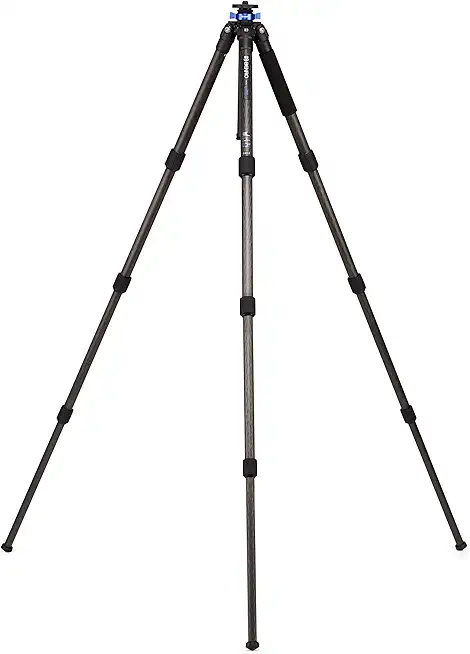
Benro Mach3 TMA38CL Carbon Fiber 3-Series Tripod
Stable carbon-fiber support for professional photographers; high load capacity, precise adjustments, quick-release plate and smooth panning for sharp images.
Check PriceThe Benro Mach3 TMA38CL Carbon Fiber Tripod is a pro-level support built for heavy camera and telephoto setups. Its carbon fiber construction keeps weight down to ≈ 4.1 lbs while offering a max load capacity of 35.3 lbs, which is rare for such a lightweight package.
In the field I find it holds sizeable camera+lens combos without flex or wobble, even when fully extended. That stability makes it excellent for wildlife work and long-exposure shooting where vibration kills sharpness.
Durability is a strong point — the Mach3 is built to take rough handling and stand up to harsh outdoor conditions. If you haul gear into remote terrain, it will endure the knocks and keep your setup steady.
Because it’s carbon fiber you get a good balance: far lighter than many aluminum tripods with comparable strength, yet still rigid under load. At ≈ 4.1 lbs you can carry it all day without draining your energy, but it still resists wind and vibration.
There are practical trade-offs to consider. It is heavier and bulkier than ultra-light travel tripods, so if absolute minimal pack weight is your priority you might look elsewhere.
Price is another factor — this is a higher-end tool aimed at serious photographers who need dependable, low-vibration support for heavy lenses and demanding shooting conditions. For those users it’s a worthwhile investment.
- Superior stability under heavy loads
- Lightweight for its strength (≈ 4.1 lbs)
- Built to withstand harsh outdoor conditions
- Low vibration for long exposures and video
- Heavier and bulkier than travel tripods
- Higher price point
2. Vanguard Alta Pro 263AB 100 Aluminum Tripod

Vanguard Alta Pro 263AB 100 Aluminum Tripod with SBH-100 Ball Head
Versatile aluminum support offering multi-angle center column, stable three-leg design, and included ball head for effortless framing and smooth camera movement.
Check PriceThe Vanguard Alta Pro 263AB 100 is a workhorse tripod that supports up to 15.4 lbs while tipping the scales at about 5.38 lbs. That capacity means it will hold most heavy DSLR bodies with substantial telephoto lenses confidently, and the aluminum build keeps costs reasonable compared with carbon fiber options.
One standout feature is the adjustable center column that allows you to shoot at varied angles and do true macro work without rigging up extra gear. As a photographer, I value that flexibility when composing low-angle or table-top shots where conventional columns limit my options.
In practice the Alta Pro is versatile and stable in both studio and field environments. Setup is straightforward and the leg locks are sturdy and easy to operate, so you’re not fighting with fiddly clamps when lighting or weather conditions are changing.
The trade-offs are clear: the aluminum construction makes it heavier to carry and it’s less compact for travel compared with carbon fiber tripods. If you’re hiking long distances every day, that extra pound or two will add up, but for short walks to hides, car-to-field work, or studio use it’s a fine compromise.
If you prioritize versatility, creative angle options, and solid support for heavy setups over ultralight portability, the Vanguard Alta Pro 263AB 100 is an excellent, budget-friendly choice. It’s particularly good for photographers who split time between studio shoots and short outdoor outings and need reliable, easy-to-use hardware.
- Supports up to 15.4 lbs
- Adjustable center column for varied angles
- Stable and solid under heavy setups
- Robust, easy-to-use leg locks
- Heavier to carry (≈ 5.38 lbs)
- Less compact for travel vs. carbon fiber
3. Slik VARI CF-703 Tripod Kit

SLIK Pro VARI CF-704 Carbon Fiber 4-Section Tripod Kit
Ultra-light carbon-fiber construction with four-section legs for compact portability, rapid setup, and reliable stability during outdoor and travel shoots.
Check PriceAs someone who carries big glass into the field, I appreciate what the Slik VARI CF-703 brings: very strong, stiff support in a travel-friendly package. The carbon fiber legs keep the kit light — roughly 2.4–2.7 lbs depending on configuration — yet deliver the rigidity you need for heavy lenses.
The kit’s modular base is its real advantage. You can switch between a quick-leveling base for fast setups on uneven ground and a traditional center column when you need extra height or precise positioning, which makes the CF-703 surprisingly adaptable for wildlife or landscape shoots.
In practice the tripod collapses to a compact size that’s easy to carry without sacrificing heavy-duty support, so it’s a solid choice when you want to hike with a long lens but still demand stability. That said, don’t treat the center column as a crutch — extending it fully will reduce stability, so plan compositions around the tripod’s native height or remove the column for the stiffest platform.
One real-world caveat: the leg locks can be fiddly until you get used to them, especially when changing angles quickly in cold or wet conditions. Spend a little time practicing deployment and locking, and the rewards are a stiff, lightweight support system that travels well and handles large lenses confidently.
If you need a balance between travel weight and heavy-lens support, and you value a modular base for varied shooting conditions, the Slik VARI CF-703 is mostly a very good fit.
- High rigidity for heavy lenses
- Lightweight carbon fiber legs (~2.4–2.7 lbs)
- Modular base system (quick-leveling or center column)
- Compact when collapsed
- Leg locks can be tricky to operate quickly
- Center column reduces stability if fully extended
4. 3 Legged Thing Winston 2.0

3 Legged Thing Winston 2.0 Pro Range Carbon Fibre Tripod System
Professional-grade carbon-fiber system delivering rock-solid support, modular adjustments, reversible center column, and versatile mounting for demanding photo and video work.
Check PriceAs a working photographer who often shoulders long telephotos, the 3 Legged Thing Winston 2.0 stands out for marrying heavy-duty performance with travel-minded design. Its carbon fiber build keeps the profile relatively compact while still delivering a load capacity of ≈ 20 kg (44 lbs), so it handles serious glass without complaint.
What I notice in the field is the exceptional rigidity even when it’s fully extended; there’s almost no perceptible flex when tracking subjects or taking long exposures. Vibration damping is excellent, which means sharper images and less time waiting for the rig to settle after a move or wind gust.
Stability on uneven ground is another real-world win — the Winston 2.0 feels secure on rough terrain, making it a reliable choice for wildlife and landscape work where footing is rarely perfect. Its compact transport size for a heavy-duty design also makes it easier to carry into remote locations compared with bulkier pro tripods.
That said, it’s aimed squarely at pros and advanced enthusiasts; the build quality and capability come at a relatively high price point. It’s also heavier than ultra-light travel tripods, so if absolute minimal weight is your priority you might reconsider — but for supporting heavy telephoto and macro rigs, it’s mostly an uncompromising tool.
- Outstanding rigidity and stability at full height
- Compact transport size for a heavy-duty design
- High load capacity for very heavy lenses (≈ 20 kg / 44 lbs)
- Excellent vibration damping
- Relatively high price point
- Heavier than ultra-light travel tripods
5. Sunpak VideoPRO-M5 Tripod

Amazon Basics 50-inch Lightweight Tripod with Bag
Budget-friendly lightweight tripod with carrying bag; adjustable height, quick setup, and compact fold for casual photography and travel.
Check PriceThe Sunpak VideoPRO-M5 Tripod is built for video production and heavy DSLR/video rigs, supporting up to 22.4 lbs. In practice that means you can mount sizable camera packages or even a teleprompter without worrying the tripod will sag or fail.
Its true fluid head delivers very smooth panning and tilting, which is a must when you’re tracking moving subjects with heavy lenses. The head’s responsiveness helps avoid jerkiness and keeps your footage cinematic when following athletes or wildlife in motion.
Leg construction is robust and designed for stability across varied conditions, so you can trust the platform even when extending height or carrying extra accessories. Setup and breakdown are fast thanks to the sturdy leg design—valuable when you need to move quickly between setups on a shoot.
The VideoPRO-M5 also offers versatile pan-handle placement, letting you configure the ergonomic feel for long takes and extended tracking. A floating ball head system helps level the rig on uneven terrain, saving you time and fuss when shooting on slopes or rough ground.
Realistically, this is primarily a video tripod, so if you’re a photographer who needs something compact or ultra-lightweight, it might feel bulky. But for videographers or hybrid shooters who often mount heavy lenses and accessories and need smooth motion control, this tripod is a dependable, purpose-built choice.
- Supports up to 22.4 lbs
- Very smooth true fluid head
- Strong, stable legs; quick setup/breakdown
- Floating ball head system for leveling
- Primarily a video tripod; less compact/flexible
- Slightly heavy compared to photo-centric tripods
Tripod Setup for Heavy Cameras and Lenses
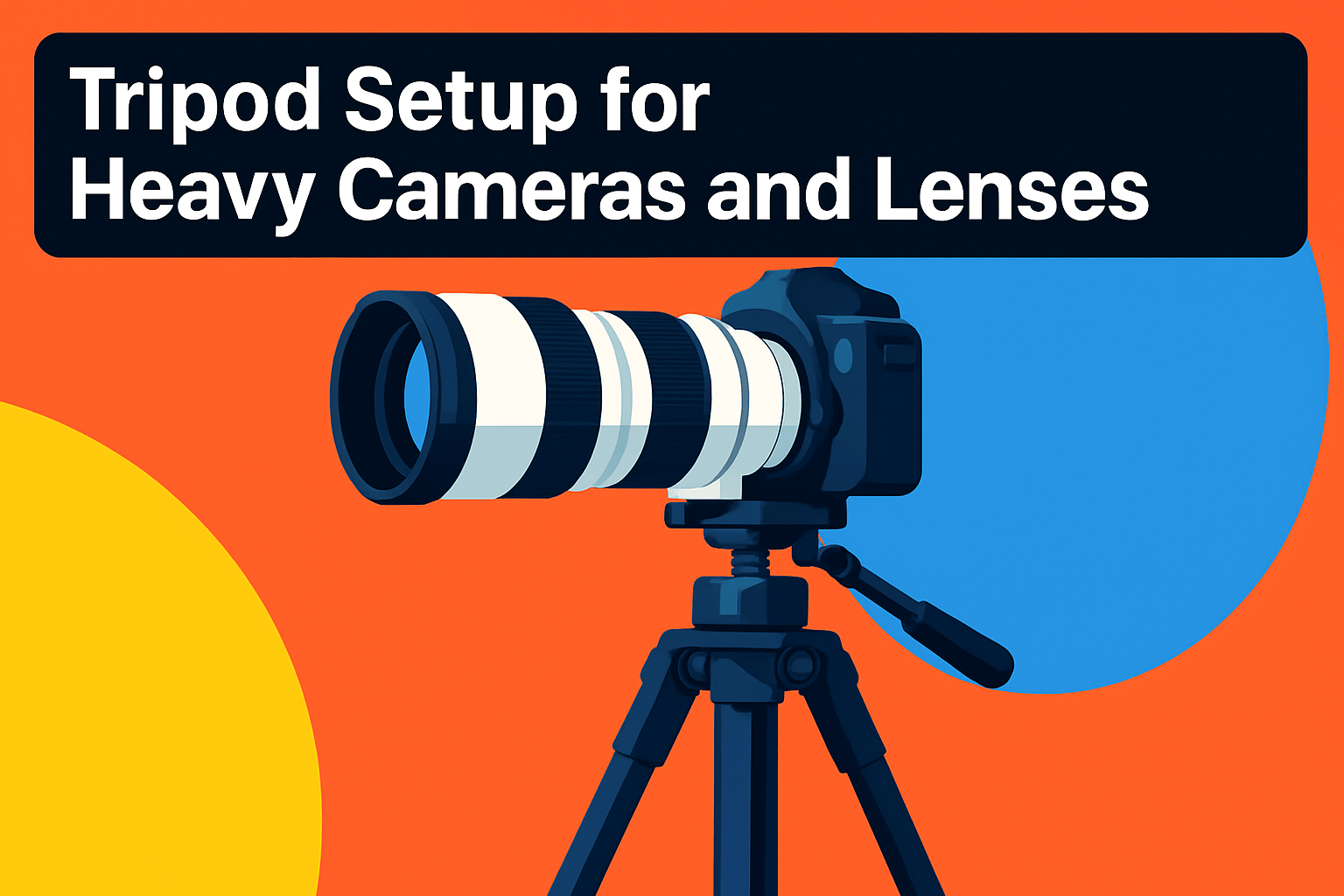
Heavy lenses need a proper platform. Start with a tripod and head that comfortably exceed your gear’s weight. Check rigidity with the legs fully extended and inspect every leg lock and the center‑column clamp—any wobble is a liability in the field.
Mount the lens by its tripod collar or foot, not the camera body. I always use an Arca‑Swiss long lens plate on the collar; it lets me fine‑tune balance and slide the camera on and off without fighting the head.
Pick the right head. Gimbal heads are ideal for big telephotos and tracking, while a heavy‑duty ball head will work if its load rating comfortably exceeds your rig and you lock it securely.
Balance is everything. Slide the plate until the combined center of gravity sits over the tripod, then snug the clamps—firm, but not so tight that you strip threads.
Keep the tripod low and avoid the extended center column whenever possible. If you need extra reach, recompose with the head rather than raising the column; removing the column gives noticeably better stability.
When ground is soft, give the legs a solid foundation. Wedge flat stones or pads under each foot and hang a sandbag from the center to lower the center of gravity and tame wind‑induced shake.
For moving subjects, slightly relax the pan or friction knobs so tracking feels smooth, while supporting the lens with one hand to damp micro‑vibrations. Once the action stops, re‑secure every lock before you let go.
Use image stabilization judiciously—some modern lenses and bodies detect a tripod mount and behave differently, so test your combo. Keep your elbows in and your stance steady; your hands are the last line of vibration control.
Stabilizing Heavy Lenses on Tripods
Mount heavy glass on its lens collar and use a long Arca‑Swiss plate on that collar. That keeps stress off the camera body and makes balancing predictable. Slide the plate until the lens’s center of gravity sits directly over the head; tiny adjustments often cure tip or drift.
Match the head to your work: gimbal heads excel at panning and vertical tracking, while heavy‑duty ball heads are fine for static shots. Make sure the head is rated above your rig’s weight and that it locks solidly.
Avoid the center column when you can, because it introduces flex and raises the center of gravity. If you must extend it, test rigidity at shooting height and inspect every leg lock and the center‑column clamp.
Add ballast to lower the center of gravity: hang a sandbag or strap a pack to the tripod hook to reduce wind sway. On soft ground sit flat stones, wooden pads, or rubber foot plates under the legs so they can’t sink or shift between frames. These small steps pay off big for long exposures and high‑magnification telephoto work.
When tracking moving subjects slightly loosen the appropriate knobs for smooth follow‑through and keep a hand under the lens to damp micro‑vibrations. For stills clamp everything and run a few quick test exposures to confirm there’s no drift. Test image stabilization on and off with each lens — modern systems behave differently on a tripod, and you’ll want to know which setting works for yours.
Set your stance to help the tripod: plant your feet, tuck your elbows, and use your torso to support the lens rather than your arms alone. Do a gentle nudge and a short exposure check before you shoot a sequence; if you see movement rebalance or add weight.
What People Ask Most
What is the best tripod for heavy telephoto lenses?
Choose a tripod that prioritizes rigidity and stable load capacity while fitting your shooting style and travel needs. Consider overall build quality, how the head interfaces with your gear, and how you plan to use it in the field.
Do I need a gimbal head for heavy lenses?
A gimbal head is very helpful for smoothly supporting and tracking heavy telephoto lenses, especially for moving subjects. However, a heavy-duty ball or tripod head can work well if it is properly rated and used with good balance.
How much load capacity should a tripod have for heavy lenses?
Pick a tripod with a clear capacity that exceeds the combined weight of your camera, lens, and common accessories to allow a safe margin. Verify both the rated capacity and real-world rigidity when the tripod is set up.
Can I use a regular tripod with a heavy lens?
You can if the tripod and head are sturdy enough and rated for the combined weight; not all consumer travel tripods are suitable. Use the lens collar or foot for mounting and avoid relying on a small plate attached only to the camera body.
What tripod head is better for heavy lenses: ball head or gimbal head?
Gimbal heads excel at balancing long lenses and making tracking effortless, while heavy-duty ball heads offer a more compact option for static or panning shots. Choose the type that matches your shooting technique and ensures secure locking under load.
Are carbon fiber tripods better for heavy telephoto lenses?
Carbon fiber offers a favorable strength-to-weight ratio and good vibration damping, which helps when carrying and stabilizing heavy gear. Aluminum and other materials can also provide excellent stability and may be more budget-friendly.
How do I mount a heavy lens on a tripod safely?
Mount the lens using its tripod collar or foot and secure it to a compatible plate so the combined center of gravity sits over the tripod. Tighten clamps securely, avoid using an extended center column when possible, and check stability before shooting.
Conclusion for Best Tripod for Heavy Lenses
Choosing the right support is ultimately about matching capacity, rigidity and portability to your shooting style, and this comparison plus the setup tips should make that decision easier.
Pairing an appropriately rated tripod and head, mounting on the lens collar, balancing the rig and keeping the tripod low while using ballast or solid footing will reduce vibration and make heavy setups more reliable.
If you want to keep sharpening your setup and stabilization skills, explore more of the site’s practical guides and gear advice to find tips that fit your workflow.
Have questions or field tips to share? Leave a comment below — we usually reply within a few hours and welcome your follow-ups.


0 Comments