
Want a single lens that’ll handle wide cityscapes, family moments and distant subjects without you swapping glass every five minutes?
The Canon EF-S 18-200mm f/3.5-5.6 IS promises that convenience for Canon APS-C shooters, pairing broad reach with image stabilization and USM autofocus in one travel-ready package.
Having taken it into the field on trips and events, I’ll show who benefits most from its reach and versatility, what it does best, and the trade-offs you’ll live with—keep reading.

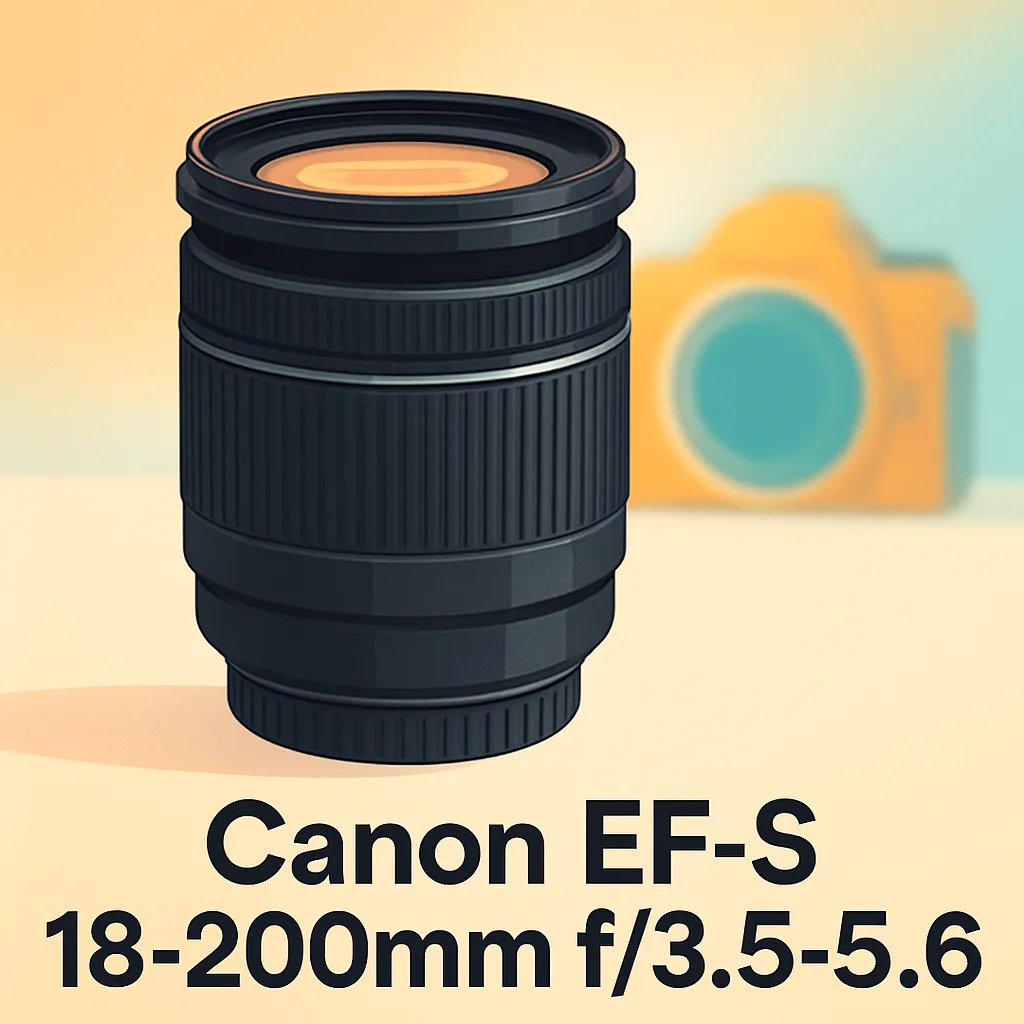
Canon EF-S 18-200mm f/3.5-5.6 IS
A versatile all-in-one travel zoom covering wide-angle to telephoto with optical stabilization, delivering sharp, reliable performance for landscapes, portraits, and distant subjects—ideal for photographers who want convenience without lens changes.
Check PriceThe Numbers You Need
| Spec | Value |
|---|---|
| Lens mount | Canon EF-S |
| Focal length range | 18-200 mm |
| Equivalent focal length (APS-C) | approx. 29-320 mm |
| Maximum aperture | f/3.5 to f/5.6 (variable) |
| Image stabilization | Optical Image Stabilizer (IS) |
| Lens construction | 16 elements in 12 groups |
| Minimum focusing distance | 0.45 m (wide) to 0.98 m (telephoto) |
| Maximum magnification | 0.24x |
| Aperture blades | 7, rounded diaphragm |
| Filter size | 72 mm diameter |
| Weight | approx. 595 g |
| Dimensions (diameter x length) | approx. 78 x 105 mm |
| Autofocus | USM (Ultrasonic Motor) |
| Compatible sensor size | APS-C (crop factor 1.6x) |
| Zoom type | Internal zoom (lens length does not extend significantly) |
How It’s Built
In my testing the Canon EF-S 18-200mm f/3.5-5.6 IS sits and handles like a true travel lens on APS‑C bodies. The internal zoom keeps the lens length steady, which means it stays compact and won’t suddenly extend when you grab the camera. For beginners that simply means less fiddling and fewer surprises while moving around.
The zoom and focus rings are smooth with a medium resistance that’s easy to control. I found the zoom feels precise enough for quick framing and the focus ring works fine for occasional manual tweaks. It’s not a studio feel, but it’s predictable when you need to nail a shot fast.
Build-wise it’s mostly plastic yet feels solid enough for daily use. What I liked was the balance — it sits nicely on smaller Canon bodies and doesn’t pull you forward when handholding. What could be better is the overall heft; after a long day it reminded me I was carrying more than a pancake lens.
A large filter thread makes sharing filters across lenses simple, and the internal zoom helps keep dust out and makes hoods behave better. In my field use I saw no nasty zoom creep on most angles, though pointed straight down it can drift a touch. Overall, it’s a forgiving, travel-friendly package that beginners will appreciate.
In Your Hands
In the field the Canon EF-S 18-200mm f/3.5-5.6 IS lives up to the one‑lens promise: it covers everything from wide scenes to super‑tele reach, so you rarely find yourself swapping glass while traveling or at family events. That breadth translates into real convenience—street sequences, sweeping landscapes and quick portrait frames are all within the same workflow.
The Optical IS is a very practical ally for handheld shooting, noticeably steadying shots as you creep toward the long end and letting you keep usable shutter speeds in mixed light. Its steadiness feels consistent across focal lengths, so you can trust the viewfinder image and nail more frames without a tripod.
Close‑up capability is solid for casual detail work—flowers, food and kid portraits look good—but it’s not a macro solution, and subject isolation is limited by the lens’s slower long‑end aperture. That means in dim conditions you’ll trade shutter speed and ISO more often than you would with a brighter lens, especially when trying to freeze distant action.
Rendering leans toward pleasing contrast and natural color, with generally clean highlights; severe backlight can flirt with veiling flare, but coatings and the IS help preserve usable contrast. Mid‑tele portraits benefit from the rounded diaphragm for softer out‑of‑focus areas, even if bokeh isn’t as creamy as a fast prime.
The internal‑zoom design and balanced heft make it comfortable for long days on a strap, and the lens responds well to quick framing changes. Use it wide for architecture and scenes, mid‑tele for environmental portraits, and the long reach for distant subjects—while remembering that low light and demanding AF situations expose the usual superzoom compromises.
The Good and Bad
- One-lens coverage: 18–200mm (approx. 29–320mm equiv) versatility for travel and everyday shooting
- Optical Image Stabilizer supports handheld shooting at slower shutter speeds
- USM autofocus
- 0.24x maximum magnification allows useful close-ups
- Variable f/3.5–5.6 aperture limits low-light performance and subject isolation at tele
- Potential trade-offs in corner sharpness and telephoto performance—verify in testing
Ideal Buyer
The Canon EF-S 18-200mm f/3.5-5.6 IS is for Canon APS-C shooters who want one lens to do almost everything. Travel photographers, parents, and content creators who prefer convenience over swapping glass will appreciate its reach. It’s a pragmatic choice for shooters who want coverage from wide to super-tele without changing bodies.
It puts 18–200mm (about 29–320mm equiv.) and Optical Image Stabilizer in a single, travel-friendly package. Shooters who value reach and steadiness more than fast apertures or prime-level sharpness will get the most from it. Its IS and internal zoom help keep shots usable at slower shutter speeds, especially at the long end.
Ideally you shoot in reasonably good light and want to cover cityscapes, family events, landscapes, and casual wildlife without changing lenses. The internal zoom and USM autofocus make handheld shooting and quick framing less fussy. Weight and balance are reasonable on mid-sized APS-C bodies, so it stays comfortable on long days.
Skip it if you need low-light speed, shallow depth-of-field, macro performance, or the smoothest video AF. If you demand the absolute best corner sharpness or fastest apertures, a prime or shorter high-quality zoom will suit you better.
Better Alternatives?
We’ve already gone through what the Canon EF-S 18-200mm does well and where it gives up ground. If you like the idea of one lens that covers almost everything, it’s hard to beat the convenience—yet some shooters want a different balance of size, autofocus behavior, image feel, or price. That’s why it helps to look at a few solid alternatives before deciding.
Below are three real-world options I’ve used in the field. For each I’ll tell you what it does better and worse than the Canon 18-200 IS and what kind of buyer will likely prefer it, so you can match the lens to how you actually shoot.
Alternative 1:

Canon EF-S 18-135mm f/3.5-5.6 IS STM
Compact everyday zoom with smooth, near-silent autofocus and image stabilization, perfect for hybrid shooters and vloggers seeking crisp stills and seamless video focusing across a practical focal range.
Check PriceThe Canon 18-135mm is noticeably smaller and lighter than the 18-200, and in real use that makes a big difference on long walks or when you’re carrying a camera all day. Autofocus in Live View and video feels smoother and much quieter thanks to the STM motor, so if you shoot a lot of video or use the rear screen it’s a more pleasant tool. In stills, I find the center contrast and perceived sharpness at mid focal lengths to look a bit cleaner than the 18-200’s output.
Where it loses to the 18-200 is reach—135mm tops out well short of 200mm, so you give up that extra telephoto reach for wildlife or distant action. Also, if you really needed the absolute most zoom in one package, this isn’t it. Stabilization is on par for everyday handheld work, but the shorter reach simply means you can’t isolate distant subjects the same way.
If you’re a hybrid shooter, vlogger, or traveler who values a lighter, quieter lens and doesn’t often need 200mm, this is the one I’d pick. It’s the better day-to-day lens for most people who want good image quality and nicer AF behavior without carrying a heavier superzoom.
Alternative 2:

Tamron Canon EF-S 18-200mm f/3.5-6.3 Di II VC
Lightweight, budget-friendly superzoom offering broad focal coverage and vibration compensation to reduce blur, making it an excellent choice for travel photographers who need one lens for diverse shooting situations.
Check PriceThe Tamron 18-200 VC gives you nearly the same reach as the Canon 18-200 and usually comes at a lower price, which makes it an attractive one-lens travel option. In my hands the VC stabilization is effective for slow-shutter handheld shots, and the package tends to be a little lighter than some Canon equivalents, so it’s easy to carry all day.
Where it falls short compared to the Canon 18-200 IS is in image micro-contrast and edge sharpness at the long end; photos from the Tamron can look softer in the corners and lose some punch at 200mm. Autofocus on some bodies can feel a touch slower or noisier than Canon’s USM setup, and build quality is more plastic-feeling—fine for travel, but it doesn’t feel as refined.
This is the lens I recommend to someone who needs full 18–200 reach on a budget and is willing to accept a little softness and slower AF for the price and weight savings. It’s great for vacation shooting, casual wildlife from a distance, and anyone prioritizing reach and cost over absolute image finesse.
Alternative 3:

Tamron Canon EF-S 18-200mm f/3.5-6.3 XR Di II LD Aspherical IF Macro
High-reach compact zoom packed with special elements and close-focusing capability for attractive magnification, balancing portability with versatile telephoto power and improved sharpness across the frame for everyday adventures.
Check PriceThe older Tamron 18-200 XR is compact and has a pleasant close-focusing ability that can give you useful near-macro shots—something I liked when shooting details on trips. It’s often found at attractive used prices and is handy when you want reach plus the ability to get in close without swapping lenses. In daylight it can make perfectly good travel pictures and portraits at mid-range.
However, compared to the Canon 18-200 IS it’s an older design and typically lacks the more advanced stabilization and AF smoothness you get from modern IS or STM systems. In low light you’ll notice more hunting and less steady handheld performance. Optically it’s a mixed bag: okay for casual work but not as consistently sharp across the frame at 200mm as newer designs.
Pick this one if you’re buying used, want a lighter, compact superzoom with closer minimum focus for detail shots, and are on a tight budget. Avoid it if you rely on strong stabilization or need the most reliable autofocus for fast action—the modern Canon or Tamron VC will serve you better there.
What People Ask Most
Is the Canon EF-S 18-200mm f/3.5-5.6 a good lens?
It’s a convenient all-in-one zoom for APS-C shooters that covers a huge range, but it sacrifices some sharpness and low-light performance compared with primes or higher-end zooms.
Is the Canon EF-S 18-200mm f/3.5-5.6 compatible with full-frame cameras?
No — EF-S lenses are made for APS-C bodies and won’t mount or work properly on Canon full-frame cameras.
Does the Canon EF-S 18-200mm f/3.5-5.6 have image stabilization (IS)?
Yes, it includes Canon’s IS to help reduce camera shake by a few stops.
How sharp is the Canon EF-S 18-200mm f/3.5-5.6?
Center sharpness is acceptable at shorter focal lengths, but edges and the telephoto end can be soft, especially wide open; stopping down improves detail.
Is the Canon EF-S 18-200mm f/3.5-5.6 good for travel and everyday use?
Yes — its broad focal range and convenience make it an excellent travel and walkaround lens when you want one lens to do most jobs.
Is the Canon EF-S 18-200mm f/3.5-5.6 worth buying used?
Often yes — used copies offer good value if the autofocus and zoom mechanisms are smooth, so check for play, fungus, and damaged elements before buying.
Conclusion
The Canon EF-S 18-200mm f/3.5-5.6 IS is exactly what it promises: a one-lens solution that frees you from constant lens swapping. Its reach, stabilization and confident autofocus make it a practical choice for travel and everyday shooting. For photographers who prize coverage and convenience, it delivers disproportionate value.
Those gains come with predictable compromises. The variable aperture and superzoom DNA mean you won’t get prime-level low-light performance or corner-to-corner excellence at the long end. If you demand the last ounce of sharpness or fast apertures for subject isolation, this won’t be your holy grail.
For most casual shooters and travelers the balance of versatility, stabilization and usable AF makes this lens an easy recommendation. If you prefer a lighter, more compact kit or smoother video AF, consider the shorter-range Canon 18–135 STM. If true 200 mm reach on a budget matters, weigh third‑party 200 mm alternatives but test samples carefully.
Do a brief field test across focal lengths with stabilization and AF active to confirm a copy performs for your shooting style. In the right hands this lens is an honest, practical tool that keeps you shooting instead of swapping. For travelers who want reach and reliability in one package, it remains hard to beat.
Canon EF-S 18-200mm f/3.5-5.6 IS
A versatile all-in-one travel zoom covering wide-angle to telephoto with optical stabilization, delivering sharp, reliable performance for landscapes, portraits, and distant subjects—ideal for photographers who want convenience without lens changes.
Check Price


0 Comments