
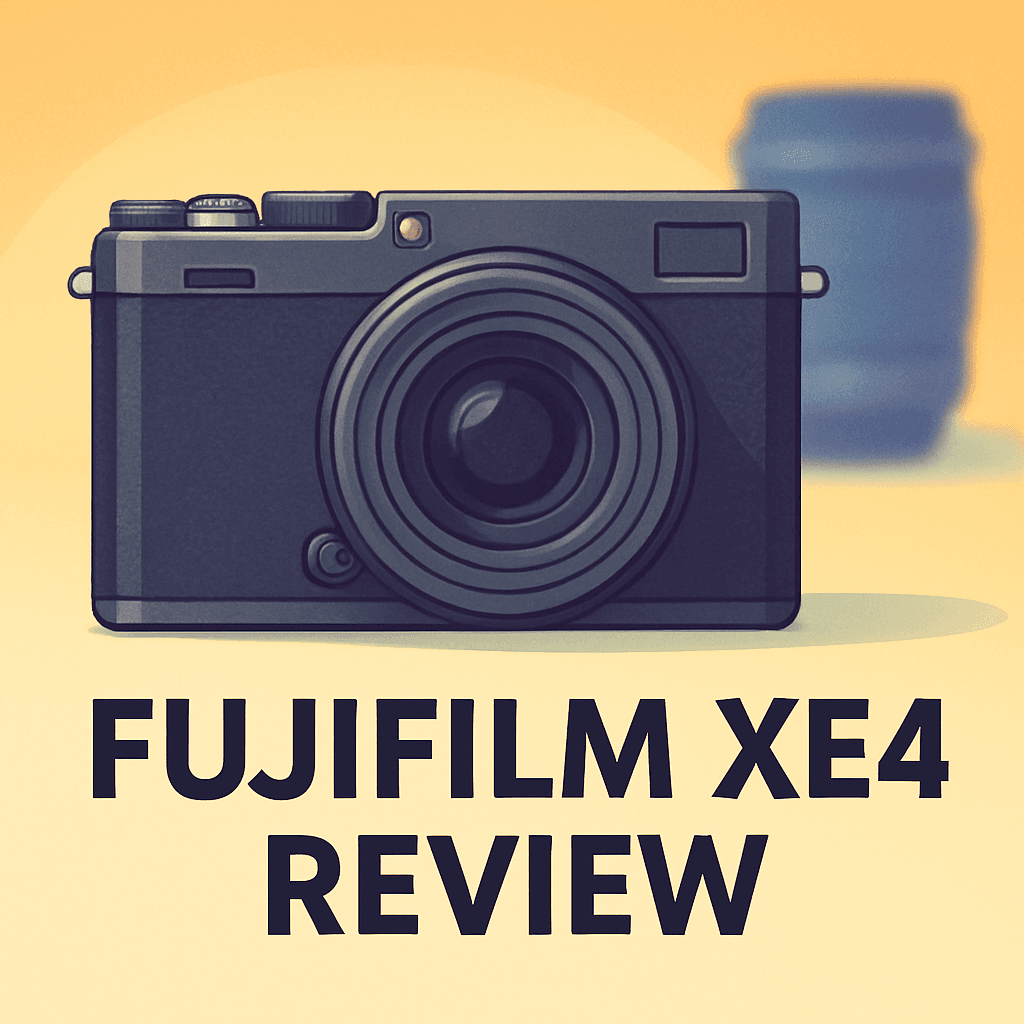
Want better images without lugging a bulky camera?
The Fujifilm X-E4 promises a slim, rangefinder-style body and Fujifilm’s famed color in a pocketable APS‑C mirrorless package.
I shot with one in the field across streets and trips, so I know how it behaves in real use.
You’ll get rich Fuji colors, snappy handling, and 4K video up to 30p that’s handy for hybrid work.
Expect trade‑offs: there’s no in‑body stabilization, no weather sealing, and the mechanical shutter is audible.
If you shoot handheld low‑light or in rough conditions, those limits matter.
This review will show who benefits most — street and travel shooters, JPEG lovers, and hybrid creators — and when to pick something else.
Make sure to read the entire review as I compare it to rivals and reveal the situations where the X‑E4 truly shines — keep reading.

Fujifilm X-E4 Camera
Pocketable rangefinder-style mirrorless boasting high-resolution imaging, film-simulation color profiles and intuitive tactile controls. Ideal for street and travel photographers craving responsive autofocus, a tilting touchscreen and crisp 4K video.
Check PriceThe Numbers You Need
| Spec | Value |
|---|---|
| Sensor | 26.1 MP APS-C X-Trans CMOS 4 |
| Image Processor | X-Processor 4 |
| Lens Mount | Fujifilm X |
| Video | 4K (DCI/UHD) up to 30 fps |
| Max Video Bitrate | 200 Mbps (4K) |
| Continuous Shooting | 8 fps (mechanical), 20 fps (electronic, E-shutter) |
| Autofocus Points | 425 |
| ISO Range | 160–12800 (expandable 80–51200) |
| Shutter Speeds | 1/4000 sec (mechanical), 1/32000 sec (electronic) |
| Viewfinder | 2.36M-dot OLED EVF |
| LCD | 3.0″ 1.62M-dot tilting touchscreen |
| Body Weight | 364 g (with battery and card) |
| Body Dimensions | 121 × 73 × 33 mm |
| Film Simulations | 18 (including Classic Neg, Eterna) |
| Connectivity | Wi‑Fi, Bluetooth |
How It’s Built
In my testing the Fujifilm X-E4 feels like a camera you actually want to carry everywhere. It’s slim, rangefinder-style, and breathes minimalism so it disappears in a jacket pocket or small bag. That freedom makes it easy to shoot more often, which is huge for beginners.
Handling is a mixed bag in real use. I found the shallow grip comfortable for quick street snaps, but if you have larger hands or plan long shoots you’ll want a hand strap or a small add-on grip. Lighter lenses pair best with the body for balance and stability.
The viewfinder is clear and the tilting touchscreen is genuinely useful for low or high angles. In my shooting I switched between EVF and screen without missing a beat, which kept composition fast and natural. Touch controls make menu tweaks simple for folks still learning settings.
Do note the trade-offs I ran into: there’s no weather sealing and the mechanical shutter makes an audible click. That means you should avoid wet weather and be mindful in quiet settings like weddings or galleries. For casual travel and street work it wasn’t a deal breaker, but it’s something to plan around.
What I really liked was how discreet and pocketable it is — ideal for getting candid shots. One thing that could be better is the protection against the elements and a chunkier grip for long days. The Fuji X-mount and built-in wireless made changing lenses and sharing images easy in the field.
In Your Hands
The X-E4 feels brisk and eager in real use, waking and locking focus with a twitchy, responsive character that lends itself to candid street work. High-speed electronic bursts catch fleeting gestures with reliability, while the mechanical shutter handles single-frame shooting dependably—just expect an audible click in quiet situations. Shot-to-shot timing and menu responsiveness keep you in the moment rather than wrestling with the camera.
Image latitude is generous, with a sensor and processor combo that preserves highlight rolloff and retrieves shadow detail in practical scenarios, so handheld evening shoots are more forgiving than you might expect. Because there’s no in-body stabilization, plan on faster shutter choices, stabilized lenses, or bracing techniques for slower-light work to maintain sharpness. Still, color and microdetail remain strong when you pair careful technique with the camera’s JPEG film simulations.
As a hybrid tool the X-E4 delivers crisp, pleasing 4K footage with Fujifilm’s characteristic color, and HLG support gives you more usable dynamic range straight out of camera. Video autofocus is steady for run-and-gun clips, though you’ll notice its limits when chasing very fast motion and with the 30p ceiling for more cinematic pacing. For short documentaries and travel vlogs it’s a compact, capable option that favors portability over cine-style flexibility.
Wireless pairing and remote control are practical on the move, making rapid image transfer and tether-free shooting straightforward during travel shoots. The broad X-mount lens ecosystem means you can build anything from ultraportable primes to more specialized optics without changing systems. In everyday use the X-E4’s small footprint, tactile handling, and out-of-camera color make it a joy to carry and shoot with all day.
The Good and Bad
- 26.1 MP X-Trans CMOS 4 with X-Processor 4
- Film Simulations (18), including Classic Neg and Eterna
- Compact and lightweight: 121 x 73 x 33 mm; 364 g
- 4K (DCI/UHD) up to 30 fps at up to 200 Mbps; HLG supported
- No in-body image stabilization (IBIS)
- No weather sealing
Ideal Buyer
If you prize pocketable gear and cinematic color straight out of camera, the Fujifilm X-E4 is built for you. Its slim rangefinder silhouette, X‑Trans sensor and Fuji film simulations deliver a look that many shooters crave without heavy processing. It rewards photographers who prefer nailing the look in-camera.
Street photographers, travel shooters and everyday carriers will love how unobtrusive it feels. The compact body slips into messenger bags and even larger coat pockets. The audible mechanical shutter and lack of weather sealing are trade-offs you accept for minimalism.
Hybrid content creators who work within 4K/30p limits will find the X‑E4 capable and color-forward. Fast electronic shutter burst modes and responsive AF let you chase fleeting moments and stills-first video. Toss in a compact prime or pancake lens and the kit stays truly portable.
This camera is less ideal if you need IBIS for steady handheld low-light shooting or if your work takes you into rain and grit. Similarly, pro videographers who require 4K/60p or built-in stabilization should look elsewhere. For anyone prioritizing small size and Fuji’s signature color, the X‑E4 is hard to beat.
Better Alternatives?
We’ve already gone through what makes the Fujifilm X-E4 such a nice little camera: the slim, rangefinder feel, the Fuji color straight out of the camera, and the light everyday carry vibe. It’s great for street work, travel, and anyone who wants great-looking JPEGs without a big kit.
If you still want something different — maybe a bit more control, a more aggressive autofocus, or a different handling style — here are three real-world alternatives I’ve used. I’ll point out what each one does better and worse than the X-E4 and who I think would prefer each one.
Alternative 1:

Fujifilm X-T30 II Camera
Compact yet powerful APS-C camera offering fast continuous shooting, advanced autofocus and a detailed electronic viewfinder. Classic tactile dials and versatile film-simulation modes deliver expressive stills and smooth 4K capture.
Check PriceHaving shot with the X-T30 II a lot, the biggest real difference vs the X-E4 is the handling. The X-T30 II has a slight grip and an integrated EVF that feels more solid in your hands for longer shoots. That extra grip and the built-in viewfinder make it easier to hold steady and faster to frame quickly when you’re moving from subject to subject.
The X-T30 II gives you the same Fuji color and image look as the X-E4, but it feels more like a traditional camera when you’re shooting all day. It doesn’t fix the lack of in-body stabilization — so low light handheld work still relies on fast lenses or higher ISO — but I found it easier to keep shots steady simply because I could hang on to it better.
If you want Fuji image quality but prefer more of a grip and built-in viewfinder, the X-T30 II is the pick. Choose it if you shoot longer sessions, want quicker access to controls, or dislike the very slim, rangefinder feel of the X-E4. If you prize the X-E4’s pocketability above all, stick with the E4.
Alternative 2:

Sony Alpha a6400 Camera
Lightweight hybrid shooter with lightning-fast real-time autofocus and reliable subject tracking. High-resolution sensor ensures sharp images, while a flip-up screen and excellent low-light performance suit creators on the move.
Check PriceOn real shoots the Sony a6400 stands out for autofocus and tracking. If you photograph moving kids, pets, or street scenes where subjects don’t stay still, the a6400’s tracking felt more confident and less likely to hunt than the X-E4. For video, I also leaned on Sony’s face and eye tracking when I needed steady, hands-off focus while moving.
Where the a6400 is weaker versus the X-E4 is color and handling. I still prefer Fuji’s in-camera film looks for quick JPEGs — the a6400 often needs more color work in post. The Sony body is more utilitarian and less charming, and it doesn’t have IBIS either, so handheld slow-shutter shots require the same care as on the X-E4.
Pick the a6400 if you need reliable autofocus for action and run-and-gun video, or if you want access to Sony’s wide lens choices. It’s great for hybrid shooters who put tracking and low-light AF above the Fuji JPEG look or the slim, classic styling of the X-E4.
Alternative 3:
Sony Alpha a6400 Camera
Versatile compact body engineered for fast-paced content creation: dependable autofocus, crisp 4K recording and customizable controls. Lightweight, discreet and portable, it empowers run-and-gun storytellers to capture professional-looking footage and stills.
Check PriceI’ve also used the a6400 specifically for vlogging and short-form work, and its flip screen and quick AF make it a solid shooter for one-person crews. Compared to the X-E4, you get a more video-friendly layout and the camera feels geared toward fast setups and quick re-shoots, which helped me when I was moving between locations all day.
That said, the a6400 doesn’t beat the X-E4 for simple, elegant shooting. The Fuji’s controls and film simulations let you get a finished image faster without fuss. The Sony requires more tweaking to get color the way I like, and like the X-E4 it lacks in-body stabilization, so handheld video needs careful technique or stabilized lenses.
If you make short videos, vlog, or need a lightweight camera that can be customized for quick workflows, the a6400 is a strong alternative. If you want that classic Fuji look right out of camera and a very slim carry, the X-E4 will still be the more pleasant daily partner.
What People Ask Most
Is the Fujifilm X-E4 worth buying?
Yes—if you want a compact, stylish APS-C camera with excellent JPEG colors and 26MP image quality; skip it if you need in-body stabilization or top-tier video features.
How is the image quality and autofocus?
Image quality is excellent with rich colors and fine detail from the X-Trans sensor, and autofocus is generally fast and reliable for everyday subjects though not class-leading for fast action.
Does the X-E4 have in-body image stabilization (IBIS)?
No, the X-E4 lacks IBIS, so you should use stabilized lenses or faster shutter speeds for low-light handheld shots.
How is the battery life and is it good for travel or street photography?
Battery life is modest—plan on a spare for long days—but its small size and discreet handling make it ideal for travel and street work.
Is the X-E4 good for video or vlogging?
It records 4K/30p with nice color, but no flip-out screen and no IBIS make it less convenient for handheld vlogging or run-and-gun video work.
How does the X-E4 compare to the X-T30 II or X-S10?
The X-E4 offers similar image quality to the X-T30 II in a sleeker package, while the X-S10 adds IBIS and better ergonomics for action and video—choose based on stabilization and handling needs.
Conclusion
The Fujifilm X-E4 Camera is a compact, rangefinder-style mirrorless that delivers the signature Fuji look and nimble handling. Its image quality and film simulations consistently make it a joy for photographers who care about color and JPEG workflow. It also doubles as a capable hybrid for video with 4K at 30p and practical shooting speeds.
That compactness comes with trade-offs you should accept up front: there’s no in-body stabilization, no weather sealing, and the mechanical shutter is audible. If you plan to shoot handheld in very low light or in rough conditions, the X-E4 will force technique or careful lens choices. For quiet street work and travel, its small footprint and discreet styling are real assets.
Ultimately, the X-E4 Camera is a recommendation, not a compromise, for anyone prioritizing portability, Fuji color science, and an unobtrusive kit. If IBIS, rugged sealing, or higher-frame-rate video are deal-breakers, consider alternative bodies that address those needs. For photographers who want beautiful color straight out of camera and a camera that invites you to shoot, this is one of the most convincing compact options.
Fujifilm X-E4 Camera
Pocketable rangefinder-style mirrorless boasting high-resolution imaging, film-simulation color profiles and intuitive tactile controls. Ideal for street and travel photographers craving responsive autofocus, a tilting touchscreen and crisp 4K video.
Check Price

0 Comments