
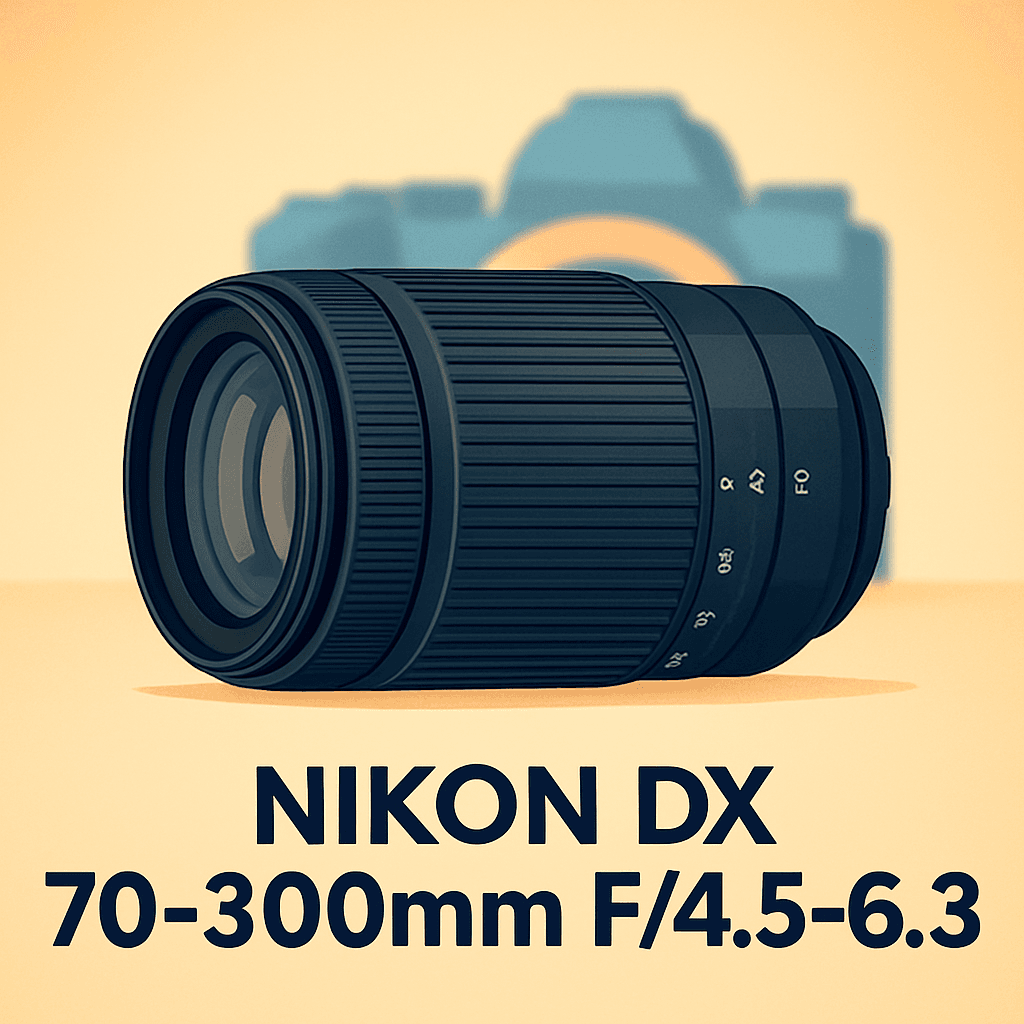
Want more reach on your Nikon DX without the heavy lens? The Nikon AF-P DX NIKKOR 70-300mm f/4.5-6.3G ED offers long reach, ED glass, light carry weight and quiet AF.
It’s aimed at DX shooters who want reach without bulk. Having taken the Nikon DX 70-300mm f/4.5-6.3 out in the field, I wanted to see how those strengths translate to real shooting.
Know the trade-offs: variable aperture, no in-lens stabilization, and some older Nikons won’t support AF-P. I’ll cover handling, autofocus, sharpness and when alternatives make more sense — keep reading.

Nikon AF-P DX NIKKOR 70-300mm f/4.5-6.3G ED
Smooth, near-silent autofocus and lightweight design deliver long-reaching versatility for wildlife, sports, and travel. Extra-low dispersion elements enhance sharpness and contrast throughout the telephoto range, while compact size aids portability.
Check PriceThe Numbers You Need
| Spec | Value |
|---|---|
| Lens type | Telephoto zoom |
| Mount | Nikon F (DX) |
| Focal length | 70–300 mm |
| Aperture range | f/4.5–6.3 (variable) |
| Optical elements | Includes ED glass element |
| Autofocus motor | AF-P stepping motor |
| Minimum focus distance | 1.1 m |
| Maximum magnification | 0.22× |
| Filter thread size | 58 mm |
| Lens construction | 14 elements in 10 groups |
| Image stabilization | None (depends on camera body) |
| Compatible sensor format | APS-C (DX) |
| Weight | Approximately 415 g |
| Dimensions (approx) | 74 × 109 mm (diameter × length) |
| Diaphragm blades | 7, rounded |
How It’s Built
In my testing the Nikon AF-P DX NIKKOR 70-300mm f/4.5-6.3G ED felt delightfully light and balanced on my small DX bodies. It sat easily on the camera without feeling front-heavy, so hand-held shooting for short bursts was comfortable. That makes it a great travel or hiking lens when you want long reach without a heavy pack.
The zoom ring turns smoothly with a reassuring, slightly damped feel and the focus ring is nearly silent thanks to the AF-P stepping motor; I liked how unobtrusive it is during video. The build is compact and practical — not tank-like, but solid enough for regular field use. One thing that could be better is the lack of in-lens stabilization, which in my testing meant I often needed a monopod or faster shutter speeds at the long end.
For beginners this lens is forgiving: easy to carry, easy to point, and quiet enough for casual video work. I found the ED glass and rounded aperture blades gave pleasant backgrounds and a sharp-looking center, so everyday shooting felt rewarding. If you value lightweight handling and quiet AF, it’s a winner; if you need steadier handheld shots in low light, plan to add support.
In Your Hands
On a DX body the Nikon AF-P DX NIKKOR 70-300mm f/4.5-6.3G ED stretches to a very long reach, turning distant subjects into tight framings and flattening perspective in a way that favors wildlife and sports. The reach gives pleasing compression that isolates subjects from busy backgrounds, especially when you can step back.
That long reach comes with the trade-off of a relatively slow maximum aperture toward the long end, which means you’ll be juggling ISO and shutter speed as light drops. Because there’s no in-lens stabilization, handheld work at the longest focal lengths often forces you to lift shutter speeds or accept reduced keeper rates without support.
Close-focusing is limited, so this isn’t a macro tool — expect usable tight shots of slightly nearer subjects but not true life-size close ups. The lens is more at home stalking birds or shooting sideline action than shooting small studio-like subjects.
In the field I found myself leaning on a monopod or using bracing much more often at the long end to protect sharpness; with careful technique handheld results are fine at shorter tele. Autofocus tracking feels quick and unobtrusive across the zoom range, making it easy to follow moving subjects, but the lack of stabilization amplifies the need for steady support to keep keeper rates reasonable in lower light.
The Good and Bad
- 70–300mm reach on DX (approx. 105–450mm equivalent)
- Lightweight and compact telephoto zoom (approx. 415 g; 74 × 109 mm)
- AF-P stepping motor for fast, quiet autofocus and better video friendliness
- ED glass element in the optical formula
- No in-lens image stabilization (VR)
- Variable maximum aperture f/4.5–6.3
Ideal Buyer
If you own a Nikon DX (APS-C) DSLR that supports AF-P lenses, this is made for you. The Nikon AF-P DX NIKKOR 70-300mm f/4.5-6.3G ED gives 70–300mm reach (about 105–450mm equivalent) in a compact, lightweight package. It’s ideal when long reach beats the need for the biggest aperture.
Bring this lens when weight, size, and quiet autofocus matter more than in-lens stabilization. The AF-P stepping motor is fast and unobtrusive for travel, wildlife at a distance, and casual video work, while the ED element helps control fringing and maintain contrast at long focal lengths. Expect to hand-hold comfortably at shorter telephoto settings and to rely on higher shutter speeds or support at 300mm.
Skip it if you routinely shoot in low light, need VR for a high keeper rate at long focal lengths, or want macro/close-focus past the 0.22x limit and 1.1 m minimum focus. Also double-check camera compatibility before buying, since older Nikon DSLRs may not drive AF-P AF. If your priorities line up, this lens reliably delivers a modern, portable telephoto experience without the extra bulk and weight.
Better Alternatives?
We’ve gone through the Nikon AF-P DX NIKKOR 70-300mm f/4.5-6.3G ED and seen where it shines: light weight, quiet AF, and long reach for DX bodies. It’s a great carry-around telephoto, but it does trade away in-lens stabilization and a true close-focus option.
If you need more keepers when hand-holding, or wider camera compatibility, there are sensible choices. Below are three real-world alternatives I’ve used, what they do better and worse than the AF-P 70–300, and the kind of photographer who’d pick each one.
Alternative 1:

Nikon AF-S DX NIKKOR 55-300mm f/4.5-5.6G ED VR
Built-in image stabilization enables steady long-telephoto shooting, ideal for distant subjects and travel. ED glass promises crisp detail and contrast, while reliable autofocus and balanced handling make handheld use comfortable.
Check PriceWhat it does better: The 55–300mm VR’s big win is the in-lens stabilization. In real shooting I noticed noticeably more sharp frames at 300mm when hand-holding — you can use slower shutter speeds and still get usable shots. It’s also built with the older AF-S focus system, so it works on older Nikon DSLRs that can’t drive AF-P lenses, which is a real advantage if you have an older body.
What it does worse: It’s heavier and chunkier than the AF-P 70–300 and the AF is a touch slower and louder, so it’s not as video-friendly or as quick to snap focus on fast-moving subjects. Optically, I felt the AF-P’s newer design can be a bit crisper in the center at some focal lengths, especially when conditions are good and you’re stopping down.
Who prefers it: Pick the 55–300mm VR if you often shoot handheld in low light, need more keepers at long reach, or own an older Nikon DSLR that won’t drive AF-P lenses. It’s for shooters who value stability and compatibility more than the lightest weight or quietest AF.
Alternative 2:

Tamron Nikon 70-300mm f/4-5.6 Di LD Macro
Versatile telephoto zoom with close-focusing macro capability for detailed near-subject shots. Low-dispersion elements reduce aberrations while lightweight construction and accessible pricing make it a favorite for enthusiast photographers who travel.
Check PriceWhat it does better: The Tamron’s big feature is the close-focus or “macro” mode — you can get much closer to small subjects than the AF-P, and that really opens up nature and detail work without carrying a dedicated macro lens. In day-to-day shooting I liked having that extra close-up option for flowers and details while still keeping long reach.
What it does worse: Autofocus on the Tamron can be slower and noisier on many Nikon bodies, and on some entry-level bodies the lens depends on the camera’s screw-drive motor so AF may be sluggish or unavailable. It also doesn’t have in-lens stabilization in the Nikon mount, so you’ll need faster shutter speeds or support at the long end. I also noticed a bit more softness and color fringing at 300mm compared with the AF-P in similar light.
Who prefers it: This one is for budget-minded shooters who want a two-in-one tool: telephoto reach plus closer working distance. If you don’t need quiet, lightning-fast AF for video or fast action and you value the macro ability, the Tamron is a practical and affordable choice.
Alternative 3:
Tamron Nikon 70-300mm f/4-5.6 Di LD Macro
Compact long-range lens offering impressive close-focus macro performance along with reliable optical clarity. Low-dispersion glass and handling deliver sharp results for wildlife, portraits, and detailed nature shots on a budget.
Check PriceWhat it does better: From my time with this Tamron I can say it’s compact and gives a lot of reach for the money, and that close-focus macro performance is genuinely useful in the field. You can carry one lens and cover distant subjects and small details, which is handy on travel or light-weight hikes.
What it does worse: Compared to the AF-P 70–300, you lose the modern AF feel — the AF-P is noticeably faster and much quieter for video work. The Tamron also lacks in-lens stabilization on Nikon bodies and tends to show more softness at the far end when the light drops. In fast or dim situations the AF-P will generally deliver more keepers.
Who prefers it: Choose this Tamron if you want a cheap, compact long zoom that can double as a close-up lens and you’re okay sacrificing the AF-P’s modern AF and the AF-P’s lighter handling. It’s a good fit for hobbyists and travelers who want flexibility on a tight budget rather than top-tier autofocus or low-light performance.
What People Ask Most
Is the Nikon DX 70-300mm f/4.5-6.3 compatible with full-frame (FX) Nikon cameras?
No — it’s a DX lens designed for APS-C sensors and will vignette on FX bodies unless the camera switches to a crop mode, which reduces resolution.
Does the Nikon DX 70-300mm f/4.5-6.3 have Vibration Reduction (VR)?
Yes, the common DX 70-300mm variants sold today include VR, though older non-VR copies exist, so check the exact model before buying.
Is the Nikon DX 70-300mm f/4.5-6.3 good for wildlife and sports photography?
It’s a good budget option for beginner wildlife and casual sports thanks to the focal range on DX bodies, but the slow aperture and consumer AF limits low-light and fast-action performance.
How sharp is the Nikon DX 70-300mm f/4.5-6.3 at 300mm?
Center sharpness is usable at 300mm but detail softens at the long end, especially wide open; stopping down improves results noticeably.
Does the Nikon DX 70-300mm f/4.5-6.3 autofocus on entry-level Nikon bodies like the D3500 or D5600?
Yes, AF-P DX 70-300mm lenses autofocus on D3500 and D5600 since those bodies support AF-P; older cameras may need firmware updates or won’t support AF-P.
What is the difference between the Nikon DX 70-300mm f/4.5-6.3 and other 70-300mm Nikon versions (AF-P, AF-S, f/4.5-5.6)?
Differences include the focus motor (AF-P = stepping motor for smoother video, AF-S = silent wave motor compatible with older bodies), aperture range (some are f/4.5-5.6 and slightly brighter), and whether they’re DX-only or FX-capable; build, weight, and VR/ED glass also vary by version.
Conclusion
The Nikon AF-P DX NIKKOR 70-300mm f/4.5-6.3G ED is an unapologetically focused tool: long reach, quiet AF, and a compact, lightweight footprint that makes long days in the field less punishing. Its modern stepping motor and updated optics deliver a usable, dependable experience for well-lit situations where portability and silence matter most.
That clarity comes with trade-offs. The lens lacks in-lens stabilization and relies on steady hands or support at the long end, its variable maximum aperture curtails low-light flexibility, and its close-focus limits mean it won’t replace a macro or stabilized tele in demanding scenarios. Older Nikon bodies may also struggle to drive the AF-P system, so check compatibility before you buy.
For DX shooters whose cameras support AF-P and who prioritize reach, low weight, and quiet autofocus for stills or casual video, this lens represents strong value. It’s an excellent travel and wildlife companion when light cooperates and you can brace or raise shutter speeds.
If you frequently shoot in low light, need in-lens stabilization, or require true close-focus capability, look to stabilized or macro-capable alternatives instead. Base your final choice on hands-on testing of AF behavior, long-end sharpness, and keeper rate without stabilization.
Nikon AF-P DX NIKKOR 70-300mm f/4.5-6.3G ED
Smooth, near-silent autofocus and lightweight design deliver long-reaching versatility for wildlife, sports, and travel. Extra-low dispersion elements enhance sharpness and contrast throughout the telephoto range, while compact size aids portability.
Check Price


0 Comments