
Want a small, fast lens that’ll lift your everyday shots without weighing you down?
The Olympus M.Zuiko Digital 25mm F1.8 Micro Four Thirds promises just that.
I’ve shot with it on street runs and travel days, so this isn’t just a spec on paper.
Its bright f/1.8 helps with subject separation and low light.
It’s pocketable and has a quiet AF motor, but it’s not fully weather sealed.
If you shoot street, travel, family moments, or light video, you’ll want to know how it behaves day-to-day.
Make sure to read the entire review as I break down handling, image character, autofocus, and real-world trade-offs — keep reading.

Olympus M.Zuiko Digital 25mm F1.8 Micro Four Thirds
Fast f/1.8 aperture delivers creamy bokeh and excellent low-light performance in a compact, lightweight build. Crisp, contrast-rich optics for portraits, street photography, and everyday creative shooting with reliable autofocus.
Check PriceThe Numbers You Need
| Spec | Value |
|---|---|
| Focal length | 25 mm |
| Maximum aperture | f/1.8 |
| Minimum aperture | f/22 |
| Lens mount | Micro Four Thirds |
| Format compatibility | Micro Four Thirds system |
| Angle of view | Approx. 47° |
| Optical design | 9 elements in 7 groups |
| Aperture blades | 7 (rounded) |
| Minimum focusing distance | 0.25 m |
| Maximum magnification | 0.12× |
| Filter size | 46 mm |
| Dimensions (diameter × length) | Approx. 56 mm × 46 mm |
| Weight | Approx. 125 g |
| Autofocus | Yes — fast, silent focusing motor |
| Weather sealing | No (not fully weather sealed) |
How It’s Built
In my testing the Olympus M.Zuiko 25mm feels delightfully small and light in the hand. It slips into a bag without complaint and hardly adds weight when I’m walking the streets all day. That compactness makes it a true “always with me” lens for travel and family shoots.
I found the balance on small Micro Four Thirds bodies very natural, so handheld shooting stays comfortable for long stretches. The focus ring has a nice, responsive feel — not gummy, not too loose — which makes manual tweaks quick and pleasant. I really liked how discreet and unobtrusive the whole package feels when shooting candid scenes.
The aperture uses rounded blades and, in my use, that gave highlights a soft, friendly look as I stopped down. There’s clear optical complexity under the hood, and it shows in clean rendering and smooth background transitions. One thing that could be better is more robust sealing; it’s not built to shrug off rain or dusty hikes.
Because it isn’t fully weather protected, I took a few simple habits with me — quick lens swaps under shelter, a microfibre cloth, and a light rain cover when needed. For beginners that means a bit of extra care, but not a deal-breaker; the build and handling make this lens easy and enjoyable to use every day.
In Your Hands
On a small Micro Four Thirds body this 25mm feels like the lens you leave on your camera; its normal perspective is ideal for travel, street, family moments and café scenes, so you catch more life without thinking about focal length. Its compactness makes it disappear in the hand and invites an “always‑carry” mindset that keeps you shooting throughout the day.
The fast maximum aperture is the feature you reach for when light gets scarce—it lets you work with lower ISO and retain shutter speed headroom in dim interiors and dusk streets. That aperture also gives genuinely usable subject separation for casual portraits and environmental headshots, producing smooth transitions from subject to background without demanding perfect technique. Stopped down a bit the rendering tightens up and stays punchy for everyday subjects.
Close-focus performance is useful rather than magical: you can frame details, food and small objects without resorting to an extension or dedicated macro glass, but it won’t deliver extreme close‑ups. Autofocus at those near distances is reassuringly quick and predictable, so you land the shot without twitchy hunting. The tactile focus ring is smooth enough for subtle adjustments when you want to fine‑tune composition.
For hybrid shooters the near‑silent autofocus is a big practical plus—focus transitions are smooth and rarely announce themselves on built‑in mics, making handheld video work feel professional. Be mindful that the barrel isn’t fully weather sealed, so I treated dusty streets and light drizzle with a little extra caution. If your work involves soggy or abrasive conditions or you crave true macro framing, workflow adjustments or different glass are worth considering.
The Good and Bad
- Compact and lightweight: approx. 56 x 46 mm, 125 g
- Fast f/1.8 aperture for low-light use and subject isolation
- Fast, silent autofocus motor benefits stills and video
- Convenient 46 mm filter size
- Not fully weather sealed
- 0.12x maximum magnification limits close-up/macro work
Ideal Buyer
If you shoot Micro Four Thirds and want a compact, everyday normal prime, the Olympus M.Zuiko Digital 25mm F1.8 Micro Four Thirds is a hard lens to beat. It gives a natural perspective for street work, family moments and casual portraits while staying tiny enough to forget on a strap. The fast f/1.8 aperture also keeps you shooting in dim cafés and tight interiors without pushing ISO into the stratosphere.
Travel and documentary shooters will love how light it is and how discreet it sits on small bodies. Its quick, nearly silent autofocus is a boon for run‑and‑gun stills and for hybrid shooters recording handheld video. The balance and tactile focus ring make it an easy lens to use all day.
Close‑up ability to 0.25 m lets you capture details and environmental portraits, though it won’t replace a macro. If you prioritize very creamy bokeh, ultra‑shallow depth of field or extreme low‑light headroom, this 25/1.8 may feel limiting. Likewise, if you often shoot in rain or dusty conditions, its lack of full weather sealing is a practical downside.
Consider alternatives like the Panasonic Leica 25mm f/1.4 for creamier rendering or a Voigtländer 25mm f/0.95 if you want manual‑focus, extreme shallow‑DOF work. For most walkers, travelers and hybrid shooters who want a fuss‑free, high‑value normal prime, the Olympus 25/1.8 is a sweet, sensible choice.
Better Alternatives?
We’ve already gone through the OM System / Olympus M.Zuiko 25mm f/1.8 — the little normal prime that’s light, fast to focus, and easy to carry. It’s a great all‑round lens for street work, family shots and video, but some shooters want different things: more creaminess, more low‑light headroom, or a cheaper package.
Below are a few real-world alternatives I’ve used. I’ll point out what each one does better and where it gives up ground compared to the Olympus 25mm f/1.8, and who I’d recommend each for.
Alternative 1:

Panasonic Leica DG Summilux 25mm F1.4 Micro Four Thirds
Ultra-fast f/1.4 glass delivers exceptional sharpness, silky bokeh and cinematic rendering. Precision-engineered metal construction and refined contrast produce professional-grade portraits and low-light video with superb color fidelity and micro-contrast.
Check PriceI’ve used the Panasonic Leica 25mm f/1.4 on evenings and tight indoor spaces where the OM 25/1.8 started to struggle. Wide open at f/1.4 it gives noticeably more subject separation and creamier backgrounds than the Olympus. Skin tones and micro‑contrast look richer straight from the camera, so it’s an easy pick for portraits and moody, cinematic video.
What it trades away is size, weight and price. The Summilux is bigger and heavier than the tiny Olympus, and you feel that on long walks or when you want the “always on” carry. Autofocus is very good, but on small, fast bodies the Olympus sometimes feels a fraction snappier. Also, you pay a premium for the Summilux’s look — if you don’t need f/1.4, the extra cost and bulk may not be worth it.
Buy the Summilux if you shoot portraits, low‑light work or cinematic video and you want the creamiest bokeh and the best wide‑open look. If you want a super light, unobtrusive lens for everyday carry or prefer the cheapest option that still autofocuses well, stick with the Olympus.
Alternative 2:
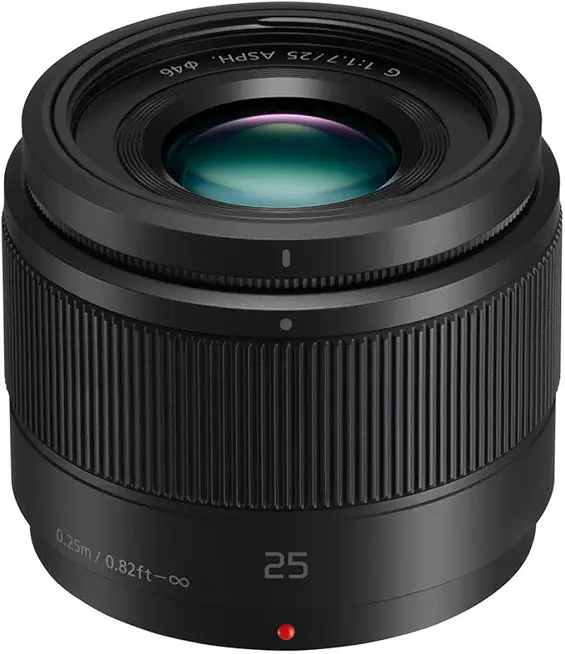
Panasonic Lumix G 25mm F1.7 ASPH Micro Four Thirds
Compact, affordable prime with bright f/1.7 aperture for low-light shooting and shallow depth-of-field. Pocketable design, responsive autofocus and sharp image quality make it a versatile choice for travel, portraits and everyday use.
Check PriceThe Lumix 25mm f/1.7 is the budget friend of the group. I’ve taken it on trips and used it as a light, throw‑in lens when I didn’t want to risk heavier glass. It’s smaller and cheaper than the Olympus, and that matters if you’re on a tight budget or prefer minimal gear. For casual shots and travel photos it does a fine job.
Where it falls short next to the Olympus M.Zuiko 25mm f/1.8 is in refinement. Wide open it’s softer, especially in the corners, and the bokeh isn’t as smooth. The autofocus and build feel are more basic — AF can be a touch noisier and a little less confident in tricky light. On the upside, it’s light, doesn’t draw attention, and you get usable images without spending much.
If you’re a beginner, a student, or a traveler who wants a cheap, small 25mm that still autofocuses, the Lumix G 25/1.7 is a solid pick. If you value slightly better sharpness, smoother bokeh, and a faster/silenter AF for video, you’ll prefer the Olympus instead.
Alternative 3:
Panasonic Lumix G 25mm F1.7 ASPH Micro Four Thirds
Delivers natural colors, pleasing out-of-focus transitions and quick manual focus control in a lightweight package. Close-focusing capability and economical price point make it ideal for vloggers and keen hobbyists.
Check PriceLooking at the Lumix 25/1.7 again from a slightly different angle: I’ve found it gives very natural color straight from the camera without heavy tweaking, which is handy for vloggers and people who want less work in post. The small front element and light weight make it easy to balance on compact Micro Four Thirds bodies for handheld video.
Compared to the Olympus M.Zuiko 25mm f/1.8, the Lumix can be easier to live with if you mainly shoot daylight or run‑and‑gun vlogging. But if you push it in low light or try to get very tight subject separation, the Olympus holds its ground better — it’s sharper wide open and its AF behaves a bit more reliably during quick focus pulls.
Choose this Lumix again if you want the cheapest way into a 25mm normal lens with decent color and easy handling for vlogs and everyday snaps. If you need top‑tier edge‑to‑edge sharpness, quieter AF for video, or a more refined bokeh, the Olympus 25/1.8 (or the Summilux if you want f/1.4) is the stronger choice.
What People Ask Most
How sharp is the OM System 25mm f/1.8?
Very sharp in the center straight from f/1.8, with corners improving noticeably by f/2.8–f/4.
Is the OM System 25mm f/1.8 weather-sealed?
No, this 25mm f/1.8 is not fully weather-sealed; the PRO f/1.2 option is the weather-rated alternative.
Does the OM System 25mm f/1.8 have fast and reliable autofocus?
Yes—autofocus is quick, quiet, and dependable on modern OM System bodies for both stills and video.
What is the 35mm-equivalent focal length of the OM System 25mm f/1.8?
On Micro Four Thirds it’s roughly a 50mm equivalent focal length on full-frame.
How is the bokeh and low-light performance of the OM System 25mm f/1.8?
Bokeh is smooth and pleasing for a 1.8 aperture, and f/1.8 gives very good low-light capability without the size and cost of faster primes.
How does the OM System 25mm f/1.8 compare to other 25mm/50mm-equivalent lenses and is it worth buying?
It’s one of the best value normal primes: compact, sharp and affordable compared with pro-level 1.2 lenses, so it’s worth buying if you want a lightweight, high-quality everyday prime.
Conclusion
The Olympus M.Zuiko Digital 25mm F1.8 Micro Four Thirds disappears in your bag and rarely disappoints on a shoot. In everyday use it delivers crisp, punchy images with pleasant microcontrast that translate well to prints and quick social edits. The fast aperture and near‑silent autofocus make low‑light shooting and run‑and‑gun video feel effortless, and the compact, unobtrusive form factor encourages it to be your go‑to optic.
It isn’t perfect and you should know its limits before you buy. The construction lacks full weather protection, so I avoid exposed downpours and dusty hikes when it’s mounted. And while bokeh is generally smooth, the aperture character can render stopped‑down highlights with a slightly geometric edge, so portrait shooters chasing super‑creamy backgrounds may want something different.
Taken as a whole, this lens is a compelling everyday normal prime that balances image quality, autofocus behavior and portability better than most competitors at its price and size. I recommend it for travel, street, family photographers and hybrid shooters who value discreet handling and reliable performance over extreme specialty features. If you need the absolute best in creamy separation or rugged weatherproofing, there are pricier alternatives to consider, but for practical, always‑carry versatility the Olympus is hard to beat.
Olympus M.Zuiko Digital 25mm F1.8 Micro Four Thirds
Fast f/1.8 aperture delivers creamy bokeh and excellent low-light performance in a compact, lightweight build. Crisp, contrast-rich optics for portraits, street photography, and everyday creative shooting with reliable autofocus.
Check Price



0 Comments