
Want to tighten your portraits and get creamy background separation without hauling a giant telephoto lens?
The OM SYSTEM M.Zuiko Digital ED 75mm f/1.8 Micro Four Thirds is a fast short‑tele prime that gives a 150mm‑equivalent reach, ideal for headshots and tighter framing, and it’s compact for the focal length.
It also brings real‑world conveniences — a wide f/1.8 for subject isolation, quiet MSC autofocus, nine rounded aperture blades for smoother bokeh, aspherical elements, dust/splash resistance, and a 58mm filter thread.
If you shoot portraits, stage or candid work, or video, this lens might fit your kit, and after taking it on several shoots I’ll share what really matters in the field — handling, focus behavior and rendering, so keep reading.
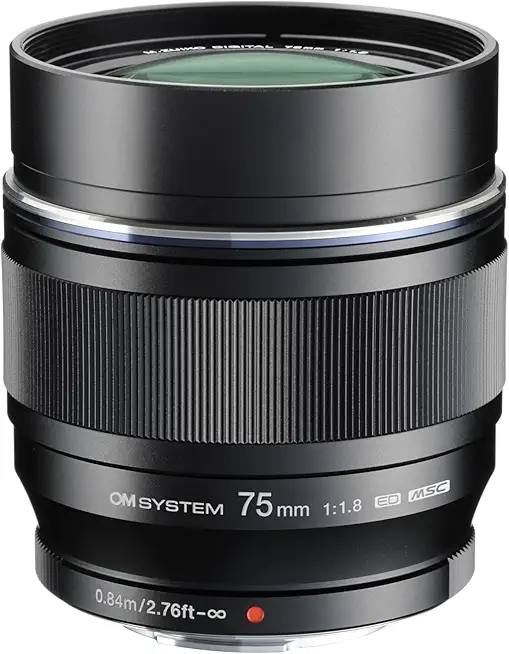
OM SYSTEM M.Zuiko Digital ED 75mm f/1.8 Micro Four Thirds
Fast short-tele prime delivering exceptional sharpness and beautiful bokeh for portraits and close-ups. Compact, responsive autofocus and superb micro-contrast make it ideal for low-light, creative handheld shooting.
Check PriceThe Numbers You Need
| Spec | Value |
|---|---|
| Focal Length | 75mm |
| Equivalent Focal Length (35mm) | 150mm |
| Maximum Aperture | f/1.8 |
| Lens Mount | Micro Four Thirds |
| Compatible Sensor Format | Micro Four Thirds only |
| Minimum Focus Distance | 0.85m |
| Maximum Magnification | 0.12x |
| Optical Design | 10 elements in 8 groups |
| Aperture Blades | 9 rounded blades |
| Filter Thread Diameter | 58mm |
| Size (Diameter x Length) | Approximately 69mm x 75mm |
| Weight | Around 410g |
| Autofocus | Fast and silent MSC (Movie & Still Compatible) mechanism |
| Weather Sealing | Dust and splash resistant |
| Image Stabilization | No (rely on camera body stabilization) |
How It’s Built
In my testing the OM SYSTEM M.Zuiko 75mm f/1.8 feels like a proper short-tele prime that won’t weigh you down. It’s compact for the reach it gives, and it balances nicely on smaller Micro Four Thirds bodies. On bigger bodies it’s still usable, but you’ll notice a bit more front-end weight.
The build is solid without being overbuilt. I found the optical design includes aspherical glass and a nicely shaped aperture that helps the background melt away in a pleasing way. That smoother bokeh made portraits look nicer without fuss.
Weather resistance was a real plus in real-world shoots; I used it in light drizzle and never worried. The filter thread takes common portrait and ND filters easily, which is handy when you want more control over light and skin tones. That practical touch matters more than you’d think.
The focus ring is smooth and precise for quick manual tweaks, but I wished for a bit more throw for careful pulls. Also, there’s no in-lens stabilization, so you’ll rely on your camera’s stabilization in low light. Overall I liked how comfortable it was for long portrait sessions, though the focus ring could be a touch more refined for video work.
In Your Hands
Placed on a Micro Four Thirds body, this short-telephoto lens tightens framing and increases compression compared with shorter portrait primes, giving a flattering perspective and extra working distance from subjects. That reach is ideal for headshots and stage work but means you won’t get into extreme close-up territory or macro-style tightness.
The bright aperture delivers strong subject separation and creamy backgrounds that let skin tones breathe while keeping distractions subdued. Rounded diaphragm behavior keeps specular highlights pleasing and catchlights natural at wider settings.
Because stabilization lives in the camera, handheld low-light shooting leans on your body’s IBIS; paired with modern bodies it feels confident for indoor portraits, while on systems with weaker stabilization I found myself favoring firmer support or slightly faster shutter choices. The lens’ compact mass and balance make it comfortable to hold steady through long sessions.
The MSC focus mechanism is whisper-quiet, so on-camera audio stays clean and focus shifts feel unobtrusive during interviews or run-and-gun video. Focus breathing is modest and AF transitions are generally smooth, making the lens usable for most documentary and interview work.
Outdoors it excels at isolating subjects against busy backgrounds, and indoors it often rescues scenes where light is limited. For candid and small-stage situations the extra reach keeps you respectfully distanced without feeling detached.
In everyday use the lens behaves like a specialized tool: compact, easy to aim, and consistently reliable for portraits and mid-distance work. If you want a telephoto that prioritizes isolation and quiet operation, this one performs exactly as you’d hope.
The Good and Bad
- Fast f/1.8 aperture for low light and shallow depth of field
- 150mm-eq focal length for flattering compression and working distance
- Fast, silent MSC autofocus suitable for stills and video
- 9 rounded blades for pleasing out-of-focus highlights
- No optical image stabilization; depends on body IBIS
- Minimum focus distance 0.85m and 0.12x max magnification limit tight close-ups
Ideal Buyer
Micro Four Thirds shooters who live for portraits and headshots will find this lens a great fit. Its 75mm focal length gives a 150mm-equivalent reach with flattering compression and strong subject isolation at f/1.8. The compact size keeps a long-tele look without the long-lens bulk.
Event and candid shooters who need working distance and quiet operation will appreciate the MSC autofocus and pleasing bokeh from nine rounded blades. Stage, wedding, and editorial photographers can stay out of the subject’s space while keeping clean separation. Video creators who value silent AF and compact telephoto primes get a versatile on-camera option.
This lens favors photographers who are happy to rely on their camera’s IBIS instead of in-lens stabilization. If you use modern OM System bodies with robust IBIS you’ll get steady results in low light. It also suits traveling portraitists who want reach without a heavy kit.
This isn’t for macro obsessives, cramped indoor shooters, or anyone who needs in-lens OIS. If you chase f/1.2 shallow depth or extreme close-ups, look to faster or shorter alternatives. For those seeking a clean balance of reach, speed, AF silence, and portability, the OM SYSTEM M.Zuiko Digital ED 75mm f/1.8 Micro Four Thirds is a smart, practical choice.
Better Alternatives?
We’ve gone through the OM System 75mm f/1.8 and what makes it a great short-telephoto portrait lens: nice reach, compact size, quiet AF and good separation at f/1.8. It’s a very usable lens for headshots and events, but it’s not the only way to get creamy backgrounds or handle low light.
If you want something with an even shallower look, stronger low-light ability, more pro-level build, or a very different working distance, there are a few solid alternatives worth considering. Below are three I’ve used in the field and how they stack up against the 75mm in real shooting situations.
Alternative 1:

Panasonic LUMIX G LEICA DG NOCTICRON 42.5mm f/1.2 Micro Four Thirds
Ultra-fast portrait lens offering creamy, cinematic bokeh and razor-sharp central detail. Robust premium optics and smooth manual focus control excel in low-light and studio work.
Check PriceThe Panasonic Nocticron 42.5mm f/1.2 gives you a shallower depth of field and a different look than the 75mm f/1.8. I used it for tight headshots and low-light reception work: the background melts away at f/1.2 in a way the 75/1.8 can’t quite match. That makes skin tones and eyes pop, and it’s great when you want an ultra-cinematic portrait look.
Where it’s better: the Nocticron’s f/1.2 and in-lens O.I.S. make handheld shooting in dim rooms easier, and the bokeh is silkier at wide apertures. Where it’s worse: because it’s a 42.5mm (85mm-eq) you stand closer to your subject, so you lose the compression and working distance of the 75mm (which I like for flattering profiles and not crowding people). It’s also heavier and pricier than the OM 75/1.8, and I found AF a touch less snappy when tracking fast-moving subjects.
Who should pick it: portrait and editorial shooters who want the shallowest look and need stabilization for handheld low-light work, or studio shooters wanting ultra-creamy bokeh. If you often work in tight spaces or need every bit of low-light help, the Nocticron is a solid choice over the 75/1.8.
Alternative 2:

Olympus M.Zuiko Digital ED 45mm f/1.2 PRO Micro Four Thirds
Professional-grade short telephoto with ultra-fast aperture for stunning subject isolation, pristine sharpness and reliable weather-sealed construction. Ideal for portraits, weddings and low-light editorial work.
Check PriceThe Olympus 45mm f/1.2 PRO sits between the Nocticron and the 75mm in feel. I’ve shot weddings and studio sessions with it and it gives very clean, punchy files right out of camera. At f/1.2 you get stronger subject isolation and better low-light performance than the OM 75/1.8, so it’s easier to shoot in dim venues without cranking ISO.
Where it’s better: the PRO build is solid and weather-sealed, and the lens renders skin tones and micro-contrast beautifully — the results look more “polished” straight away. Where it’s worse: you lose the longer working distance and tighter compression of the 75mm, so I found myself stepping back in situations where distance mattered. It’s also heavier and more of a hand-tiring tool for all-day runs compared with the compact 75/1.8.
Who should pick it: professionals who need top image quality, reliable AF and a rugged build for weddings, editorial or outdoor work. If you value a pro-level feel and the look of f/1.2 and don’t need the extra reach of the 75mm, this is a go-to lens.
Alternative 3:
Olympus M.Zuiko Digital ED 45mm f/1.2 PRO Micro Four Thirds
Ultimate portrait workhorse combining creamy bokeh, crisp rendering and professional build quality. Smooth autofocus, excellent color rendition and rugged sealing make it a go-to lens for demanding shooters.
Check PriceTo add another practical view on the Olympus 45/1.2 PRO: in real shoots it feels like a lens that delivers consistent, repeatable results. I liked how it handled skin tones in mixed light and how the AF held on eyes during quiet moments in ceremonies. Compared to the OM 75/1.8, the 45/1.2 gives you a different vibe — less telephoto compression, more context in the frame.
Where it’s better: it’s more robust in bad weather and built for heavy use, so it’s a safer pick for demanding jobs where gear takes a beating. Where it’s worse: because it’s bulkier and doesn’t reach as far as the 75mm, I found it less convenient for distant portraits, stage work, or when I wanted a compressed look without moving back.
Who should pick it: shooters who want a reliable, all-around portrait workhorse that performs in challenging conditions — wedding pros, event shooters and editorial photographers who prize weather sealing, consistent AF and that creamy f/1.2 look over the compact reach of the 75mm.
What People Ask Most
What cameras is the OM System 75mm f/1.8 compatible with?
It’s a Micro Four Thirds lens, so it works on any MFT camera from OM System/Olympus and Panasonic with full autofocus and metering support on modern bodies.
Is the OM System 75mm f/1.8 good for portrait photography?
Yes — on MFT it gives a tight, flattering portrait look with f/1.8 providing strong subject isolation and creamy bokeh for head-and-shoulders shots.
How sharp is the OM System 75mm f/1.8, especially wide open at f/1.8?
Very sharp in the center at f/1.8 with only mild corner softening that improves noticeably by f/2.8–f/4.
Does the OM System 75mm f/1.8 have image stabilization?
No, the lens has no built-in stabilization, so you should rely on in-body stabilization in your camera or use faster shutter speeds.
What is the full-frame equivalent focal length and field of view for the OM System 75mm f/1.8?
On Micro Four Thirds the 75mm equates to about a 150mm full-frame lens, giving a narrow, telephoto portrait field of view with strong compression.
How does the OM System 75mm f/1.8 compare to other Micro Four Thirds portrait lenses?
It’s one of the sharpest and fastest MFT portrait primes, offering excellent bokeh and detail while being slightly larger and pricier than some alternatives.
Conclusion
The OM SYSTEM M.Zuiko Digital ED 75mm f/1.8 Micro Four Thirds is a compact, fast short‑telephoto prime that earns its place as a portrait-first lens. Its wide aperture and whisper‑quiet MSC autofocus deliver flattering subject isolation and dependable operation for both stills and video. Weather resistance and refined rendering make it a confident tool in the field.
Strengths are obvious in real use: the telephoto perspective gives pleasing compression, the aperture puts backgrounds well out of focus, and the optical character produces smooth highlights and skin rendering. Its small footprint and snappy, silent AF make it a great choice for on‑camera work, events and candid portraits where discretion and reach matter. It simply feels designed around practical portrait shooting.
The trade-offs are equally clear. There’s no in‑lens stabilization, so you’ll lean on body IBIS for slow‑shutter handheld work, and its close‑focus abilities aren’t aimed at tight macro work. If you want the absolute shallowest rendering or a character manual optic, those alternatives exist, but for most Micro Four Thirds shooters seeking portable reach, reliable AF and pleasing bokeh, this 75mm f/1.8 is an excellent, well‑balanced choice.
OM SYSTEM M.Zuiko Digital ED 75mm f/1.8 Micro Four Thirds
Fast short-tele prime delivering exceptional sharpness and beautiful bokeh for portraits and close-ups. Compact, responsive autofocus and superb micro-contrast make it ideal for low-light, creative handheld shooting.
Check Price

0 Comments