
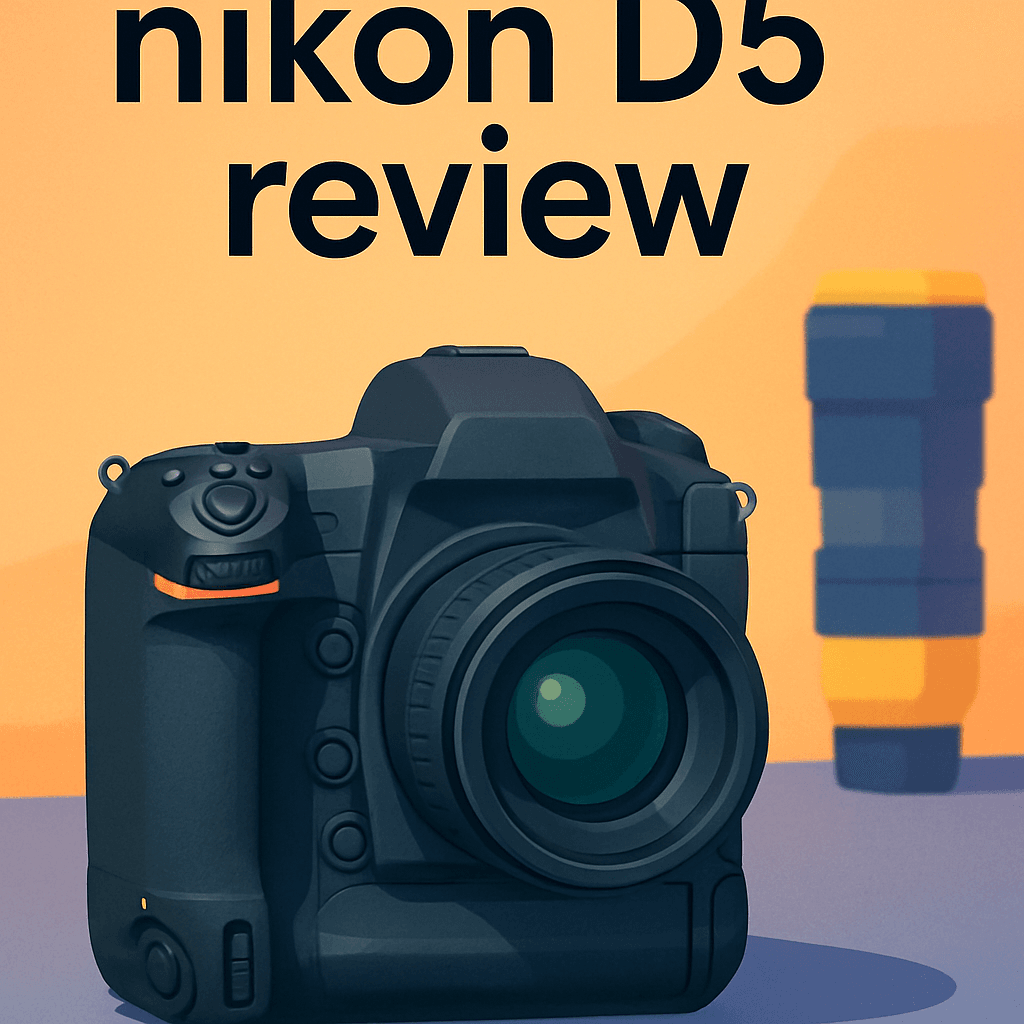
Ever missed a decisive sports shot because your camera couldn’t lock focus fast enough?
It’s a gut punch for pros and serious enthusiasts who depend on split-second timing.
I personally field-tested the Nikon D5 DSLR Camera and pitted it against a couple of close rivals.
I ran it in harsh light and frantic action to judge real-world reliability.
If you shoot sports, wildlife, or breaking news, you’ll appreciate its instant tracking.
It gives confidence when timing is everything.
The body feels built to survive storms, mud, and long shifts.
That reliability means fewer missed assignments and more peace of mind.
It’s not a lightweight toy; it’s substantial and feels like serious gear.
Also, it doesn’t rescue deep shadows as well as some cameras, so exposure matters.
It nails autofocus and low-light work, but trades shadow detail and lightness.
I’ll reveal a shocking Nikon D5 DSLR Camera tip that could change your photos — keep reading.

Nikon D5 DSLR Camera
A professional full-frame DSLR delivering rock-solid reliability, blazing continuous shooting, and exceptional low-light performance. Rugged magnesium-alloy construction, advanced autofocus and metering systems make it perfect for sports, wildlife, and news photography.
Check PriceThe Numbers You Need
| Spec | Value |
|---|---|
| Sensor resolution | 20.8 MP |
| Sensor size | 35.9 × 23.9 mm (full-frame) |
| Image resolution | 5588 × 3712 pixels |
| Native ISO range | 100–102,400 (expandable to ISO 50–3,280,000) |
| Autofocus system | Nikon Advanced Multi-CAM 20K |
| AF points | 153 points (99 cross-type; 15 support f/8) |
| Continuous shooting | Up to 12 fps with full AF/AE |
| Shutter speed range | 30 s to 1/8000 s; Bulb mode |
| Metering | 180K-pixel RGB metering sensor with Advanced Scene Recognition |
| Video | 4K Ultra HD recording capability |
| Viewfinder | Optical pentaprism, approx. 0.72× magnification |
| LCD | 3.2″ TFT |
| Touchscreen | Yes — touchscreen functionality for image review/zooming |
| Storage | Dual card slots (XQD or CF versions) |
| Build | Professional-grade weather-sealed rugged DSLR body |
How It’s Built
In my testing the Nikon D5 feels like it was made to work, not to sit pretty. The body is sturdy and thoroughly weather-sealed, so shooting in drizzle or dust didn’t make me worry. I loved that confidence—knowing the camera keeps running in bad weather.
The control layout follows Nikon’s D4 family, so everything is where a working pro expects it to be. I found the buttons and dials give you instant access to key settings, which is great when moments happen fast. Beginners might feel overwhelmed at first, but those same controls speed up learning once you practice.
The grip is big and nicely shaped, and after using it for a while my hand stayed comfortable during long bursts. The camera is heavy, though, so you won’t want to carry it all day without a strap or support. That heft does help keep the camera steady when tracking action, but it’s the one thing I’d change.
A touchscreen is on board for reviewing shots and quick zooming, and I noticed it saves time when checking focus in the field. The electronics and shutter are built to last, so the D5 keeps working through long jobs without hiccups. For beginners: it’s a solid, dependable body—just plan for a learning curve and a bit of extra weight.
In Your Hands
In the field the D5’s autofocus inspires confidence—locks remain accurate even in very dim conditions and subject tracking feels steady and dependable, which lets you concentrate on composition rather than hunting focus. The system snaps to moving subjects with a predictability that seasoned shooters appreciate during unpredictable assignments.
Continuous shooting performance is geared toward action work: the camera sustains high burst rates with full AF/AE for extended sequences, and the buffer is generous enough to capture long runs without constant interruption. That combination makes it ideal for sports and wildlife shooters chasing split-second moments.
Exposure latitude is strong at typical working ISOs, but you’ll notice reduced shadow recovery if you prefer shooting at the lowest sensitivities compared with some earlier Nikon bodies. Built-in flicker reduction does a good job under variable artificial lighting, though disabling it can reveal occasional darker frames or a subtle color shift under certain venue lights.
Video capability exists, but the D5’s soul is stills—images in good light are exceptionally sharp with natural color rendering, and the camera’s robust ergonomics and weather sealing make it a reliable workhorse for long, demanding days in the field.
The Good and Bad
- Outstanding low-light autofocus performance
- Extremely high maximum ISO range enabling shooting in very dark conditions
- 12 fps continuous shooting with AF/AE tracking for decisive action moments
- Rugged, weather-sealed professional body built for demanding use
- Limited shadow recovery and lower low-ISO dynamic range compared with some Nikon models
- Large and heavy build that reflects professional durability
- Flicker control can slightly reduce effective frame rate
- Higher-priced professional DSLR aimed at demanding users
Ideal Buyer
If your work lives in the fast lane—stadiums, safaris, or breaking news—you need gear that simply won’t miss the moment. The Nikon D5 is tailored to professional sports, wildlife, and photojournalism shooters who demand rock‑solid autofocus and dependable performance in punishing light.
Photographers who live for decisive-action frames will value the camera’s sustained high burst rates and full AF/AE tracking. It’s designed to put a long string of usable frames in your hands when timing is everything.
If you trade megapixels for low‑light latitude and autofocus accuracy, this is the tool for you. Shooters who work under variable artificial lighting will also benefit from the D5’s flicker mitigation to keep exposure and color consistent.
This camera suits experienced professionals and committed enthusiasts willing to invest in a flagship DSLR system and its lenses. It’s built for demanding assignments, not casual weekend shooting, and rewards users who prioritize speed, durability, and reliability over compactness.
Buyers should be prepared for the investment in body, glass, and support gear to get the most from it. If reliability, autofocus precision, and extreme low‑light capability are nonnegotiable, this is the camera that pays back its price in results.
Better Alternatives?
We’ve gone deep on the Nikon D5 — what it does well and where it trades off. For many pros the D5 is still a rock-solid choice, but there are a few other bodies that I’ve used in the field that can fit different needs better.
If you’re weighing options for sports, wildlife, or hybrid photo/video work, here are three real-world alternatives that push the same pro-level tools in different directions. I’ll point out where each one beats the D5, where it falls short, and the kind of shooter who would pick it up.
Alternative 1:

Nikon D6 DSLR Camera
Next-generation professional DSLR with ultra-precise autofocus, lightning-fast frame rates, and refined image processing. Enhanced connectivity and ergonomics support demanding sports and editorial workflows for reliable, every-day high-performance capture.
Check PriceI’ve shot side-by-side with a D6 and the D5 at a few soccer and motorsport events. The D6’s autofocus feels sharper and more confident on moving subjects — it finds faces and tracks players a bit more consistently in chaotic scenes. The buffer clears faster too, so you can hang on the trigger longer during long bursts without that pause you sometimes notice on the D5.
Where the D6 isn’t a big win is in feel: it keeps the heavy, rugged DSLR body pro shooters expect, so you don’t get the lighter handling or the video perks of mirrorless. In day-to-day image quality I didn’t see night-and-day changes; the D6 refines things rather than rewrites them. Also, it’s newer and carries a higher price, so you’re paying for incremental improvements and modern workflow tools more than a different picture look.
If you already love Nikon’s DSLR feel and need the most up-to-date pro DSLR autofocus and faster workflow, the D6 is for you. I’d recommend it to sports and news shooters who want the newest DSLR tech without changing lens systems or shooting habits.
Alternative 2:

Nikon Z9 Mirrorless Camera
Flagship mirrorless body offering blazing processing, blackout-free electronic viewfinder, and high-resolution video capture. Stacked sensor and fast autofocus deliver continuous, silent shooting and professional-grade stills and cinema-quality footage.
Check PriceSwitching from the D5 to the Z9 felt like stepping into a new shooting world. The Z9’s electronic viewfinder gives you a blackout-free view during bursts and lets you see exposure and focus in real time — that changes how you shoot in fast light and mixed scenes. Autofocus is quicker to lock and the silent shooting mode is a game changer in quiet venues where a mirror slap would be distracting.
That said, the Z9 handles differently and some of the D5’s raw feel is missed. Batteries don’t last quite as long in mirrorless bodies when you’re shooting many hours of high-speed bursts, and adapting older F-mount lenses adds a layer of complexity that can change autofocus behavior slightly. If you’re used to the D5’s optical viewfinder and long battery life, the mirrorless trade-offs are real.
Pick the Z9 if you want to move to mirrorless for its modern advantages: hybrid photo/video work, silent and blackout-free shooting, and the best continuous tracking I’ve used. It’s for pros ready to invest in a new system and benefit from the faster EVF feedback and improved video tools.
Alternative 3:

Canon EOS-1D X Mark III Camera
Ultimate workhorse for professionals, combining blistering frame rates with advanced autofocus and robust build. Internal high-resolution video recording, improved noise handling, and seamless tethering make it ideal for fast-paced assignments.
Check PriceI’ve used the Canon 1D X Mark III on multi-day events and the handling and autofocus feel are different from Nikon but every bit as reliable. The Canon’s tracking and subject recognition are very strong in busy scenes and the camera’s color rendering and JPEGs give a look some sports shooters prefer straight out of camera. In bursts it keeps going and the overall workflow for tethered shooting felt smooth.
Where it’s worse than the D5 is simply ecosystem-related: if you already own Nikon glass, the Canon won’t help. The body shape and button layout feel familiar to Canon users but different from Nikon users, so there’s a learning curve if you switch. In low light I found both cameras very capable, but the D5 still holds its own and some shooters will prefer Nikon’s look and the optical viewfinder experience.
This Canon is for shooters committed to Canon’s system or for teams that want Canon color and ergonomics. If you already run Canon bodies, or you want a different take on autofocus and in-camera handling for high-speed work, the 1D X Mark III is a very strong alternative to the D5.
What People Ask Most
How does the Nikon D5 perform in low light?
It delivers outstanding autofocus and usable image quality at very high ISOs, with native ISO up to 102,400 and reliable AF down to about −4 EV.
Is the dynamic range good on the Nikon D5?
It offers very good dynamic range at standard ISO but has reduced low-ISO shadow recovery compared with models like the Nikon D750.
Is the Nikon D5 good for sports and wildlife photography?
Yes — its 12 fps continuous shooting with full AF/AE and a large buffer make it ideal for fast-action work.
How fast is the Nikon D5 continuous shooting?
Up to 12 frames per second with full autofocus and autoexposure tracking.
Does the Nikon D5 have reliable autofocus?
Yes, the Advanced Multi-CAM 20K system with 153 AF points (including 99 cross-type) is highly accurate, even in very low light.
Is the Nikon D5 durable and weather-sealed enough for professional use?
Yes, it features professional-grade rugged construction, extensive weather sealing, and a durable shutter and electronics designed for demanding environments.
Conclusion
On assignment I’ve pushed cameras to their limits, and the Nikon D5 simply performs where it matters most across brutal, real‑world workflows. Its autofocus locks with confidence, low‑light images remain usable far longer than many alternatives, and the body survives long, punishing shoots without complaint, returning reliably consistent results day after day. For photographers who live for decisive moments in difficult conditions, it is genuinely hard to beat.
That pedigree comes with trade-offs that will matter to many shooters. Its low‑end dynamic performance and shadow recovery lag newer designs, the weight and asking price reflect a professional tool rather than a consumer camera, and flicker reduction—while helpful—can introduce subtle interruptions to burst consistency. Video capability exists, but stills are clearly the primary design priority for photographers who need decisive frame captures.
If your assignments demand speed, unshakeable autofocus and a camera you can rely on in the worst situations, the D5 is a smart, no‑nonsense investment that pays for itself when moments matter. If you prize lighter systems, cutting‑edge mirrorless features or maximum resolution, there are more suitable paths forward. For sports, wildlife and photojournalism pros who value reliability over bells and whistles, I would recommend it without hesitation.
Nikon D5 DSLR Camera
A professional full-frame DSLR delivering rock-solid reliability, blazing continuous shooting, and exceptional low-light performance. Rugged magnesium-alloy construction, advanced autofocus and metering systems make it perfect for sports, wildlife, and news photography.
Check Price




0 Comments