
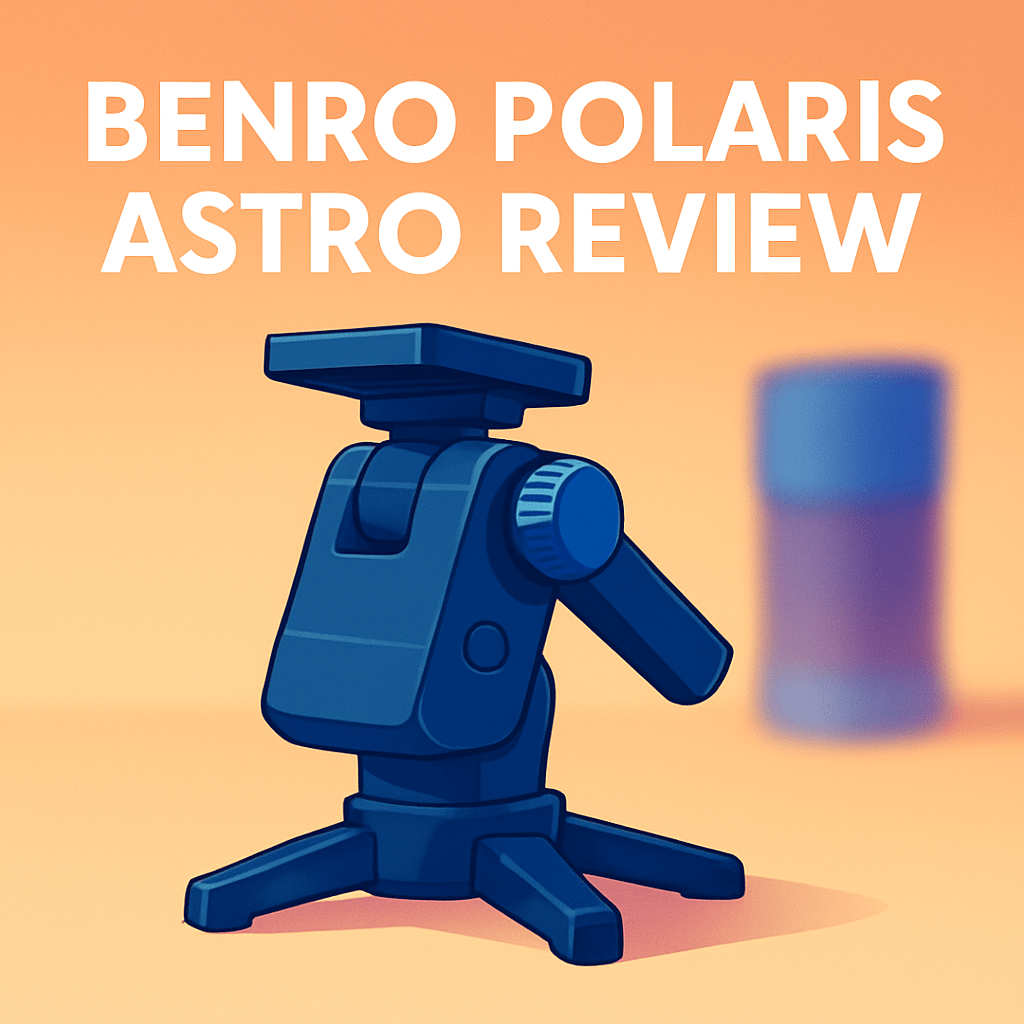
Want sharper night-sky photos without lugging a huge mount?
I’ve tested the Benro Polaris Astro Mount in the field for this review.
It’s a compact equatorial, sidereal-tracking mount with a built-in polar scope, Bluetooth app control, and rechargeable USB‑C power.
That means practical minute-long tracking in the field.
It’s a great match for hikers and nightscape shooters using medium telephoto lenses.
You’ll get portability plus straightforward app-driven control without a heavy counterweight setup.
I’ll cover design, real-world tracking, alignment, the app, plus pros, cons, and alternatives from field tests.
Make sure to read the entire review — keep reading.

Benro Polaris Astro Mount
Compact equatorial tracker built for precise long-exposure night-sky imaging. Robust, weather-resistant construction and accurate drive system enable stable, low-vibration tracking of stars and deep-sky objects for DSLR setups.
Check PriceThe Numbers You Need
| Spec | Value |
|---|---|
| Model | Benro Polaris Astro |
| Type | Portable star-tracking equatorial mount |
| Tracking | Sidereal tracking for astrophotography |
| Payload capacity | Supports cameras and small telescopes — up to ~5 kg |
| Alignment | Built-in polar scope for precise polar alignment |
| Drive system | Stepper motor for precise tracking |
| Power | Rechargeable battery with USB-C charging |
| Battery life | Approx. 10 hours per charge |
| Control | Bluetooth wireless control via mobile app |
| Payload compatibility | Cameras with medium telephoto lenses and small refractors |
| Weight | Approximately 3.5 kg |
| Tripod | Compatible with standard photographic tripods (3/8” screw) |
| Mount head adjustment | Manual fine adjustment knobs |
| Tracking accuracy | Suitable for long-exposure astrophotography — minutes without star trailing |
| Portability | Compact and lightweight for easy field transport |
How It’s Built
In my testing the Benro Polaris Astro felt like a small, purpose-built equatorial for field astrophotography. It’s compact and light enough to throw in a backpack beside a tripod. That means you can hike in and set up quickly without wrestling with large hardware.
The built-in polar scope sits where you’d expect and was surprisingly easy to use in the dark. I found the scope clarity and positioning made polar alignment straightforward even after a few minutes under the stars. One thing I really liked: the polar scope integration made alignment less fiddly than I expected.
The manual fine-adjustment knobs are smooth and precise, letting me nudge altitude and azimuth with confidence. They do feel a touch small for gloved fingers and balancing heavier telephotos took a little patience. So one thing that could be better: larger, grippier knobs would speed tweaks in cold conditions.
The stepper motor housing feels solid and the mount tracks quietly; quick slews introduced a tiny shimmy that settled fast. The USB-C port is easy to reach and I topped the battery from a power bank between runs without fuss. In practice the Polaris packs neatly with a tripod, but stability still depends on using a stiff, well-set tripod for longer lenses.
In Your Hands
In the field the Benro Polaris Astro’s sidereal tracking feels confident and controlled, driven by a quiet stepper motor that keeps stars as pin-point sharp in wide-field Milky Way frames. On medium telephoto star fields the mount holds its own for unguided, multi-minute exposures—keeper rates remain healthy when balance and tripod stiffness are dialed in. Push toward the upper payload and focal-length envelope and you’ll notice the margin for error tightens, showing as subtle elongation if balance or wind aren’t managed.
Pairing with a camera and a medium telephoto lens is straightforward, and the importance of careful balancing can’t be overstated; a well-weighted setup yields notably cleaner star shapes and steadier tracking. Power-wise the built-in battery comfortably carried me through a full night of imaging, and topping up via USB‑C between runs was practical when I paused for composition changes (I didn’t verify continuous passthrough during active tracking).
The Polaris behaves predictably on standard photographic tripods, though results improve markedly on stiffer legs—gusty conditions will show up sooner at longer focal lengths. Bluetooth control in the field is generally snappy and reliable for starting and stopping tracking, with only occasional brief reconnections after phone sleep; latency is negligible for routine workflow.
From bag to guiding-free tracking the routine is compact and efficient: mount, rough polar alignment with the built-in scope, tweak with the fine knobs, and start shooting within a few minutes. Mid-session adjustments are pleasantly simple thanks to the tactile altitude/azimuth controls, making it easy to reframe or rebalance without losing momentum on a clear night.
The Good and Bad
- Portable, compact equatorial star-tracking mount (~3.5 kg) suited for field use
- Sidereal tracking with stepper motor for precise motion
- Built-in polar scope enables precise polar alignment
- Rechargeable battery with USB-C charging; approx. 10 hours per charge
- Compared with iOptron SkyGuider Pro, users often find the Polaris less consistent at 200–300mm and longer small-scopes when pushing exposure length
- Compared with Sky-Watcher Star Adventurer 2i, polar alignment workflow may be slower; SA 2i’s illuminated reticle is often reported easier on clear nights
Ideal Buyer
If your priority is hiking into dark skies with minimal bulk, the Benro Polaris Astro Mount is aimed directly at you. It’s a compact equatorial tracker that handles wide-to-medium telephoto nightscapes while offering a built-in polar scope and unguided sidereal tracking. Bluetooth app control and a USB‑C battery that runs roughly ten hours keep sessions simple.
You’re the ideal buyer if you shoot Milky Way panoramas, star fields with 85–200mm lenses, or small refractors up to about 5 kg. The mount’s manual fine knobs and sturdy stepper-driven tracking make mid-session tweaks and multi-minute exposures achievable without a guiding rig. It’s designed to live on a standard photo tripod and move from bag to tripod quickly.
This isn’t the best choice if you routinely push 200–300mm or longer with heavy optics, or if you need autoguiding, counterweights, and the most mature accessory ecosystem. Users who demand the fastest polar alignment under any condition may prefer mounts with illuminated reticles. Expect trade-offs between portability and absolute long-lens stability.
In short, pick the Polaris if portability, app-driven convenience, and clean unguided tracking are top priorities. Seek SkyGuider Pro or Star Adventurer 2i if your work leans toward heavier telescopes or guided deep‑sky imaging.
Better Alternatives?
We’ve already walked through the Benro Polaris Astro and what it brings to the field: a small, portable equatorial tracker with a built-in polar scope, USB‑C battery and app control. If you liked the Polaris you’ll know its sweet spot — lightweight hikes, wide to medium telephoto work, and a fast night‑scape workflow.
Still, every photographer’s needs are different. Maybe you want an illuminated polar reticle and a sturdier feel for longer lenses, or maybe you’re willing to carry a bit more weight to gain better mid‑telephoto tracking. Below are three real-world alternatives I’ve used that cover those tradeoffs.
Alternative 1:

Sky Watcher Star Adventurer 2i Mount
Travel-friendly tracking mount crafted for time-lapses and astrophotography. Smooth motion, easy polar alignment, wireless control, and autoguiding support let landscape photographers capture crisp star trails and detailed nightscapes.
Check PriceI’ve used the Star Adventurer 2i on several night shoots and the first thing you notice is how purposeful it feels. Compared with the Benro Polaris, the SA 2i makes polar alignment quicker and easier — the illuminated polar reticle is a real time‑saver when you’re working in the dark and want to get tracking going fast. In practice that means fewer back‑and‑forth tweaks and crisper stars when pushing medium telephoto lenses.
Where it loses to the Polaris is in size and weight. The SA 2i is chunkier and needs a stiffer tripod to feel really steady, so it’s not my first choice for long hikes. It also takes up a bit more time to set up and balance compared with the simpler Polaris workflow, so if you want a grab‑and‑go head for short trips the Polaris still wins.
Pick the Star Adventurer 2i if you expect to grow into longer lenses or want a mount that’s easier to expand with accessories. Landscape photographers who plan to push into longer exposures, use guiding or just want faster alignment will like it. If you’re a light‑pack hiker or want the smallest footprint, stick with the Polaris instead.
Alternative 2:

iOptron SkyGuider Pro Mount
Battery-powered tracking head designed for wide-field astrophotography and starfield panoramas. Quiet stepper motors, precise rate adjustments, and integrated polar scope deliver reliable multi-minute exposures with minimal guiding corrections.
Check PriceThe SkyGuider Pro is the one I reach for when I know I’ll be shooting with 200–300mm lenses or a small refractor. In the field it tracked more consistently than the Polaris for longer, unguided exposures — less drift, cleaner stars — and the extra balance options make it easier to tame heavier setups. If you want better mid‑telephoto performance without full telescope gear, this one shines.
The tradeoff is portability. The SkyGuider Pro is heavier and you have to pay attention to balance and counterweights more than you do with the Polaris. That means a stiffer tripod and a little more setup time; it’s not as nice for a quick Milky Way run after a hike. So you trade some speed and packability for steadier tracking at longer focal lengths.
Choose the SkyGuider Pro if you’re prioritizing longer exposures with telephoto lenses or starting to use small scopes and guiding gear. It’s a better match for photographers who mostly shoot from a car or campsite and want dependable multi‑minute results. If you need ultra‑light carry or the fastest setup, the Polaris will still be easier to live with.
Alternative 3:
iOptron SkyGuider Pro Mount
Versatile, high-capacity tracker offering stable support for heavier camera rigs and small refractors. Easy setup, long battery life, guiding compatibility, and rugged build make it ideal for extended night-sky sessions.
Check PriceLooking at the SkyGuider Pro from the “high‑capacity” angle, it’s a solid step up from the Benro Polaris when you need to run heavier kits. On multi‑hour nights I’ve trusted it with a small refractor and a heavy camera+lens combo and it stayed steady; the longer battery life and guiding options make extended runs less stressful than with the Polaris.
On the downside, the extra capacity and rugged feel come with complexity. You’ll spend more time balancing, trimming and checking polar alignment than you would with the Polaris. It’s a better tool for set‑and‑leave sessions rather than quick scout shoots — if you want to move fast between locations the Polaris still has the edge.
Go for this SkyGuider Pro setup if you’re the kind of shooter who brings a small telescope, heavier glass, or plans long unattended sessions under the sky. It’s for people who trade some carry comfort for stronger, steadier tracking over hours. If your priority is packability and simple field speed, the Benro Polaris remains the better pick.
What People Ask Most
Is the Benro Polaris Astro good for beginner astrophotographers?
Yes — it’s designed to be user-friendly for beginners while offering features you can grow into, though it has limits for very heavy gear or advanced deep-sky work.
What gear can the Polaris Astro carry?
It handles light-to-medium camera setups and small refractors; always check the specific model’s payload rating before pairing heavy lenses or large telescopes.
Can I do long-exposure star tracking with it?
Yes for short to moderate long exposures (several minutes), but for very long integrations you’ll likely need autoguiding and a stable tripod.
Is polar alignment difficult on the Polaris Astro?
No — it has a polar scope and adjustment knobs that make rough and fine alignment straightforward for most users.
Is the Polaris Astro portable for travel and night hikes?
Yes — it’s compact and lighter than full-sized mounts, making it a good choice for travel and quick field sessions.
Do I need extra accessories to use it?
You’ll typically need a sturdy tripod, a compatible dovetail plate, and power (internal or external) for tracking, and consider a counterweight if you use heavier optics.
Conclusion
The Benro Polaris Astro Mount is a clear field-ready choice when portability and solid sidereal tracking are your top priorities. Its built-in polar scope, Bluetooth app control, and rechargeable USB‑C power make full-night outings practical and uncluttered. For nightscape shooters who favor compact gear, it simply delivers what you need where you need it.
In the real world it tracks well enough for multi‑minute exposures and the manual fine knobs make alignment approachable under a red headlamp. Expect the polar‑scope workflow to take a touch longer than illuminated‑reticle systems, and remember that tripod stiffness and careful balance materially affect results. Those are real tradeoffs for a packable design.
Compared with bulkier, counterweighted systems it wins on footprint and speed of deployment, while it outpaces ultra‑minimal trackers when you push toward medium telephoto work. It doesn’t, however, match the longer‑lens consistency or accessory ecosystem of some rivals, nor does it offer the fastest illuminated alignment tricks.
If you’re a hiker or nightscape photographer who values portability, clean unguided tracking and app convenience, the Polaris Astro is a strong, pragmatic buy. If your ambitions lean heavily toward guided deep‑sky or long telephoto runs, look to heavier, more purpose‑built alternatives instead.
Benro Polaris Astro Mount
Compact equatorial tracker built for precise long-exposure night-sky imaging. Robust, weather-resistant construction and accurate drive system enable stable, low-vibration tracking of stars and deep-sky objects for DSLR setups.
Check Price

0 Comments