
Looking for the best camera for a high school photography class?
Whether you’re a teacher building a lab or a student shopping for a first dedicated camera, the choice matters. Great images can boost student confidence and strengthen portfolios.
This guide pares down the options to five student-friendly cameras that balance ease of use, durability, and image quality. We also walk through buying advice, simple lighting techniques, and a FAQ section to answer classroom concerns.
You’ll find plain-language explanations of features that actually matter in schoolwork—handling, battery life, autofocus reliability, and stabilization. We avoid jargon and focus on what helps students capture better photos during projects and events.
Some cameras favor long battery life and a rugged build for field trips. Others prioritize compact size and video capabilities for multimedia assignments.
We also include starter lighting tips that work with natural light and simple reflectors so students can shape mood. Those exercises are designed for classroom time and limited budgets.
By the end you’ll have a short, sensible shortlist and confidence to pick a camera that fits budget and curriculum. Flip the page and let’s find the best match for your class. Let’s get started.
1. Canon EOS Rebel T8i 850D

Canon EOS 850D (Rebel T8i) DSLR with 18-55mm, 75-300mm III & 420-800mm lenses
Complete photography kit covering wide to extreme telephoto ranges, high-resolution sensor, responsive autofocus and intuitive controls—ideal for beginners expanding into wildlife and portrait work.
Check PriceThe Canon EOS Rebel T8i (850D) is a solid all-rounder for high school photography classes. Its 24.1MP APS-C CMOS sensor delivers sharp, detailed images with vibrant color — ideal for yearbook prints and classroom projects.
Autofocus is a real classroom asset: Canon’s Dual Pixel AF with face and eye detection makes it easy to capture candid portraits and moving subjects during sports or events. Students spend less time missing moments and more time learning composition and exposure.
Video options are useful for assignments — the camera offers 4K recording and Full HD at 120fps for slow motion. Be aware the 4K mode is heavily cropped and doesn’t support autofocus, so plan framing carefully for video work.
Ergonomics and usability matter for beginners, and the T8i delivers with a comfortable grip, intuitive controls, and guided menus that help students transition from auto to manual modes. That guided interface shortens the learning curve without sacrificing creative control.
Battery life is another practical benefit: you can expect roughly ≈800 shots per charge when using the optical viewfinder, which cuts down interruptions during long shoots or outdoor classes. The lack of in-body image stabilization (IBIS) is a limitation, so for low-light handheld shooting or steady video consider using a tripod or stable support.
Overall, the T8i is a dependable classroom camera that balances image quality, autofocus performance, user-friendly controls, and endurance — making it a strong choice if you want a camera that helps students actually take photos instead of fussing with settings.
- 24.1MP APS-C — sharp, detailed stills
- Canon Dual Pixel AF with face/eye detection
- Versatile video options: 4K and Full HD 120fps
- Excellent battery life — ≈800 shots per charge
- 4K heavily cropped; no AF in 4K
- No in-body image stabilization (IBIS)
2. Sony Alpha a5100

Sony a5100 with 16-50mm lens
Compact mirrorless camera with fast hybrid autofocus, flip-up touchscreen, and versatile compact zoom—perfect for travel, vlogging, and everyday shooting.
Check PriceThe Sony Alpha a5100 brings a lot to a high school photography class in a tiny package. Its 24.3MP APS-C Exmor CMOS sensor paired with the BIONZ X processor delivers sharp, well-exposed images and good dynamic range, which means prints and yearbook shots retain detail and color without needing heavy edits.
Physically it’s a compact, lightweight mirrorless body that’s easy to carry around campus and fits smaller hands comfortably. That portability makes it ideal for field assignments, photo walks, and students who don’t want something bulky hanging off their shoulder all day.
Autofocus is fast and accurate, and the face detection is particularly useful for class portraits and candid shots — students capture people reliably even when subjects are moving. Paired with the kit Sony E PZ 16-50mm f/3.5-5.6 OSS, the power zoom is classroom-friendly for quick framing and the Optical SteadyShot (OSS) helps reduce handheld blur during low-light or slower shutter situations.
Workspace-wise, the a5100 lets students focus on composition and learning exposure rather than wrestling with heavy gear. The combination of a strong sensor and lens-based stabilization provides forgiving performance for beginners learning to handhold in hallways, classrooms, and outdoor shoots.
Do note this is an older model, so it lacks some modern conveniences such as advanced touchscreen functionality. If your class needs the latest touch-driven menus or video features, that could be a drawback — but for straightforward still photography education, it remains a very practical, student-friendly option.
- Pocketable
- Good AF
- Lens-based stabilization
- Strong sensor performance
- Older model with some dated features
- Lacks advanced touchscreen functionality
3. Fujifilm X-T50 Mid 2026
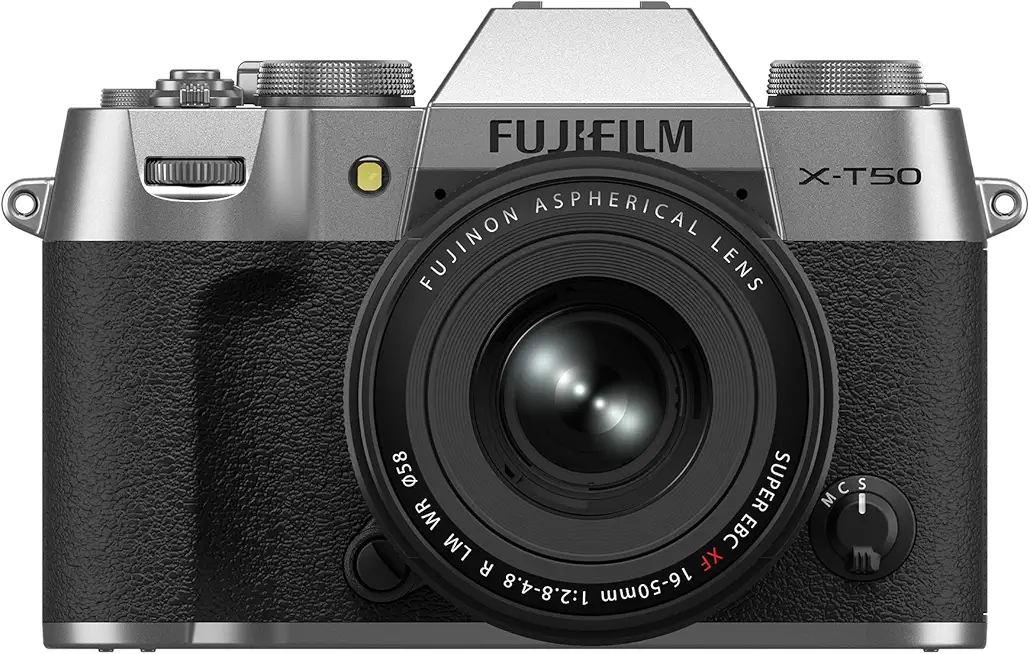
Fujifilm X-T50 with XF 16-50mm f/2.8-4.8 R LM WR lens
Retro-styled mirrorless delivering rich colors, advanced film simulations, rapid autofocus and weather-resistant zoom—crafted for creative photographers seeking portable performance.
Check PriceThe Fujifilm X-T50 (released mid-2026) brings a lot to a high school photography classroom. Its 40.2MP APS-C X-Trans CMOS 5 HR sensor delivers very high resolution and excellent color rendition, so prints and yearbook shots will look crisp and vibrant.
It also features Film Simulations that let students experiment with creative looks straight out of camera. Those presets are a great way to teach color theory without getting lost in post-processing.
Stabilization is a standout: the X-T50 has 7-stop in-body image stabilization (IBIS), which makes handheld shooting in classrooms and low light much more forgiving. Combined with a compact, light body and retro styling, it’s easy for teens to carry and comfortable to handle.
Video is strong too, with capable 4K performance for multimedia projects and short films. The tactile control dials are satisfying to use and encourage learning manual exposure — a real plus when teaching fundamentals.
There are a couple things to watch: there’s no weather sealing, so you’ll want to be careful on rainy field trips. And absolute beginners may find a slight learning curve, though that same complexity makes it a camera students can grow into.
- 40.2MP sensor — superb detail and color
- 7-stop IBIS — steady handheld shots
- Strong 4K video — great for projects
- Retro, tactile controls; compact, light body
- No weather sealing
- Slight learning curve for absolute beginners
4. Nikon D3500 DSLR

Nikon D3500 with AF-P DX 18-55mm f/3.5-5.6G VR lens
Beginner-friendly DSLR with superb battery life, easy-guide shooting modes and stabilization-ready kit lens—perfect for learning photography fundamentals and everyday use.
Check PriceThe Nikon D3500 is a straightforward DSLR built around a 24MP APS-C CMOS sensor that delivers clean, detailed images good enough for prints, yearbooks, and digital portfolios. Its image quality gives students a solid foundation for learning exposure, composition, and post-processing without fighting noise at typical classroom ISOs.
What makes the D3500 especially classroom-friendly is the beginner-friendly Guide Mode that teaches camera functions while shooting. Students can start in guided automatic modes and gradually move to full manual control as they gain confidence.
Battery life is another big win — the D3500 can shoot thousands of photos on a charge, so a single battery often lasts through long classes and field trips. The camera also has a durable, reliable DSLR feel that stands up to student handling and gives a reassuring, ergonomic grip for learners.
Most kits with the D3500 include an 18–55mm kit lens, which is a versatile starter option covering portraits, classrooms, and landscapes. That bundled lens makes this a practical, cost-effective package for programs on a budget.
There are trade-offs to consider: the D3500 is bulkier and heavier than many mirrorless alternatives, which can matter for smaller hands or long walks between shooting locations. It’s also limited to Full HD video and does not record 4K, so students who want advanced video capabilities may find it restrictive.
- Simple interface with Guide Mode
- Excellent battery life (thousands of shots)
- Durable, reliable DSLR feel
- Commonly bundled 18-55mm kit lens
- Bulkier/heavier than mirrorless
- Limited to Full HD video (no 4K)
5. Canon EOS R100 Mirrorless

Canon EOS R100 with RF-S 18-45mm f/4.5-6.3 IS STM lens
Lightweight mirrorless offering intuitive controls, steady-image stabilization and quiet STM focusing—ideal for vloggers and novice photographers capturing crisp everyday footage.
Check PriceThe Canon EOS R100 is a smart, no-nonsense mirrorless option for high school photography classes. Its APS-C sensor and modern Canon processing deliver image quality and color that clearly step beyond what a smartphone can produce, so prints and yearbook photos will look noticeably better.
As a photographer who’s taught students, I appreciate the R100’s simplified controls and guided user interface. Those features make it easy to move from automatic to more creative manual settings without overwhelming beginners, so students learn fundamentals while still getting great results.
Build-wise the R100 is robust and designed with student use in mind. It feels durable enough for classroom handling and field trips, which reduces the worry about bumps and dents during lessons or quick shoots outdoors.
Creatively, the camera includes tools for shallow depth-of-field effects that let students produce portraits with subject separation and a more professional look. Those capabilities mean the R100 can grow with a student’s skills over a semester or school year, from simple assignments to more intentional compositions.
There are a couple of trade-offs to be aware of. The R100 does not have a touchscreen and relies on a D‑pad for menu navigation, which some teens expect from modern devices. It also lacks the advanced autofocus and video capabilities found on higher-end models, so it’s not the best pick if your class focuses heavily on fast-action sports or advanced filmmaking projects.
- Intuitive guided interface
- Durable, student-friendly build
- Good APS-C image quality and color
- Grows with student skills (creative features)
- No touchscreen (uses D-pad)
- Lacks advanced AF/video features
Budget Tips For High School Photographers
When money is tight, think like a photographer, not a gear addict. An APS-C body with a basic 18–55mm kit lens will cover most school assignments: portraits, events, and landscapes. That combo keeps costs down and teaches students to see and move, rather than leaning on fancy glass.
Buy used or refurbished bodies to stretch your budget. Cameras like older Sony a5100 or a Nikon D3500 often appear at steep discounts and still deliver excellent image quality. Check shutter count, test autofocus, and make sure the return policy is friendly.
Spend your savings on practical accessories. A sturdy tripod, a spare battery, and a handful of fast SD cards will improve every shoot. Add a collapsible reflector or a DIY diffuser (white foam board or baking parchment works) to control light without breaking the bank.
Prioritize features that help learning. Reliable autofocus and long battery life trump headline megapixels for schoolwork. Cameras with guided modes or simple menus ease beginners into exposure and composition without overwhelming them.
Don’t overspend on lenses early on. A solid, affordable prime (35mm or 50mm) can be a great second lens if the budget allows, but it’s not required for class. Encourage students to master framing and light with the kit lens first; creativity beats focal length most of the time.
Consider sharing and renting for one-off projects. If a class needs a specialty lens or lighting kit for a project, renting is cheaper than buying something that sits unused. It also lets students try gear before committing.
Finally, focus on care and workflow. Teach students to clean lenses, carry cameras in padded cases, and back up images the same day. Good habits extend gear life and make every purchase feel like a smarter investment.
Lighting Basics For High School Photography
Lighting makes or breaks a photo, and the great news is you don’t need expensive gear to learn it. Start with natural light and watch how the same scene changes through the day. Morning and late afternoon—the golden hour—give warm, soft light that flatters faces and reduces harsh shadows.
Pay attention to direction. Front light fills in detail, side light sculpts texture, and backlight creates rim light or dramatic silhouettes. A roughly 45° angle from the subject is a friendly place to begin when teaching portrait lighting; it adds depth without hiding features.
Reflectors and diffusers are your classroom secret weapons. A white poster board bounces soft fill into shadows and a sheet of tracing paper makes harsh sun kinder. You can improvise with foil, a bedsheet, or a cheap collapsible reflector and still get professional-looking results.
Introduce three-point lighting when students are ready to control every element. Start with a key light, add a fill to soften shadows, and finish with a backlight to separate the subject from the background. That structure teaches how light shapes mood—high-key setups feel bright and airy, while low-key setups are moody and contrasty.
Hands-on exercises work best. Give students flashlights or desk lamps and ask them to create portrait looks with one, two, then three lights. Have them try backlighting to produce a glowing rim or silhouette and then add a reflector to see the difference.
Finally, teach adaptability. Class shoots won’t always have ideal light, so learn to work with windows, lamps, and flash. Encourage experimentation and repeat practice—reading light becomes intuitive the more students shoot and compare results.
What People Ask Most
What is the best type of camera for a high school photography class?
An APS-C sensor camera usually provides a good balance of image quality and cost for student work. Choose a model with simple, guided controls and a versatile kit lens to support learning.
DSLR or mirrorless: which is better for high school photography students?
Both formats have advantages: DSLRs tend to be durable with long battery life, while mirrorless cameras are lighter and often offer stabilization and modern features. Pick the format that fits your class priorities for portability versus endurance.
What features should I look for in a camera for a high school photography class?
Look for reliable autofocus, a user-friendly interface or guided modes, and some form of stabilization or the ability to use a tripod. Also prioritize portability, battery life, and compatibility with a versatile kit lens.
Are compact point-and-shoot cameras suitable for high school photography classes?
Point-and-shoots can be great for teaching composition and exposure basics because they are simple and portable. They may limit creative control and lens options compared with interchangeable-lens cameras.
Can a smartphone be used for a high school photography class instead of a camera?
Smartphones are convenient and suitable for many assignments and help teach framing and lighting skills. They often lack the manual controls and lens versatility that help students develop more advanced photography techniques.
What lenses and accessories are essential for a high school photography class?
Begin with a versatile standard zoom kit lens and include basic accessories like a tripod and simple reflectors or diffusers for lighting practice. Small practical lights or desk lamps are also useful for hands-on exercises.
What camera settings should beginners learn in a high school photography class?
Start with automatic and guided modes, then introduce the basics of aperture, shutter, and ISO as students progress. Teach autofocus modes and stabilization techniques to help capture sharp images in different situations.
Conclusion For High School Photography Cameras
These recommendations and tips are meant to help students and teachers pick a camera that fits classroom needs, whether you want DSLR endurance, mirrorless portability, or a high-resolution creative tool—options range from the Nikon D3500 and Canon R100 to the Canon T8i, Sony a5100, and Fujifilm X-T50.
Keep your choice focused on the classroom priorities we covered—ease of use, battery life, portability, reliable autofocus and stabilization—and pair that with simple lighting practice and essential accessories to get the most from any kit.
If you want to grow your technical skills and classroom projects, explore more articles on our site for practical how-tos, lighting exercises, and lesson-friendly ideas to practice between shoots.
Have questions or want advice about your specific classroom setup or camera choice? Leave a comment below and we usually reply within a few hours.




0 Comments