
Have you ever watched a distant osprey vanish into the treeline and wished you could freeze the moment? Choosing the best spotting scope for wildlife viewing can change that frustration into crisp, frame-ready sightings. A well-matched scope brings distant behavior, fine plumage, and subtle movement into clear view.
But the optics market is noisy and offers endless models, specs, and marketing claims. Picking the right scope boils down to balancing clarity, light gathering, weight, and how you use it in the field. Those tradeoffs decide whether you bag keeper shots at dawn or lug heavy gear that sits in the trunk.
This guide walks you through five standout spotting scopes selected for real-world wildlife viewing. We’ll break down magnification considerations, the practical differences between angled and straight designs, and other must-know factors. You’ll also find concise answers to common questions that help you choose gear you’ll actually use.
Expect straightforward advice, field-tested insight, and clear buying cues rather than jargon. Whether you’re a birdwatcher, wildlife photographer, hunter, or weekend naturalist, this piece will point you toward the best spotting scope for wildlife viewing for your needs. Let’s get you closer to the wild.
Ready to find the scope that matches your priorities and field habits? You’ll get practical tips, field notes, and buying advice aimed at real use. Read on to identify the best spotting scope for wildlife viewing for your needs.
1. Swarovski ATX/STX 85mm Modular Spotting Scope

Swarovski ATX Modular Zoom Eyepiece Angled
Precision zoom eyepiece delivers crystalline, edge-to-edge sharpness and smooth focus for adaptable high-magnification viewing in the field.
Check PriceThe Swarovski ATX/STX 85mm modular spotting scope is consistently ranked among the very best for wildlife observation, and for good reason. Its modular design lets you swap objective lenses and eyepieces, giving real flexibility to tailor the rig to particular outings or digiscoping setups.
Optically it’s spectacular — you get exceptional brightness, clarity and color fidelity, even in low light, thanks to the generous 85mm objective that excels at dawn and dusk. As a photographer I appreciate how much detail it pulls in at low light; it gives you usable images when lesser scopes go flat.
On the build side it’s robust: waterproof and fog-proof construction stands up to real field conditions, so you can keep glassing through damp mornings and afternoon mist. Be honest with yourself about the downsides though — it’s very high cost and is heavy and bulky, so it’s best suited to folks who use it frequently and can justify the investment and transport effort.
If you’re a serious wildlife enthusiast, birder, or professional photographer who prioritizes top-tier optics and adaptability, this scope is a standout and many users say the investment is justified with frequent field use. For casual weekend users who need ultralight gear or a tight budget, it may be overkill — but for dedicated fieldwork it’s hard to beat.
- Outstanding optical quality: exceptional brightness, clarity, color fidelity, even in low light
- Impressive low-light performance: 85mm objective excels at dawn/dusk
- Durable and weather-sealed: robust waterproof and fog-proof construction
- Modular system praised by advanced users; useful for tailoring setups and digiscoping
- Very high cost
- Heavy and bulky
2. Zeiss Victory Harpia 85mm Spotting Scope

ZEISS Victory Harpia 85mm Angled Spotting Scope Body
Rugged, high-performance optical body engineered for extreme long-range observation, superior contrast, and reliable weatherproof durability.
Check PriceThe Zeiss Victory Harpia 85mm is a true flagship spotting scope built for wildlife observation, and you feel that intent in the field. Its unique wide-field view makes it noticeably easier to locate and track fast-moving wildlife, which is a huge advantage when animals are skittish or moving across open terrain.
Optically it delivers pin‑sharp images with edge-to-edge sharpness and minimal distortion or chromatic aberration, so identification of subtle field marks is effortless. The 85mm objective gathers ample light, giving excellent low-light performance at dawn and dusk when many species are most active, and the smooth zoom control is precise and easy to use for quick framing and fine composition.
As a working tool for serious wildlife observers and birders, it stands out when scanning large areas and when you need the highest resolving power available. That said, it’s very expensive and heavy and bulky, so it’s best suited to users who prioritize optical performance over weight and budget — professional observers, long‑term hides, and anyone who values the widest FOV and ultimate resolving power for long sessions of glassing.
- Extraordinarily wide field of view: easier to locate and track fast-moving wildlife
- Pin-sharp optics: edge-to-edge sharpness with minimal distortion or chromatic aberration
- Excellent low-light performance: 85mm objective gathers ample light
- Smooth zoom control: precise and easy to use in the field
- Very expensive: cost prohibitive for many casual users
- Heavy and bulky: not ideal for long hikes or backpacking
3. Vortex Razor HD 27-60×85 Spotting Scope

Vortex Razor HD Spotting Scope
Professional-grade glass offering exceptional resolution, low-light performance, rapid focusing, and durable construction for demanding outdoor use.
Check PriceThe Vortex Razor HD 27-60×85 is a high-performance spotting scope that pairs a large 85mm objective with a 27–60x zoom, but at a price that’s more approachable than flagship models. It’s positioned as a workhorse for field use, and it comes backed by Vortex’s Lifetime VIP warranty — a real comfort for long-term ownership.
Optically the Razor HD delivers bright, sharp images with very good color rendition, which makes subjects pop in early morning and late afternoon light. Be aware there is slight color fringing at the edges when you push into the highest magnifications, so plan to back off a touch for critical viewing.
The build is rugged: a rubber-armored body stands up to rough handling and adverse weather, so it’s at home on a hunting ridge or a rainy photo stakeout. That robust construction and reliable weather resistance feel reassuring when you’re hauling gear through rough terrain.
Handling is smooth — focus and zoom action are well-damped and intuitive, which helps you lock on fast-moving animals without fuss. The trade-off is weight; it’s heavier than many compact travel scopes, so a solid tripod is more necessity than option for long sessions.
Real-world users — hunters, birders, and wildlife photographers — often call it dependable and optically impressive for the money. If you want a durable, great-looking image and a warranty that removes worry, this scope is a strong contender.
My practical take: choose the Razor HD if you value image quality, durability, and service support over backpack-friendly weight. Use lower magnifications to scan and then zoom in for detail, but expect a touch of edge fringing at max power.
- Bright, sharp images
- Rubber-armored, durable body
- Smooth focus and zoom
- Lifetime Vortex VIP warranty
- Heavier than compact scopes
- Minor color fringing at very high magnifications
4. Kowa TSN-88 Prominar Spotting Scope

Kowa TSN-88A PROMINAR Angled Spotting Scope
Premium fluorite optics deliver vivid color fidelity, outstanding resolution, and lightweight portability for extended glassing sessions.
Check PriceThe Kowa TSN-88 Prominar is a photographer’s favorite when you want near-top-tier optics without hauling an oversized rig. Its fluorite crystal objective delivers exceptional sharpness and color fidelity, so details and subtle tones in plumage or fur really pop even at distance.
Despite that premium glass, the scope stays surprisingly portable thanks to a magnesium alloy body. That lighter weight makes it a practical choice for birders and wildlife watchers who hike frequently and need something they can carry all day.
What I appreciate most in the field is the dual-focus system. A quick coarse focus gets you on target fast, and the fine focus lets you pull out minute detail on a perched bird or distant mammal — a real advantage for fast-moving subjects.
It’s also digiscoping friendly and works with a wide range of adapters, so you can pair it with your camera for high-magnification photography without fighting complicated mounts. In practice you get a lightweight package that still supports serious digiscoping setups.
Be aware this is a premium product and sits at a higher price point. Also, eyepieces are sold separately, so your total cost will rise if you want a full zoom eyepiece or specialized options — many users mention a noticeable “wow” factor but also that accessories increase the investment.
- Superb optical clarity: fluorite crystal objective
- Lightweight magnesium alloy body
- Dual focus system for quick and fine tuning
- Digiscoping friendly — wide adapter compatibility
- High cost
- Eyepieces sold separately
5. Nikon Monarch Fieldscope 60ED-A

Nikon Monarch Fieldscope 60ED-S with MEP-20-60
Compact ED-glass spotting system with versatile eyepiece range, crisp color, and reliable all-weather performance for birding and target observation.
Check PriceNikon Monarch Fieldscope 60ED-A is a compact, lightweight spotting scope I reach for when travel and portability matter. Its 60mm objective keeps the weight down, so it’s easy to carry on long hikes or pack for international trips.
Optically it punches above its size. The ED glass minimizes chromatic aberration, delivering clear, vibrant images in good light — exactly what you want for daytime wildlife work.
One of the real-world strengths is the close-focus ability. That makes the Monarch 60ED-A great for butterflies, insects, and feeder birds where you need tight, detailed views at short ranges.
Build quality suits real outdoor use. The body is rugged and weather-sealed, so it stands up to most field conditions without fuss.
There are limitations to keep in mind. The 60mm aperture simply can’t match the low-light gathering of 80mm+ models, so dawn and dusk viewing will be noticeably dimmer. Also, the eyepieces aren’t fully weather-sealed, which is worth factoring in if you routinely work in very wet environments.
Overall, if you prioritize portability and daytime performance the Monarch Fieldscope 60ED-A is a very solid choice. It won’t replace a larger, heavyweight scope for faint-light scenarios, but for travel, hiking, and close-focus wildlife work it’s a practical, dependable tool.
- Lightweight and portable
- ED glass reduces chromatic aberration
- Good close-focus for insects and feeder birds
- Rugged, weather-sealed construction
- 60mm aperture limits low-light performance
- Eyepieces not fully weather-sealed
Understanding Spotting Scope Magnification
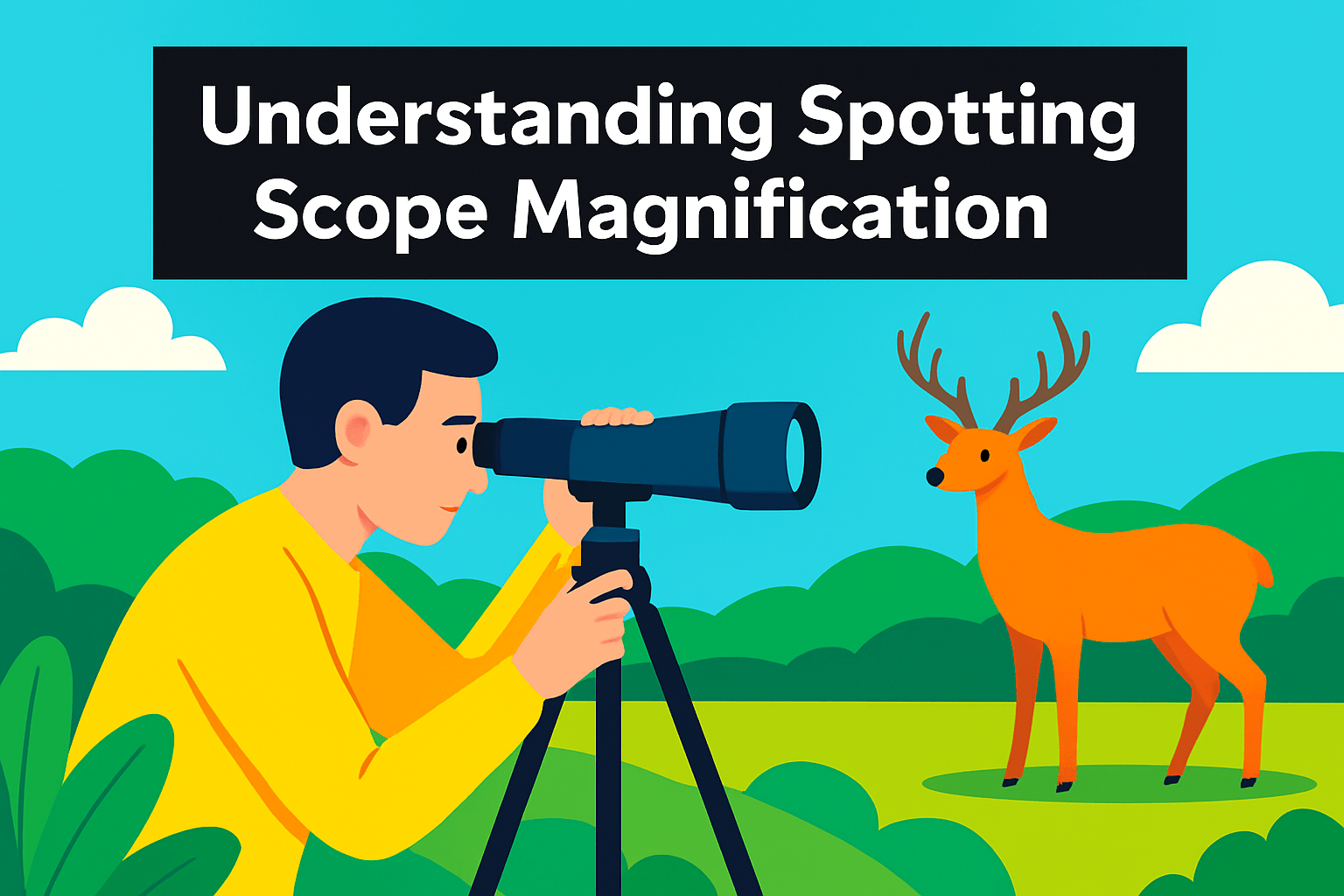
Magnification is more than a number — it’s how you frame a scene and read the field. As a photographer I treat it like lens choice: low power for context and movement, higher power for detail and storytelling. Picking the right magnification changes how easily you find, follow, and photograph wildlife.
Most spotting scopes cover roughly 15x–60x. Low magnification (15–30x) gives a wide field and quick target acquisition, great for scanning open areas or tracking fast movers. Medium power (30–45x) is the practical sweet spot for most wildlife work because it balances resolving detail with a usable field of view.
High magnification (45x+) lets you zoom into fine detail on distant subjects, but it narrows your field and reduces image brightness. It also magnifies shake, so anything above mid power demands a solid tripod and calm atmospheric conditions. Reserve high power for perched raptors, distant shorebirds, or stationary subjects when the light cooperates.
Field of view changes inversely with magnification, so locating and tracking animals becomes harder as you zoom. My workflow is simple: start low to find and compose, then increase power to refine detail. Zoom eyepieces are indispensable for that quick transition from search to scrutiny.
Brightness depends on magnification and objective size, so an 85mm objective will hold usable brightness at higher power better than a 60mm. Whenever you crank up magnification, stabilize: a sturdy tripod, a smooth panning head, and deliberate movements make the difference between a usable image and a frustrating view. Wind and vibration are your enemies at high power.
Also factor in atmospheric limits. Heat shimmer and distance often cap effective magnification long before your scope’s spec sheet does. Test your gear in the real spots you’ll use it to learn the practical upper limits for your setup and typical conditions.
For digiscoping or photography, lower magnification usually gives stronger results — more light, easier alignment, and a wider framing to crop from. Choose a versatile zoom, practice the start-low-then-zoom routine, and you’ll spend less time wrestling the scope and more time capturing clean, detailed wildlife shots.
Straight Versus Angled Spotting Scopes
One small design choice — straight or angled eyepiece — changes how you spend hours watching wildlife. Straight scopes put the eyepiece in line with the body. Angled scopes set it at an angle, usually around 45°, and that simple bend affects comfort, sharing, and how you mount the rig.
Straight scopes feel natural if you’re used to binoculars. They’re faster for quick target acquisition and work well from vehicle windows or when you’re glassing on the move. The lower profile also helps when you need to stay concealed behind a low ridge or blind.
The tradeoff is comfort. A straight scope often forces you to raise the tripod to eye level, which can be tiring for long sits. Sharing between people of different heights also becomes awkward without constant tripod adjustments.
Angled scopes shine in prolonged fieldwork. You can sit, kneel, or stand without constantly shifting the tripod. They’re kinder on the neck during long dawn or dusk watches and much easier to pass around in a group — two observers can view without moving the whole setup.
There are downsides though. Angled eyepieces can take a moment to get used to when tracking fast-flying birds. They’re also less convenient for vehicle-based glassing where the eyepiece orientation may not match the window or seat position.
From a photographer’s viewpoint, think ergonomics first. If your outings are long blinds, point counts, or group field trips, go angled for comfort and sharing. If you’re mobile, glass from a truck, or need the fastest possible acquisition on skittish subjects, choose straight.
My practical tip: try both on the tripod you intend to use. Pay attention to tripod height, eyepiece height with your jacket and hat on, and how easily you can switch between low and high magnification. Pick the body that fits your typical day in the field, not the one that sounds best on paper.
What People Ask Most
What magnification is best for a spotting scope for wildlife viewing?
Moderate magnification often gives the best balance between a wide field of view and useful detail. A zoom eyepiece is practical since you can start low to find subjects and increase magnification to inspect details.
What objective lens size is best for wildlife spotting scopes?
Larger objective lenses generally deliver brighter images in low light but add weight and bulk. Choose a size that balances brightness needs with how much gear you want to carry into the field.
Should I get an angled or straight spotting scope for wildlife observation?
Angled scopes are more comfortable for long sessions and easier to share between viewers of different heights. Straight scopes are often faster for quick target acquisition and vehicle use.
Spotting scope vs binoculars: which is better for wildlife viewing?
Binoculars are more portable and better for scanning large areas, making them ideal for initial searches. Spotting scopes provide higher magnification and finer detail at distance but typically need a tripod for steady use.
Do I need ED glass or special lens coatings for wildlife spotting scopes?
ED glass and quality coatings can improve sharpness, color fidelity, and reduce chromatic aberration in demanding conditions. They enhance image quality but may increase the cost, so weigh the benefit against your budget and needs.
How far can a spotting scope see when viewing wildlife?
Effective viewing distance depends on magnification, objective size, atmospheric conditions, and subject contrast. Scopes allow you to resolve details at much greater distances than unaided eyes, but exact ranges vary widely.
Do I need a tripod or specific mounting for wildlife spotting scopes?
A sturdy tripod is essential for stable viewing at higher magnifications and for long observation sessions. Use a tripod and head that match the scope’s weight and your preferred shooting posture for best results.
Conclusion for Wildlife Viewing Scopes
Choose the spotting scope that best matches your priorities—whether you value ultimate optical performance, low‑light capability, lighter carry weight, budget friendliness, or modular flexibility—and factor in your typical subjects and terrain when deciding magnification and eyepiece orientation.
Use the product strengths—optics versus weight versus overall value—as your decision framework so the scope you pick fits how and when you’ll be in the field.
Practically, favor wider fields of view and lower magnification for scanning and fast subjects, then step up magnification for fine detail, and rely on a stable support for the sharpest, most usable images.
If you want to sharpen your glassing and wildlife‑photography skills, read more articles on the site to deepen your understanding and make better equipment choices over time.
Leave a comment with your questions or experiences below and we’ll usually reply within a few hours to help you decide or troubleshoot in the field.


0 Comments