
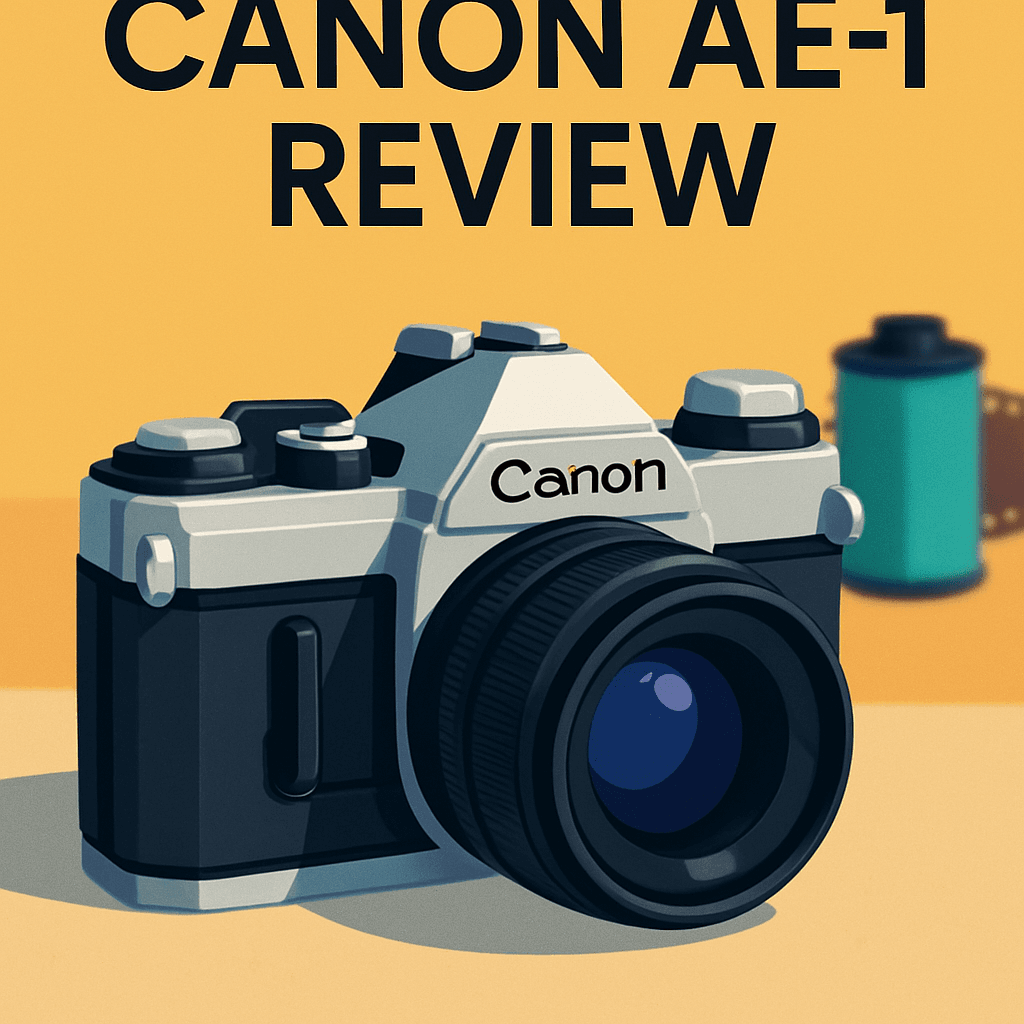
Want a classic 35mm SLR that’s actually easy to learn and use? You’ll recognize it by its simple controls and solid feel on the street.
I personally field-tested the Canon AE-1 35mm SLR and pitted it against a couple of close rivals. I’ll share what surprised me in real shooting conditions and low light.
Beginners and enthusiasts will benefit most from its approachable controls and steady performance. It’s compact enough to carry and offers plenty of real-world versatility.
Its strengths are simple, reliable controls and a durable metal body that’s lasted for decades. The headline compromise is that it doesn’t offer aperture-priority.
I’ll also flag where the meter can mislead you and how real shooting tricks fix that. That truly matters when light changes fast.
You’ll want to know one surprising trick I discovered. For a revelation about the Canon AE-1 35mm SLR that can boost image quality, keep reading.

Canon AE-1 35mm SLR
Lightweight, user-friendly shutter-priority SLR offering reliable electronics and intuitive controls. Ideal for photographers learning film basics, it pairs with a wide range of vintage FD lenses for timeless, tactile shooting.
Check PriceThe Numbers You Need
| Spec | Value |
|---|---|
| Type | 35mm focal‑plane shutter SLR |
| Picture size | 24 × 36 mm |
| Lens mount | FD |
| Shutter speeds | 2s to 1/1000s, plus Bulb mode |
| Exposure modes | Shutter‑priority semi‑auto; Full manual |
| Metering system | TTL central‑emphasis metering |
| Viewfinder | Fixed eye‑level pentaprism, 0.86× magnification |
| Flash sync | X‑sync; automatic‑switching sync contacts, German socket and hot shoe |
| Film speed range | ISO 25 to 3200 |
| Battery | 4LR44 alkaline or 4SR44 (6V) |
| Body construction | Durable metal body |
| Electronic control | Built‑in microprocessor for electronic functions |
| Dimensions | 141 × 87 × 48 mm |
| Weight | Approximately 590 g |
| Finish | Typically silver with black grip and chrome trim; some all‑black variants |
How It’s Built
In my testing the Canon AE-1 surprised me with how solid it feels despite being smaller and lighter than many older SLRs. The metal body gives real confidence in your hands, and that means you can shoot all day without feeling like you’re handling something fragile. I really liked that balance of weight and toughness — it makes walking around with a lens on the front much less tiring.
The camera’s electronic controls are smooth and intuitive when you’re working with it. I found the dials and levers click into place nicely, so you learn the camera by touch as well as sight. One thing to be aware of is the reliance on electronics, so in practice you’ll want a spare battery if you’re out shooting for long stretches.
The classic silver-and-black finish looks great and gives a vintage vibe, while the all-black models hide scuffs better. After using one for a while I noticed chrome edges can show wear, which is only cosmetic but might bother neat-freaks. For beginners that’s useful to know: cosmetic wear won’t stop the camera from making images, but it’s worth handling with care.
Overall the AE-1 feels like a camera built to be used, not just looked at. I liked the confident, tactile build and the compact size, though the visible wear on finishes could be better. Try one in your hands and you’ll see why it’s still a favorite for learning film photography.
In Your Hands
I’ve relied on the Canon AE-1 35mm SLR in city streets, studio sidelines, and open landscapes; its compact metal body and uncluttered control layout make it easy to pick up and shoot after a short warm-up. The shutter-priority mode is especially approachable—set the shutter speed and the camera finds an aperture—so beginners learn exposure relationships without becoming overwhelmed. The viewfinder is bright enough to compose quickly, and the tactile dials and solid feel encourage deliberate shooting.
In mixed and low-contrast light the AE-1 produced consistent, usable frames more often than not, and the shutter response feels immediate whether stalking candid moments or firing off deliberate sequences. That said, the mechanical meter can be a touch conservative in high-contrast situations, so I routinely expose-test or bracket challenging scenes to be safe. For everyday work it reduces decision fatigue and lets composition and timing take precedence.
Mounted to different FD lenses the camera proves versatile, delivering a range of characterful images that reward experimentation with focal length and framing. Its electronics simplify use but do rely on battery power, so bringing a spare keeps shoots uninterrupted and confidence high in the field. Decades in, the AE-1 remains a dependable teaching tool and a satisfying creative companion for both newcomers and seasoned shooters.
The Good and Bad
- Easy to use, well suited to learners and hobbyists
- Versatile lens options thanks to FD mount ecosystem
- Reliable operational performance in typical shooting scenarios
- Compact design compared with many contemporaneous SLRs
- Lacks an aperture-priority exposure mode
- Possible inaccuracies reported with the light meter
Ideal Buyer
The Canon AE-1 35mm SLR is perfect for someone taking their first serious step into film photography. Its approachable controls, compact metal body and a shutter‑priority mode make reliable results easy without overwhelming new shooters. It tolerates basic mistakes well.
Enthusiasts who want a tactile, hands‑on experience will appreciate the AE‑1’s mixture of full manual control and an accessible autoexposure option. The microprocessor‑controlled electronics keep exposures consistent while the durable construction feels built to last. Learning shutter speed and metering here translates directly to better film technique.
Photographers planning to build a kit will value the FD lens ecosystem that pairs with the AE‑1, from fast primes to specialty optics. That breadth of glass makes the camera useful across street, portrait and landscape work. Its modest weight and compact footprint also keep it portable for travel shoots.
Buyers who need aperture‑priority automation or rock‑solid metering accuracy might look elsewhere, since the AE‑1 lacks that exposure mode and some users report meter quirks. For learners and film enthusiasts who relish manual control and classic handling, though, it remains a compelling, dependable choice. It rewards photographers who enjoy thinking through exposure rather than relying on automation.
Better Alternatives?
We covered the Canon AE-1 in depth — why it’s friendly to beginners, how its shutter-priority auto mode works, and what makes it a reliable every-day 35mm SLR. It’s a great all-rounder, but there are classic cameras that give you different vibes and make different trade-offs in real shooting.
Below are three solid alternatives I’ve used in the field. I’ll tell you how each one feels compared to the AE-1, what they do better or worse in real shooting, and what kind of photographer might prefer them.
Alternative 1:

Nikon FE2 35mm SLR
Rugged, precision-engineered manual SLR with a high-speed mechanical shutter and accurate TTL metering. Built for serious enthusiasts who value solid metal construction, near-silent operation, and broad F-mount lens compatibility.
Check PriceThe Nikon FE2 feels like a step up in build and control when you pick it up. Compared to the AE-1, the FE2 is stiffer and more solid in your hands — that helps when you shoot in rough conditions or hand-hold at slower speeds. In real use the metering felt a touch more trustworthy to me in mixed light, and the shutter action is quick and crisp, which made action and candid shooting easier.
Where it loses points versus the AE-1 is in ease and speed for casual shooting. The AE-1’s simple layout and shutter-priority auto are forgiving when you want to work fast; the FE2 leans toward precise, deliberate shooting. If you like to push for exact exposures or want a camera that pairs with a huge range of Nikon glass, the FE2 will reward you. If you want a camera that gets out of the way for quick snapshots, the AE-1 is still easier.
Buyers who will prefer the FE2 are serious enthusiasts who want a tougher, more precise tool — people who shoot varied subjects, need reliable mechanical feel, and plan to use lots of different lenses. If you do a lot of street work or shoot under mixed lighting and want a camera that feels more “professional” in the hand, reach for the FE2.
Alternative 2:

Minolta X-700 35mm SLR
Versatile, user-friendly 35mm SLR offering program and manual exposure modes plus dependable metering. Smooth handling and excellent Rokkor glass make it perfect for creative film work, street photography, and everyday shooting.
Check PriceThe Minolta X-700 is one of my go-to bodies when I want features and ease. Compared to the AE-1, the X-700 adds more automatic flexibility — I liked having program and aperture-priority modes alongside manual. That makes it quick to switch from careful, creative shooting to “set-and-shoot” moments without fumbling. The handling is very smooth and the Rokkor lenses I used produced pleasing tones and contrast straight out of the camera.
Where it falls short against the AE-1 is in long-term reliability and simplicity. The AE-1’s layout is simpler and more direct; the X-700’s extra modes add buttons and steps that can slow you when you just want a straightforward frame. Also, some older X-700s can show quirks in their electronics — not a deal breaker, but something to watch for when buying used.
If you want a camera that gives you more automation and creative freedom without being complicated, the X-700 is a great pick. It’s ideal for photographers who shoot a lot of street and travel work and like to switch between quick auto settings and manual control during the same outing.
Alternative 3:

Pentax K1000 35mm SLR
Check PriceThe Pentax K1000 is pure and simple. Compared to the AE-1, it strips away most electronics and auto modes and forces you to think about the basics: shutter, aperture, and film speed. That made it my classroom and my go-to when I wanted to practice getting exposures right every time. It’s light, rugged, and easy to repair — great for shooting long days without fuss.
What it doesn’t offer versus the AE-1 is convenience. The AE-1’s shutter-priority mode and automatic handling make it faster for changing scenes and low-light work. With the K1000 you’ll slow down, which is great for learning and for thoughtful shooting, but isn’t as handy when you need to react fast or want built-in exposure help.
Buy the K1000 if you want a no-nonsense, fully manual camera that teaches you exposure and lasts forever. Students, teachers, and photographers who prefer a simple tool that won’t get in the way will love it. If you want more automation or faster switching between settings, stick with the AE-1 or one of the other alternatives above.
What People Ask Most
Shutter speed range?
2 seconds to 1/1000 second, plus Bulb mode.
Lens compatibility?
Compatible with a wide range of Canon FD-mount lenses.
Primary exposure modes?
Shutter-priority semi-automatic and full manual exposure modes.
Battery type?
Uses a 4LR44 alkaline or a 4SR44 6V battery.
Film speed range?
Supports film speeds from ISO 25 up to ISO 3200.
Ease of use for beginners?
Yes — it’s highly regarded for approachable controls and beginner-friendly operation.
Conclusion
The Canon AE-1 35mm SLR remains a practical classic for photographers who want a straightforward film SLR without fuss and who value hands-on learning. Its compact, microprocessor‑controlled design makes it approachable and dependable in the field, and it slips easily into camera bags for travel. For many shooters it’s an immediately usable camera that still delivers character and control, and it encourages thoughtful exposure and composition rather than automatic fixes.
Its strongest assets are obvious: easy, tactile controls, a useful shutter‑priority autoexposure mode, and broad compatibility with FD lenses that keep it versatile, opening creative options with vintage glass. The metal-bodied build feels reassuring and the camera rewards deliberate shooting rather than gadget chasing, so you learn to get the most from each frame. In real-world use it performs reliably across genres from street work to travel, and it renders images with a character that many shooters still find appealing.
It’s not without clear compromises — there is no aperture‑priority mode and the light meter can be finicky, so you should confirm exposures when it matters. That forces users to learn the fundamentals, which is a virtue for students but a frustration for photographers who demand speed and absolute metering precision. For learners and enthusiasts it’s a smart, characterful buy on the used market, but pros needing more automation and pinpoint metering should look to other models.
Canon AE-1 35mm SLR
Lightweight, user-friendly shutter-priority SLR offering reliable electronics and intuitive controls. Ideal for photographers learning film basics, it pairs with a wide range of vintage FD lenses for timeless, tactile shooting.
Check Price


0 Comments