
What is NFT photography — could a photo on your phone become a rare, sellable art piece?
This guide answers what is NFT photography in plain language. It explains tokens, files, editions, and where images are stored.
You will learn how the tech works: blockchains, wallets, smart contracts, minting and gas fees. Then we walk you through how to create, mint, price, and sell your photo NFTs.
We also cover copyright, royalties, security tips, and common mistakes to avoid. Expect checklists, a visual minting flow, marketplace comparisons, pricing examples, and real photo-NFT case studies to get started safely.
What is NFT Photography?
NFT photography is a way to publish and sell a photo as a unique digital token on a blockchain that proves provenance, scarcity, and ownership of that token.
If you came here asking what is nft photography, think of it like a signed certificate linked to your image, recorded on a public ledger that anyone can verify. The token is the collectible receipt, while the image file is the art people view and enjoy.
Owning the token does not automatically mean owning the copyright or the raw file. The token is proof-of-ownership of a specific entry on a blockchain, while the image file can be shared or downloaded, and the copyright stays with the photographer unless a license says otherwise.
Photographic NFTs come in different formats. You will see 1-of-1 artworks, small limited editions, animated or dynamic photography that changes with data, and even generative series where code helps compose or sequence images.
Most projects store the main image off-chain on services like IPFS or Arweave, while the token on-chain points to that file with metadata. On‑chain storage exists but is rare for large photos because it is expensive, so the token acts like a durable index card that points to the full-resolution work.
A common myth is that buying an NFT means you can make prints or merch from the photo. In reality, you buy the token unless the listing includes an explicit license, so rights for reproduction or commercial use must be spelled out in the description or metadata.
Imagine a museum ledger that records who owns the signed print, but the print can hang on many walls as a faithful copy online. That is the split between token provenance and the image file, and it is the simplest way to understand what is nft photography in practice.
For a plain primer written for creators and collectors, explore this overview of photography NFTs and compare how editions, rights, and storage are handled across marketplaces.
How NFT Technology Works: Blockchains, Wallets & Smart Contracts
Behind the scenes, a few simple pieces fit together to make NFT photography work end to end. You only need to understand the basics to mint confidently and stay safe.
A blockchain is a shared database that no single company controls, and NFT standards describe how tokens behave on that chain. On Ethereum, ERC‑721 handles single tokens and ERC‑1155 handles single or multiple editions, while Tezos uses FA2 and Solana uses its SPL token standard.
Smart contracts are small programs deployed on-chain that mint tokens, store metadata, and define things like royalties. Think of them as vending machines for your photo drop, always on and transparent about the rules they follow.
Your wallet is your key to this world. Tools like MetaMask for Ethereum, Phantom for Solana, or Temple for Tezos hold your private key, which unlocks your tokens and signs transactions; your seed phrase is the human-readable backup that must never be shared or typed into random websites.
Marketplaces connect to your wallet and ask you to approve actions by signing. Never sign something you do not understand, and prefer a hardware wallet to keep keys offline for higher-value mints or sales.
Minting creates the token and its metadata, while lazy minting defers the on-chain write until purchase to save fees. Your metadata describes title, description, edition size, attributes, license terms, and a link to the image stored via IPFS, Arweave, or trusted off‑chain hosting.
Gas fees are the small costs paid to the network to process your mint or listing. Ethereum mainnet has the biggest collector base but higher fees, Layer 2 options like Polygon cut costs dramatically, Tezos stays very low-fee and eco-friendly, and Solana is fast and inexpensive with growing art communities.
Royalties are often set in the contract using standards like EIP‑2981, but enforcement depends on the marketplace. Treat royalties as “best effort” across platforms and chains, and communicate clearly with buyers about your expectations.
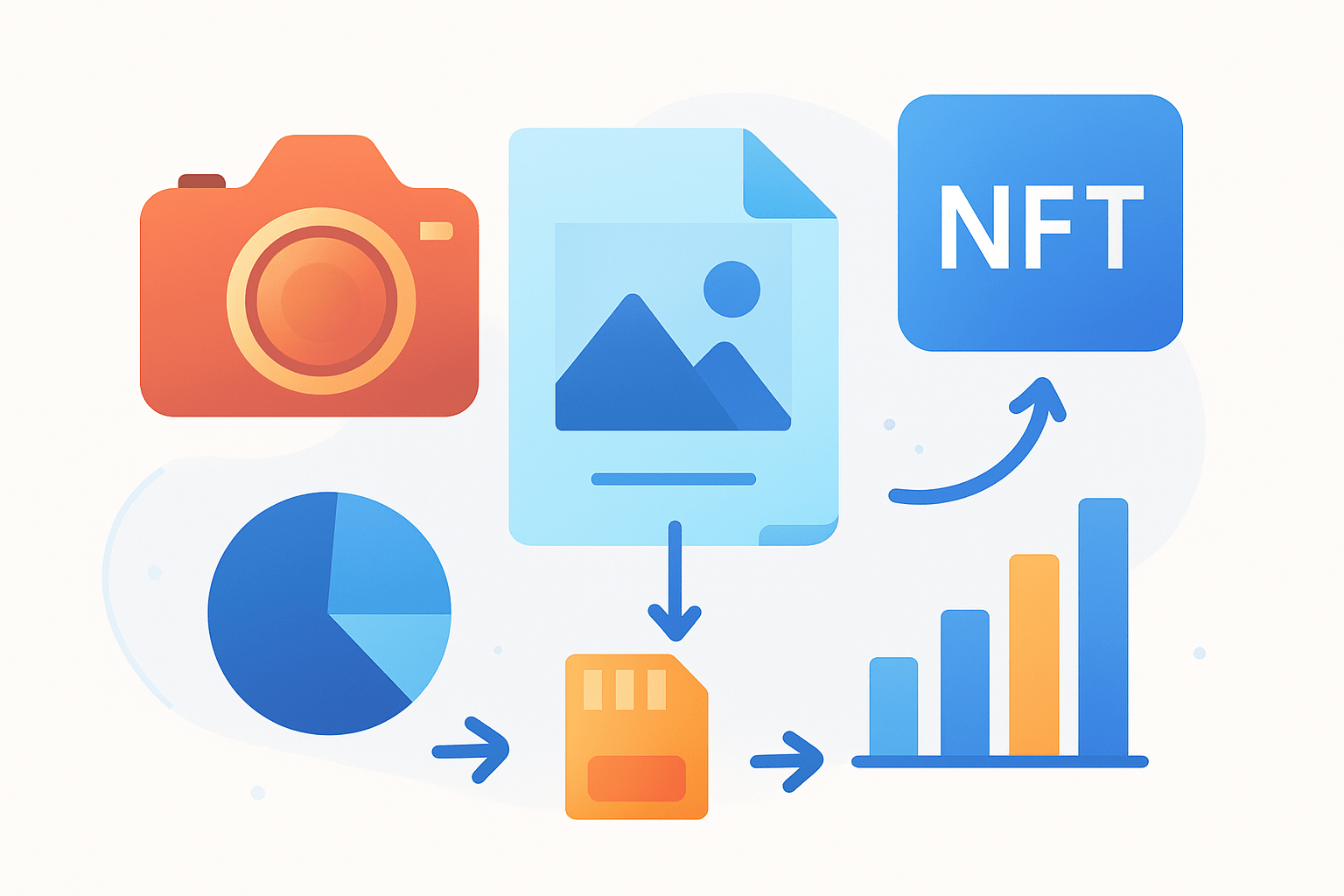
Here is the simple flow most photographers follow: Camera and edit → wallet setup and funding → mint the token and metadata → list on a marketplace → a collector buys → optional unlockable delivery of the master file or print code → future resales route royalties back to your wallet.
If you want a non-technical map of terms before you start, skim this concise photography NFTs guide and keep it open while you mint your first piece.
Why NFT Photography Matters: Benefits and Market Impact for Photographers
NFTs matter for photographers because they finally let us sell digitally, prove provenance, and earn on future resales with no middleman taking the master cut. The result is new income streams and a closer link to collectors.
Direct-to-collector sales mean you set the price, edition size, and story around each image. Your audience is global and always open, and your token can carry perks like print claims, studio visits, or token-gated content.
Royalties change the math by rewarding secondary demand long after the first sale. A typical 5–10% royalty can turn a growing body of work into recurring income while preserving scarcity like a digital print run.
Provenance is built in because the ledger shows a clean chain of custody, and that trust is valuable to curators and galleries. Community-building is also native here, because collectors can be recognized on-chain and invited into drops or allowlists.
Different styles thrive in different formats. Fine-art photographers tend to anchor 1-of-1s and small editions, documentary shooters can mint series that fund ongoing work, and experimental or animated photographers shine with dynamic or generative treatments.
Market signals have been strong enough to cross over into traditional art spaces. Major auction houses have included photo NFTs, galleries have staged on-chain shows, and brands have commissioned image drops to reach web3-savvy audiences.
Two clear examples illustrate the range. Justin Aversano’s Twin Flames series brought photography NFTs to blue-chip auction rooms, with headline results at Christie’s and Sotheby’s that validated the medium for fine art buyers. Street photographer Drift’s Where My Vans Go documented daring rooftops and bridges, building a devoted collector base and achieving six-figure primary and secondary sales on key pieces.
Landscape artist Cath Simard also showed how licensing can align with tokens when she sold a 1-of-1 tied to a free-to-use image, proving that creative licensing can live alongside scarcity. These stories show why collectors care about what is nft photography and how it can reward both vision and community.
Of course, markets are cyclical and prices can swing, so plan for the long run. Build a body of work, nurture collectors, and treat royalties as a bonus rather than the plan.
How to Create, Mint and Sell Your Photography as NFTs — Step‑by‑Step
Here is a practical path from your edited photo to a sold token, written for beginners. Follow it once and the second mint will feel routine.
First, prepare the asset with care. Export a master file in JPEG, PNG, or TIFF, aim for 3K–6K pixels on the long edge, and keep the on-platform file under common limits that range roughly from 50 MB to 200 MB depending on the marketplace.
Write clean metadata with title, year, location, camera details if helpful, and a short story that invites the viewer in. Add a plain license line that says what buyers can and cannot do, and prepare an unlockable link to a higher-resolution file or print claim if you offer one.
Next, choose a blockchain by balancing fees, audience, and environmental goals. Ethereum mainnet has the widest collector base and the strongest resale liquidity, Polygon is cheap with quick mints, Tezos is low-fee and art-forward, and Solana is fast with rising photography support.
Set up a wallet and fund it safely. Create the wallet, write down the seed phrase on paper, enable two-factor on your email and exchange accounts, and add a small amount of crypto for gas before you mint.
Then choose a marketplace that matches your goals and style. OpenSea is open, simple to use, carries a broad audience, and charges about a 2.5% fee; Foundation is curated via invites, emphasizes art presentation, and charges around 5%; SuperRare is application-based with higher primary commissions and a serious fine-art collector base; Objkt on Tezos is open, low-fee, and beloved by experimental artists; Magic Eden spans multiple chains with large mainstream traffic; photography-native platforms like Quantum offer curated drops and dedicated collectors.
Mint the work by connecting your wallet, uploading the file, setting the edition size, entering your royalty percentage, and pasting clear license text. Lazy minting can reduce upfront costs on some platforms, while a direct on-chain mint is preferred for important 1-of-1s.
List the piece with a fixed price or an auction, set a reserve if needed, and pick a sensible duration. Keep your description concise but evocative, and add utility such as a signed print or behind-the-scenes video if it genuinely fits the work.
Promote with intention on X, Instagram, and your newsletter instead of spamming. Share the story of the image, thank early collectors, and consider collaborations or spaces that bring context instead of noise.
After the sale, deliver the unlockable master file or print claim promptly and keep a simple ledger of transactions. Monitor secondary sales, thank resellers, and tag collectors when appropriate to strengthen relationships.
Quick-start checklist you can print and tape to your monitor: pick one hero image, write a 100–150 word story, choose chain and marketplace, set wallet and fund it, mint with 10% royalty and clear license, list at a price you can defend, announce once with the image and once with the story, deliver unlockables, log the sale, and follow up with collectors a week later.
Pricing can be simple and transparent. Decide what you want to net, then add estimated gas and divide by the marketplace take; for example, to net 0.25 ETH on a platform that charges 2.5% with 0.002 ETH in gas, set price = (0.25 + 0.002) ÷ (1 − 0.025) ≈ 0.2585 ETH, and round to a clean 0.26 ETH.
For editions, lower the unit price and let scarcity drive the set; for a 20-edition drop targeting a 1 ETH total, a 0.05 ETH list price leaves room for promos and a healthy sell-through. For 1-of-1s, research comparable artists and size, then place slightly below the floor to attract first collectors.
Here is a quick minting walkthrough to demystify the clicks. Screenshot: wallet connect button in the top right, you approve the connection and see your address appear; Screenshot: upload panel with title, description, properties, and royalty field; Screenshot: confirm mint transaction and pay a small gas fee; Screenshot: live listing page with price and auction controls ready to share.
Mini case study to model your first drop: Ana, a documentary photographer, mints a 1-of-1 city-night portrait on Ethereum at 0.25 ETH with a 10% royalty and includes a signed 12×18” print as an unlockable. She also releases a 20-edition companion detail on Polygon at 0.02 ETH each, announces both in one thread, delivers the print within two weeks, and sees two secondary resales that pay her royalties while new collectors join her list.
Common mistakes to avoid at this stage include minting without researching editions, using vague titles or missing license text, trusting random DMs with your seed phrase, and pricing without factoring gas and marketplace fees. Slow down for an extra hour before you hit mint and you will save days of headaches later.
Copyright, Royalties, Risks and Best Practices for Photographers
The legal default in most NFT sales is simple: the buyer owns the token, and you own the copyright unless the listing includes a license that transfers specific rights. If you want to grant print rights, commercial use, or a creative commons license, put it in writing where the token can reference it.
Here is sample language you can adapt: “Buyer owns this NFT and may display the image privately or publicly in non-commercial contexts. Photographer retains all copyright and reproduction rights. Commercial use, derivative works, and printing beyond personal display require written permission unless otherwise stated.” Keep it short and unambiguous.
Protect your work before minting by registering copyright in your jurisdiction when possible, embedding metadata, and keeping raw files backed up. If someone mints your image without permission, contact the platform, file a takedown under the site’s policy or DMCA process, and post a signed proof showing you as the original author.
Understand market risks so you do not learn the hard way. Forgeries, wash trading, and hype cycles exist, so verify contracts, avoid chasing pumps, and build collectors one honest conversation at a time.
Security is non-negotiable because your wallet is your gallery, cash drawer, and certificate cabinet. Store seed phrases offline, use a hardware wallet for high-value mints, keep a separate “minting” wallet with minimal funds, and regularly review and revoke dapp approvals you no longer need.
Environmental questions have improved with proof‑of‑stake chains that use far less energy than before. You can choose low‑energy chains or L2s, share a short note about your selection, and offer optional carbon offsets for print shipping to communicate your choices clearly.
Taxes also apply because sales are income and resales can be capital gains, and rules vary by country. Keep a simple spreadsheet with dates, transaction IDs, prices in both crypto and fiat, fees, gas, and royalty receipts, and speak with a professional for final advice.
Common mistakes to avoid across legal and safety fronts include assuming “NFT = copyright transfer,” skipping license text, clicking “sign” on unknown sites, leaving seed phrases in cloud notes, and promising utilities you cannot fulfill. A careful description and a secure workflow are as valuable as a strong image.
If you want a broader non-legal explainer that touches rights and scams from a photographer’s perspective, this concise guide to NFT photos is a good companion while you draft your license and listing text.
What People Ask Most
What is NFT photography?
NFT photography is photos turned into unique digital tokens on a blockchain so ownership and provenance can be tracked. It allows photographers to sell and prove authenticity of digital images.
How does NFT photography work?
Photographers mint a digital file into an NFT on a blockchain and list it on a marketplace for buyers. Ownership of the token is recorded on the blockchain, which verifies who owns the piece.
How can I start selling my photos as NFTs?
Create high-quality digital files, choose a marketplace, set up a crypto wallet, and mint your photos as NFTs to list them for sale. Many platforms guide beginners through each step.
Will selling an NFT photo make me lose the copyright to my image?
No, selling an NFT usually transfers the token but not the copyright unless you explicitly include copyright transfer in the sale. You can specify licensing terms to control how your image is used.
Are NFT photos only for famous photographers or big collectors?
No, NFT photography is open to anyone with digital images and an internet connection, and many newcomers find buyers. It can help smaller creators reach a global audience without traditional galleries.
What are common mistakes beginners make with NFT photography?
Beginners often skip reading marketplace terms, misunderstand licensing, or fail to promote their work beyond the platform. Checking fees and clearly stating rights helps avoid these issues.
Can NFT photography create ongoing income for photographers?
Yes, many platforms support creator royalties that pay a percentage of future resales, giving potential ongoing income. Long-term earnings depend on visibility, demand, and how you market your work.
Final Thoughts on NFT Photography
NFT photography turns digital photos into verifiable, tradable tokens on a blockchain, letting creators sell scarcity and track provenance. Even a limited run of 270 can signal scarcity to collectors, while still letting you control editions and royalties. For photographers it’s a new revenue and visibility path that skips some traditional gatekeepers.
That said, the tech and markets aren’t magic—fees, platform choices, and legal detail can eat margins or create headaches, so plan accordingly. Still, the real upside is not just one sale but continued income and a clearer chain of ownership, which suits fine-art, documentary and experimental shooters best. We also walked through the practical steps, minting flow, and security habits you need to get started without flying blind.
We began by asking what NFT photography is, and this guide showed the plain-language answer, the tech map, how to mint and the legal guardrails. Keep experimenting with thoughtful work and solid processes; the landscape will keep changing, and your photographs will be the way you shape it.




0 Comments